She didn't come home last night. The little honey bee at the Harry H. Laidlaw Jr. Honey Bee Research Facility, University of California, Davis, wound up in a spider's stomach.
Many beekeepers keep bees, but Norman Gary wears them. Gary, who received his doctorate in entomology (apiculture) from Cornell University, served as a professor at the University of California, Davis for 32 years, retiring in 1994.
Some 1300 people, including beekeepers, entomologists, gardeners, nature lovers, and children--plus millions of bees in the vicinity--helped celebrate the grand opening of the Hagen-Dazs Honey Bee Haven last Saturday, Sept. 11. The haven, a bee friendly garden planted last fall next to the Harry H.
Pest management. Pain management. Early in his career, entomologist Bruce Hammock, now a distinguished professor of entomology at the University of California, Davis and a newly selected fellow of the Entomological Society of America, probed regulating the development of insect larvae.
Glory bee. There are more than just honey bees in the Hagen-Dazs Honey Bee Haven. Think butterflies, dragonflies, sweat bees, metallic sweat bees, carpenter bees, hover flies, tachinid flies, wasps, praying mantids and what not.
Diane Ullman, Donna Billick and Sarah Dalrymple (Sarah is shown at right) are used to thinking outside the box. Now they are thinking inside and outside the hive. Visitors to the grand opening celebration of the Hagen-Dazs Honey Bee Haven, set from 10 a.m. to 2 p.m. on Saturday, Sept.
Ever notice how the coloring of the wool carder bee resembles a yellowjacket and European paper wasp? Talk about capitalizing on the colors. Carder bees, so named because they card the fuzz or down from leaves to make their nests, are black and yellow.
There are "bees" and there are "flies." And then there are "bee flies." Bee flies? They're so named because they look somewhat like bees. Order: Diptera. Family: Bombyliidae. We spotted a single bee fly, as identified by UC Davis forensic entomologist Bob Kimsey, foraging on our sedum yesterday.
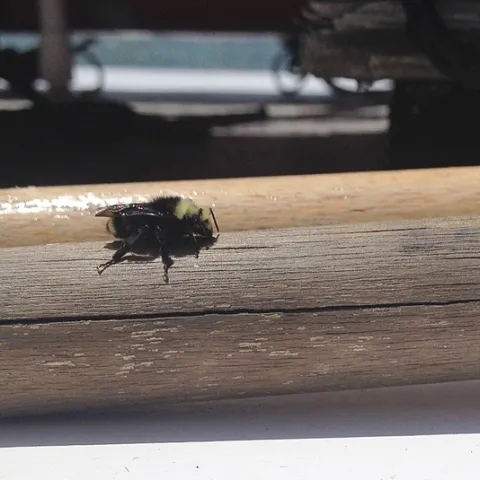
"A" is for anemone, "B" is for bumble bee and "C" is for coneflower. A visit to the Oregon state capitol grounds in Salem last Tuesday found scores of yellow-faced bumble bees (Bombus vosnesenskii) working the anemones and purple coneflowers.
When the Hagen-Dazs Honey Bee Haven's grand opening celebration takes place on Saturday, Sept. 11, visitors can expect to see scores of flowers, including the ever-popular catmint (Nepeta). Honey bees love the mints. So do bumble bees, carpenter bees, butterflies and assorted other insects.