
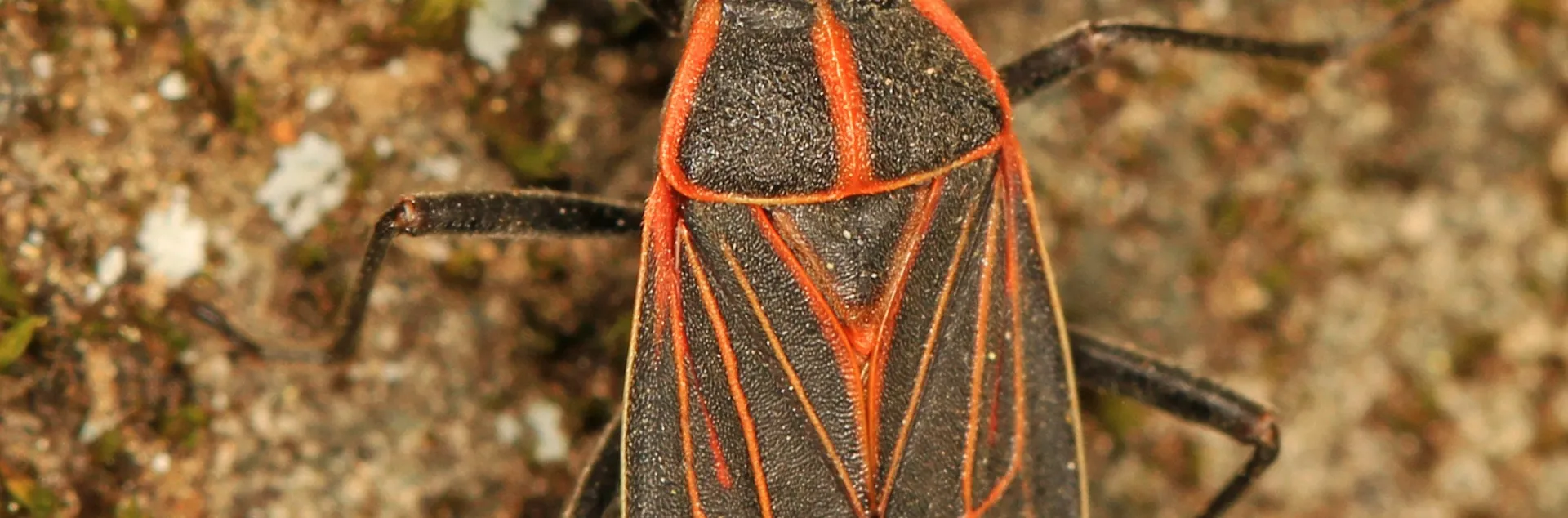

If you’ve noticed clusters of red-and-black insects sunning themselves on your house lately, you’re not imagining things, those are probably Western boxelder bugs.
Most of us associate boxelder bugs with fall — when they suddenly blanket warm, west-facing walls and make it feel like your house is being swallowed. Fall is their most dramatic season. But it’s not the only time they show up.
Here in Marin, especially near creeks and mature maples, boxelder bugs can be seen on sunny walls in multiple seasons. What changes is the reason.
The Western boxelder bug (Boisea rubrolineata) is native to the western United States and has long been part of our local ecosystem. Adults are about half an inch long, black with thin red lines tracing the thorax and wings. The younger stages are bright red at first, gradually developing darker markings. They’re eye-catching, which is part of why they feel alarming.
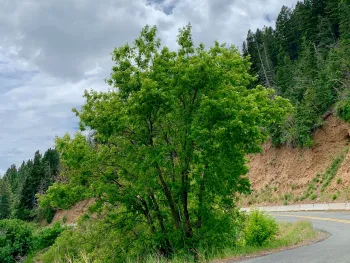
Their main food source is the boxelder tree (Acer negundo), a maple that thrives in riparian corridors. You’ll often see boxelder growing along Lagunitas Creek through Fairfax and San Geronimo Valley, along Corte Madera Creek as it winds through Ross and Kentfield, and beside Miller Creek and Novato Creek in the North Bay. They’re also common near Gallinas Creek, Arroyo Corte Madera del Presidio in Mill Valley, and other streamside areas where soils stay moist and deep.
Because these trees cluster along waterways and in older neighborhoods planted decades ago, homes nearby naturally see higher numbers of boxelder bugs. The insects feed mostly on seeds and sap. They may wander onto other maples, ash, or even fruit trees, but they rarely cause meaningful damage. Established trees typically tolerate them without issue.
So why are they on your house in March?
In fall, adults gather on warm, south- and west-facing walls as they prepare to overwinter. They’re looking for tiny cracks and gaps where they can shelter through colder months. That’s when we see the big aggregations — sometimes hundreds or thousands at once.
Over winter, many remain tucked into siding gaps, attic vents, or other protected spaces. Then, on warm late-winter and early-spring days — like the ones we’ve been having — they re-emerge and cluster on sunny surfaces to warm up. It’s essentially their version of stretching in the morning sun.
During summer, you’ll mostly find them near host trees, feeding and developing. So while fall is the main event, wall congregations aren’t strictly seasonal.
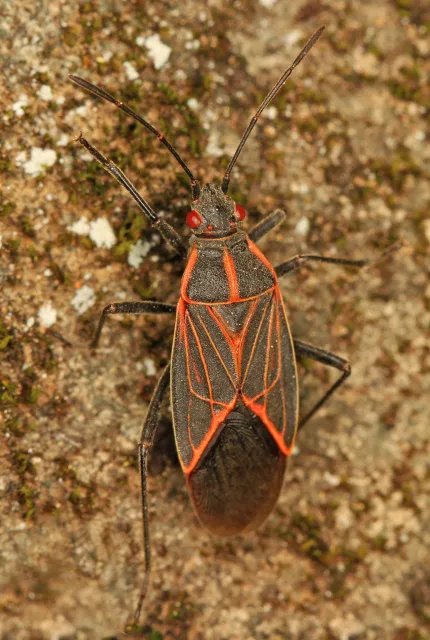
The good news is that boxelder bugs are far more dramatic than destructive. They don’t bite, they don’t sting, they don’t transmit disease, and they don’t reproduce indoors. If they wander inside, it’s accidental — they’re just looking for shelter.
This is where a little Integrated Pest Management mindset really helps. Instead of reacting with sprays — which rarely solve the problem and can harm beneficial insects — it’s more effective to think about what the bugs are trying to do.
They’re looking for warmth and entry points.
If they’re getting inside your house, the long-term solution is sealing cracks around windows, doors, vents, siding seams, and utility lines. A careful afternoon with caulk can make a noticeable difference next season.
If they’re clustered outside, a strong stream of water will break up the group. It won’t eliminate them, but it disrupts the aggregation. Indoors, a vacuum works well. Crushing them isn’t recommended — they can stain surfaces, and they can stink.
Living in Marin means sharing space with a lot of wildlife, some more charming than others. Boxelder bugs may not win popularity contests, but they were here before we were. If they’re sunning themselves on your wall this week, take it as a sign that spring is warming up. And know that, with a few simple adjustments, you can keep the relationship manageable — even when fall brings the encore performance.
By James Campbell, March 28, 2026