
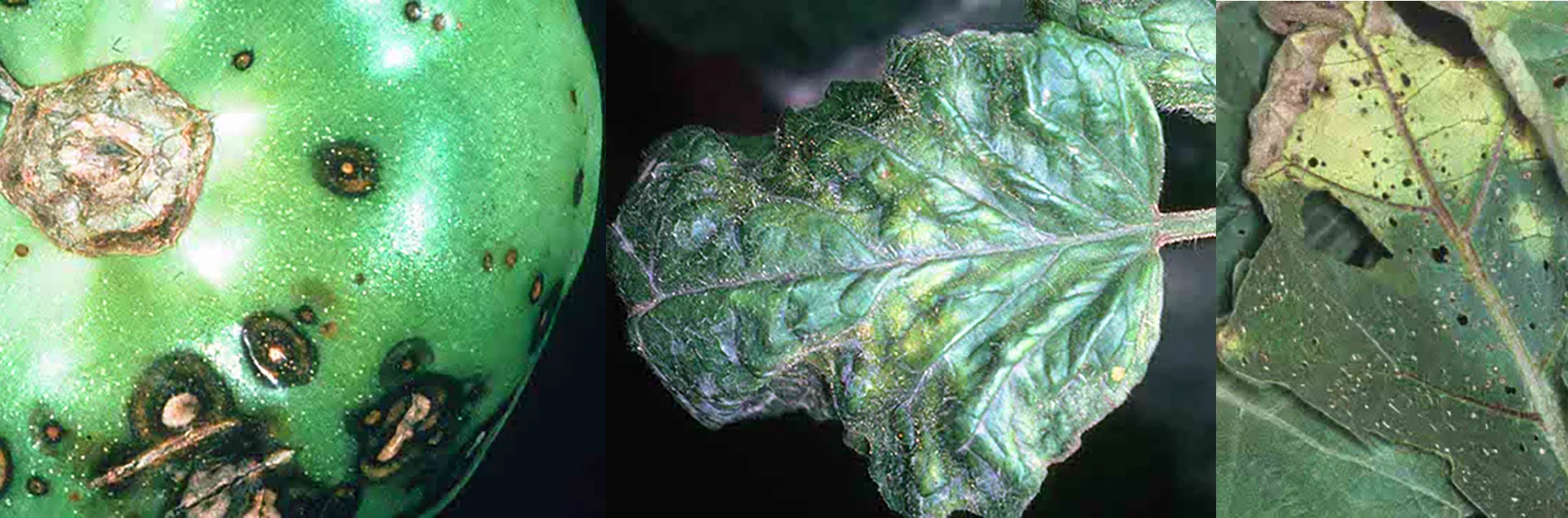
Have you ever wondered about the string of letters after the name of the tomato variety? You will see these letters often on tomato plant labels or seed packets. Some varieties will have them, and some won’t. Sometimes there are just one or two, and other times there are a long string of them. These letter codes signify that the variety has genetic resistance to a tomato disease or pest. Here are some examples:
Early Girl—V,F,N,TMV
Chef’s Choice Pink—F,N,A,TMV
Enroza—V,F,TMV,ToMV
It is important to know that resistance does not mean that the plant has complete immunity to a disease. Despite this, planting these resistant varieties can make a very big difference for those of us who have had sickly tomato plants and disappointing harvests. Instead of losing your whole crop to a disease, the resistant plants can tolerate certain pathogens. In most instances, this allows them to grow to maturity and produce fruit. While there are very few heirloom plants that have any disease resistance, most hybrid varieties will have one or more resistance codes after their names. New varieties that are developed to have greater immunity to a wider range of diseases come on the market regularly. In addition to the fungal and viral diseases indicated by these codes, one soil dwelling pest is also on the list: nematodes (N). The diseases and pests listed here are serious problems because most have no cure once the plant is infected. In the few cases where there is a treatment, they are rarely 100% effective. This leaves us with the best option of planting resistant varieties.
Below are brief descriptions of the disease and pest codes that apply to plants grown in Contra Costa County. There are several resistance codes that are not listed here because the diseases they indicate are not known to be a problem in our area.
• A—Alternaria stem canker, Alternaria alternate. It is most likely to affect tomatoes grown on or near the coast. It is uncommon in the drier inland areas. Disease spread is favored by rains, dew, and overhead irrigation. Symptoms of Alternaria stem canker can appear on stems, leaves, and fruit. Brown to black cankers (dark, sunken lesions) occur on stems. These stem cankers can enlarge, girdling the stem and killing the plants. Dark brown sunken lesions with characteristic bullseye patterns develop on green fruit.
• F—Fusarium wilt, Fusarium oxysporum f. sp. Lycopersici is a strain of fungal pathogen that infects only tomatoes. The fungus penetrates the plant's roots either directly or through wounds. The fungus grows and spreads upward through the plant’s vascular system, restricting water flow. Symptoms of infection include yellowing leaves starting on one side or branch, gradually spreading throughout, and can eventually kill the plant.
• FF—Fusarium wilt strains 1 and 2 and FFF Fusarium wilt strains 1, 2, and 3. In some cases, fusarium fungi have overcome the initial “F” resistance designation. Some newer tomato varieties have been bred to be resistant to secondary fusarium strains.
• V—Verticillium wilt, Verticillium dahlia. This soil borne fungal disease appears very much like fusarium wilt. It can be difficult to tell them apart. The leaf symptoms often start as a yellowing between the major veins of the leaves. Instead of being on one side or branch, it affects all parts of the plant, beginning with the lower leaves. The fungus moves throughout the plant eventually causing entire leaves and stems to turn yellow then die. Verticillium wilt will also affect other garden plants including several varieties of flowers, vegetables, shrubs and trees.
• LB—Late blight, Phytophthora infestans. In addition to tomato, the late blight fungal disease will infect other vegetables in the same family, including potato, pepper, and eggplant. It mostly occurs in cooler, damp coastal areas or in crops that are watered overhead. Lesions typically first appear as irregular, small, and light to dark green spots that look water soaked. The spots usually have a halo of yellowish tissue around them. They can expand rapidly and become brown or purplish black. Discoloration of the fruit can also be a symptom and starts at the top (stem end).
• EB—Early blight, Alternaria solani is a fungal disease. Because of our normally dry, rain free summer growing conditions, this disease is not common in the inland areas of our county. Long periods of wet weather or overhead watering can create the conditions required for infection to occur. The symptoms are black or brown spots, ¼ to ½ inch wide, appearing on leaves, stems, and fruit. Usually on older leaves first. The spots have a pattern of concentric rings, giving them a bull’s eye effect.
• T or TMV—Tobacco mosaic virus. Symptoms include light green or yellow mosaic patterns (uneven coloring) on leaves. Leaves may also be distorted or thin and stringy looking. The symptoms are sometimes confused with those of nutrient deficiencies or herbicide damage. Tobacco mosaic virus can sometimes be introduced into the garden by contaminated seed. More commonly, the virus is carried on the hands and clothing of people who use tobacco products. Infected plants produce fruit, but both the quality and size of the harvest is seriously reduced. There is no cure for tobacco mosaic virus.
• ToMV—Tomato mosaic virus. Tobacco mosaic virus and Tomato mosaic virus are genetically very similar. Symptoms of ToMV can be indistinguishable from those of TMV (see above). ToMV is a specific strain of TMV that more commonly infects tomato plants. Infected seed is the most common way for the disease to be introduced to the garden. It can be spread between plants by hands, clothing and tools during pruning or harvest. Other hosts of this disease include plants in the Solanaceae family, including pepper, eggplant, and potato; and the Cucurbitaceae family which includes squash, pumpkin, and cucumber. As with the other viral diseases of tomatoes, there is no cure for ToMV.
• TSWV—Tomato spotted wilt virus. Infected tomato plants can exhibit discoloring or bronzing of the top sides of young leaves. The leaves later develop distinct, necrotic (dead) spots, and can show tip dieback. They may also be curled or cupped downward. Green fruit can become somewhat bumpy or misshapen, and both green and ripening fruit will develop distinctive circular spots- often with concentric rings. The virus is spread by tiny sucking insects called thrips. There is no cure for plants infected with this virus.
• N—Nematodes are microscopic roundworms that live in the soil and feed on plant roots. While there are several species of parasitic nematodes, the ones that do the most damage in the vegetable garden are root knot nematodes, Meloidogyne species. Root knot nematodes attack a wide range of plants, including vegetables, ornamentals, and fruit trees. An infestation of root knot nematodes will cause distinctive swellings (called galls) on the roots of affected plants. Above ground, the plant can show a loss of vigor, slow growth, and yellowing leaves. These symptoms are similar in appearance to those caused by a lack of water or nutrients.
If the symptoms of any of these diseases sound familiar, and you think that the previously grown or currently growing tomato plants in your garden may be infected, the best thing for you to do is to identify the disease or pest and plan to grow resistant varieties in the future.
Please look at the information in the link below. It will take you to the University of California Integrated pest management (UC IPM) website. It will provide you with more detailed information including how the above listed diseases and pests are spread, their life cycles, and photos of the symptoms.
https://ipm.ucanr.edu/home-and-landscape/tomato/index.html
Help Desk of UC Master Gardeners of Contra Costa County (SMH)
Go Back to Here's What's NEW in 2026
Go back to 2026 Great Tomato Plant Sale