

Water is the very definition of life. It is the source of all life on Earth; it is what we search for on other planets to prove the possibility of life there. Without water, everything dies. Extreme heat and drought are the enemies of all life.
But we are running short on water. Droughts are becoming more frequent, and their consequences are more severe. Recently, the City of Tehran began rationing water and warned its citizens that the “drought was so severe that the capital may have to be evacuated.”1 The huge infrastructure of canals, dams, and aqueducts we have constructed in California to move water around the state is useless if there is not enough rain and snowfall from the sky.
In the United States, we use about 40% of our residential water for outdoor purposes. In Contra Costa County, we live in a Mediterranean climate, which means that normally we have cool, wet winters and hot, dry summers. For almost six months a year, we get no rain. Even in normal years, we will need to use plenty of water to irrigate our gardens if we are to get through the hot, dry summers.This is where we, as UC Master Gardeners of Contra Costa County, can be helpful. While there may be no more untapped, unallocated water, there are strategies to use the water we do have more effectively: more conservation, more efficient irrigation systems, capturing more rainwater and storm run-off, and better usage of non-potable water.
In the Fall issue of News To Grow By, we focused on the extraordinary benefits of sub-irrigated planters (SIPs), which capture rainwater, store it, and then provide it to the plants growing in them on an ‘as-needed’ basis throughout the dry summer growing season. But this article will focus on the four to six months of the year when we are blessed with naturally distilled, free water from the sky in the form of rain and how we can collect that rain. (It’s not too late this winter for you to still collect rainwater in your own garden!)
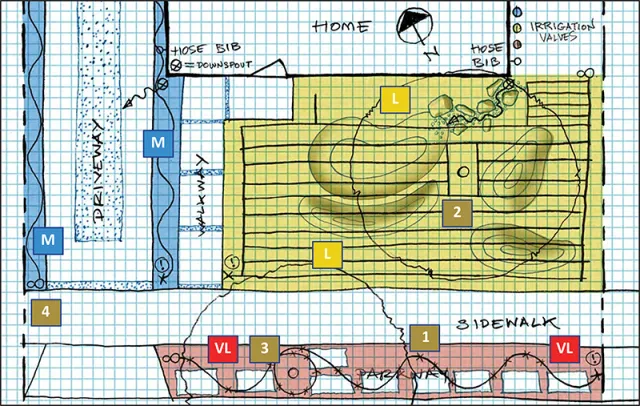
But you will first need to think a bit differently about your garden. It is more than the collection of plants, trees, pathways, and structures you have placed in it. It is a ‘mini-watershed’— “the total area of a landscape draining or contributing water to a particular site or drainage.”2 You will want to devote some time to looking closely at your own watershed to understand and see where there are natural slopes, where rainwater collects, or where there is bare, compacted dirt that is impenetrable and contributes to runoff. Are there areas of your garden where, if you raised the soil level and created a swale, you could collect more rainwater and prevent this runoff? Or are there other areas where, if you dug down and made a depression, you could collect rainwater?
In his outstanding 2-volume handbook, Rainwater Harvesting for Drylands and Beyond 2, Brad Lancaster has a very simple mantra for all of us to memorize if we want to garden more sustainably using harvested rainwater: “slow, spread, and sink.” Lancaster reminds us that before we plant any plants, we must first plant rainwater. Here are some of the easy ways we can plant rainwater in our own gardens.
- Collect water from the highest point in your watershed…your roof!
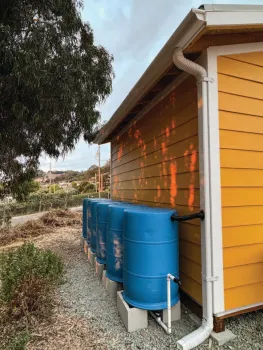
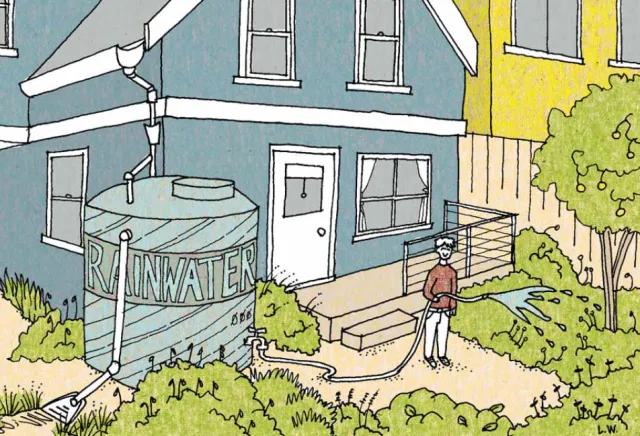
The largest single rainwater catchment ‘basin’ in your watershed is the roof of your house. It is your built-in rainwater collector. A rough rule of thumb for calculating the amount of rainfall runoff volume from a roof is 600 gallons of water per inch of rain falling on a 1000 square foot roof. (Lancaster, V. 1, p. 184). An average rainstorm of just 2” of rain produces 1200 gallons of harvestable rainwater. Even if we only divert the downspouts back into the garden, we are still harvesting that rainwater. But we can even take it a step further and store that rainfall in cisterns, culvert tanks, barrels, and large containers for later irrigation use during the hot, dry summer.
- Slow down runoff and spread it out!
One of the easiest ways to harvest rainwater in our gardens is to slow runoff during a storm and spread it out across the landscape, giving it more time to infiltrate the soil. If you live on a hill, the steeper the slope, the faster the runoff. The goal of rainwater collection is to slow this runoff down within our watershed and give rainwater time to soak down into our garden’s soil. Bare dirt is the culprit. It is prone to getting compacted and reducing the ability of rainwater to infiltrate. The answer is simple: mulch, mulch, mulch! Mulch will slow down runoff and allow water to slowly soak down through the mulch and, with time, into the soil. On steep slopes, be sure to add swales, which direct runoff into the soil by spreading and sinking its flow. Swales also prevent mulch from being washed away in huge storms. Mulch turns the soil in our gardens into a giant sponge! Let the leaves from your trees accumulate and decompose slowly, protecting the soil from the erosive force of falling raindrops.
- Create infiltration basins throughout our gardens.
Another word for an infiltration basin is a “rain garden.’ These rain gardens are relatively shallow depressions dug into the earth to capture and hold rainwater. Unfortunately, we don’t think too often about digging down in our gardens, except when we are making holes for our plants. But small depressions work particularly well on flat landscapes that have no berm. They can also work on moderate slopes, where we can create terraces of these depressions. These basins should be planted and mulched. We can also create simple basins around the trees in our garden, 1.5 to 3 times the diameter of the tree’s canopy dripline, by building up a low berm, slanting in towards the tree, to hold rainwater, allowing it to soak down into the trees’ roots. These are tree wells. With a little more effort, we can dig infiltration trenches at the edge of the tree canopy, fill them with gravel to let rainwater soak down and percolate into the root zone of the surrounding soil. Or, we can dig a deeper hole, sink a plastic pipe with holes in it, and backfill it. This will encourage deeper, more robust, and drought-tolerant root development.
In his 1986 groundbreaking book, Cadillac Desert 3, Marc Reisner charted the billion-dollar battles over water rights and competition for water in California that transformed the state into a “semidesert with a desert heart.” He spoke elegantly about the vulnerable aspect of the “promise of inexhaustible water in our desert empire.” But by collecting rainwater, by sheet mulching lawns and planting instead drought-tolerant plants, by installing SIPs with rainwater reservoirs and undergrounding drip irrigation systems, and by using grey water, each of us can continue to garden more sustainably, using less water, and be better prepared for the hot, dry summers of our Mediterranean climate. Slow, spread, and sink!
References
- Mahoozi, S. & Solomon, E . As Aquifers Dry Up, Tehran Rations Water and Calls for Rain Prayers. New York Times, 11/9/2025.
- Lancaster, Brad. Rainwater Harvesting for Drylands and Beyond. Volume 1, 3rd Edition, Rainsource Press, 2019.
We highly recommend this 2-volume set and it is available at the Contra Costa Library. - Reisner, Marc. Cadillac Desert. 1986.
Pg 1: “semidesert with a desert heart.”
Pg 499: “promise of inexhaustible water in our desert empire.” - San Francisco Rainwater Harvesting Manual - SFPUC https://www.sfpuc.gov/sites/default/files/learning/RWH_Manual_Final-APR2018.pdf
- G3 Green Gardens Group, CA Watershed Approach to Landscape Design, 2018
https://greengardensgroup.com/landscape-guidebooks/california-watershed-approach-to-landscape-design/
Banner photo courtesy of Gary Kernick - Change of Seasons