

Imagine walking through a vibrant, blooming garden in the heat of summer—where every plant is thriving, even though it’s been weeks since the last rainfall. Is this vision wishful thinking? Maybe not! Thanks to 20+ years of research by the University of California’s Landscape Plant Irrigation Trials (UCLPIT), we now know that many of the most beautiful plants in our gardens don’t actually need as much water as we once thought.
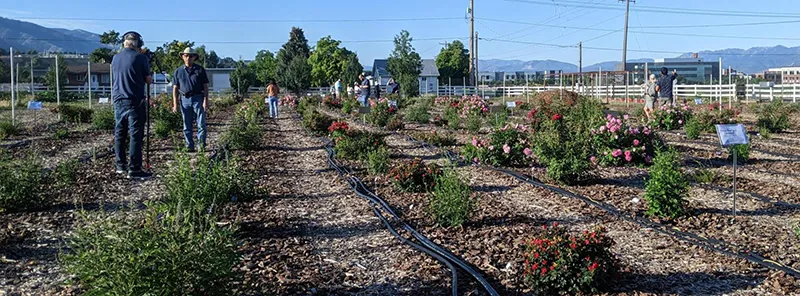
UC scientists have been testing how ornamental plants perform with less and less water at research sites in both Davis (Central Valley climate, full sun) and Irvine (coastal/Mediterranean climate). Over the course of two years, they grow popular landscape selections under three irrigation levels—low, moderate, and high—based on local weather conditions. Only during the second year, when the plants have settled in and are fully established, does the real test of drought resilience begin: Irrigation is being reduced to 50%, but frequency varies (low, moderate, and high)
As UC Master Gardeners, we’d like to encourage planting CA native plants because they are better adapted to our climate, more drought resistant, water-wise, and require less maintenance. However, many of our gardens include ornamental plants, especially those popular with landscape professionals, municipalities, and nurseries.
California native plants have been somewhat underrepresented in these UCLPIT trials, and here is why:
- Many native plants have been excluded because they’re already known to do well with minimal or no summer watering. Including them in the trials might not provide much new information, especially when the goal is to test plants with unknown or uncertain drought performance. So yes, keep on planting those CA native plants!
- Launched in 2004 with California Native Plants, the original goal was to evaluate the water needs and performance of plants from the UC Davis Arboretum All-Stars list.
- The initial trial focused on 10 California native species exposed to four irrigation levels. Five species showed strong, consistent performance under low-water conditions. Encouraged by early results, researchers added 6 more native species to expand the study.
- Due to strong interest from the landscape and nursery industry, the trial broadened its scope in 2012 to include non-native ornamental plants.
- In partnership with other universities, UCLPIT launched the Climate Ready Plants program in 2020 to identify plants that not only perform well under today’s conditions but are also likely to thrive in a changing climate.
- UCLPIT primarily tests commercially available ornamental plants used in urban and suburban landscapes. These often include non-native plants that are widely marketed and installed in new developments, business parks, and civic spaces. While many native plants are excellent choices for sustainable landscapes, they haven’t always been widely used in mainstream commercial landscaping, which is what the trials have aimed to influence.
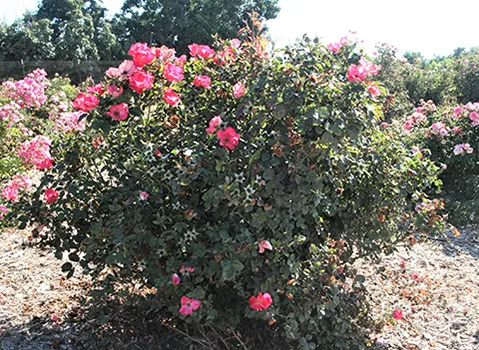
Plants that continue to flourish—showing strong growth, flowers, vigor, and visual appeal—on the lowest irrigation setting earn the coveted Blue Ribbon™ status (Plants scoring ≥4 on the low-water treatment). These are the water-wise heroes of the garden world.
With our long, dry summers and clay-heavy soils in Contra Costa County, choosing plants that can thrive with minimal watering isn’t just a smart choice, it’s essential. The UC Davis trials have already identified several top performers that not only save water but also add structure, texture, and year-round color to local gardens. Here is a link to the UC Davis Blue Ribbon List. Some standouts worth mentioning are:
- Muhlenbergia ‘Regal Mist’, a native ornamental grass whose soft pink plumes catch the autumn light,
- Heuchera maxima or Island alumroot, an attractive herbaceous perennial California native, even when not flowering,
- Lippia ‘ECOLOPIA2’ or Pink Kurapia® is the latest in this line of very low, vigorous groundcovers. With the same characteristically shorter internodes of New White Kurapia, Pink created a tight mass of small leaves on spreading stems. Lippia nodiflora ‘New White’ or Kurapia New White is a newer cultivar of a vigorous, low-growing plant marketed as a “utility groundcover” with white flowers.
- Rosa ‘Sprogreatpink’ or Pink Brick House. An outstanding performer on low irrigation in Davis earning the Blue Ribbon™ award. This is a dense, well-formed shrub with extremely clean, deep green foliage and a unique color of reddish-pink blooms which appear in abundance from April through at least October,
- Salvia microphylla or 'Hot Lips' is truly a plant worthy of the All-Stars name. It bloomed from March to December with really heavy bloom for the four months June through September. The best flowering and foliage appearance were in the 40 to 60% of ETo range, with only marginally higher relative growth on the 60% treatment.

Although every new plant is in high need of water until established, maintaining a water-smart garden doesn't mean giving up on beauty. Quite the opposite. When we select the right plants for our climate, we create landscapes that not only survive but truly thrive—with less maintenance, fewer pests, and a deeper connection to our local environment.
With resources like UCLPIT, we’re no longer guessing which plants are tough enough for Contra Costa summers. We have the data—and now, we have the inspiration too.
Visit uclpit.ucdavis.edu to explore the full list of trial results, find detailed irrigation scores, and see what’s blooming in this year’s trials. Because smart watering starts with smart planting—and your garden can be part of the solution.
Resources available on uclpit.ucdavis.edu :
- Plant Index: Full list of evaluated plants, irrigation classification, aesthetic scores (uclpit.ucdavis.edu).
- Reports: Annual results dating from 2008–2022 (downloadable PDFs) .
- Nuts & Bolts: In-depth methodology on layout, irrigation scheduling, ETo, etc. (uclpit.ucdavis.edu).
- History & Funding: Origins of the trial, grants, and research alliances (ucanr.edu).
Findings & Applications
- Blue Ribbon Plants
- Plants scoring ≥4 on the low-water treatment earn Blue Ribbon status. In 2021–22 NOAA highlights include Lomandra ‘Pom Pom Shorty’ and Rosa ‘Brick House Pink’ (plantsciences.ucdavis.edu). [LINK removed]
- UC Davis List: https://uclpit.ucdavis.edu/UC_Davis_Blue_Ribbon_List
- Use in Regulations
Results feed into WUCOLS and serve landscape water budgets under California’s Model Water Efficient Landscape Ordinance (MWELO) (uclpit.ucdavis.edu). - Educational Outreach
Monthly/seasonal field-days open to professionals to rate plant aesthetics and discuss irrigation methods (uclpit.ucdavis.edu).