
Photos provided by Titania Buchholdt
My fellow Class of 2020 graduate, Titania Buchholdt, has had to overcome some significant challenges in her life. From being badly injured when hit by an impaired truck driver when she was a youngster to surviving the COVID–19 pandemic shutdown as a freshly minted UC Master Gardener volunteer, Titania’s path through life has not been a cake walk. But somehow, she has retained her artistic spirit and commitment to volunteerism, both in the CoCoMG program and in other ways. I interviewed Titania the other day to better understand her survival skills.
Let’s talk about your background before the UC Master Gardener certification. Where did life take you?
“Well, I grew up not far from the Matanuska Valley in Southcentral Alaska, which is the home of giant vegetables, especially cabbages. With 20+ hours of daylight during the summer months and on the edge of the North American temperate rainforest, we had a lot of “liquid sunshine,” and plants grew like crazy. Year–round, my mom would take the family to commercial and municipal greenhouses, and to the state fair at the end of summer to marvel at the prizewinning flowers and vegetables. I grew houseplants and flowers at first, then vegetables.”
You suffered a traumatic injury as a young person. What happened?
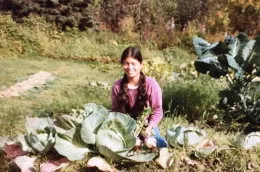
“When I was 21, I was in the crosswalk on a green light when a speeding delivery truck driver ran their red light and plowed into me. It was a hit–and–run, but eyewitnesses helped the police find the driver, who had been driving under the influence of drugs and alcohol. I was lucky to survive. Besides a traumatic brain injury, my leg was shattered into 76 pieces – I counted all the pieces on the X–ray film! (Titania laughs). The surgeons did a great job of reconstructive surgery so I could walk again, but they told me I would need more surgeries someday. In fact, I am still recovering from the follow–up surgery I had just last year. But with the lawsuit settlement, I was able to buy five acres of old farmland and establish my own quarter–acre garden. I grew a lot of carrots.”
That’s tragic, to be struck down so young in life! When did you become interested in applying as a UC Master Gardener?
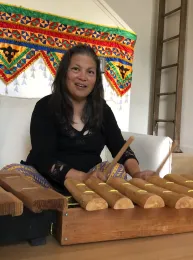
“That occurred much later, after I graduated from UC Berkeley and Georgetown University and moved to the Bay Area. I was focused on music — I study and perform the ancient traditional ensemble music of the South Philippines called Kulintang. But in 2017, just as I was preparing to perform at the Smithsonian Folklife Festival in Washington, D.C., I saw that our huge pine tree in the front yard was dying. When that tree was taken down, the whole front yard was exposed to sunlight. During the next two springs, I was amazed to find large numbers of pop–up volunteer tomato plants in the yard. The tomatoes just grew by themselves!
I decided to learn as much as I could about transforming the front yard from a field of wild tomatoes into something else. I found the Contra Costa UC Master Gardener website, and the invitation to attend a UC Master Gardener “Join Us!” orientation session caught my eye. I signed up for the session, then applied to the program. Because I did regular volunteer work as a student, I emphasized my history as a volunteer in the application.”
You graduated with me in 2020, just two weeks before the COVID–19 pandemic shut everything down. How was that experience?
“Pretty strange, really! I graduated with lots of plans for our next steps as a UC Master Gardener. We were so excited to jump into CoCoMG projects and try out new things, right? And then every event was canceled, and we could only gather online. Terri Takusagawa’s “Class of 2020” online training sessions were a joy. They kept us involved and interacting. But it was the giveaway of thousands of Great Tomato Plant Sale seedlings — because the plant sale was canceled that spring — that really changed my life that summer. I grew dozens of veggies — tomatoes, peppers, eggplant, squash, artichokes —and even flowers. I had an excellent yield that summer.”
What volunteering in the UC Master Gardener program did you focus on during those dark years?
“When the GTPS was online in 2021 and 2022, I joined the sales team to help with the online ordering system, to help customers resolve computer issues and to answer questions over the phone while the website was open for ordering plants. But many customers just wanted to talk to another human being. It turned out to be an emotional experience for them, with some people literally crying over being shut in and unable to visit public gardens or spend time out in the world. Customers actually talked with me about their emotional connections with specific tomato varieties! (She laughs again) I just let them cry on my shoulder.
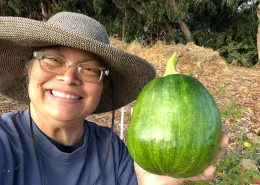
“Now that we’re back to normal, I mostly volunteer for GTPS watering duty at the El Cerrito Water Conservation Garden and manage our program’s Facebook presence. I’ve recently specialized in growing Asian vegetable varieties, and I managed the Asian veggies table at this year’s West County GTPS in Richmond. It emphasized Liz Rottger’s idea to honor the many Japanese American gardeners who have historically lived in our area.”
What advice in the future would you like to share with new UC Master Gardeners?
“Speaking for myself, I prefer to volunteer ‘wherever the need is greatest’. It doesn’t really matter where you initially want to volunteer. The opportunities will arise where you can use your skills and experience to everyone’s benefit. So, try things you haven’t tried before, and be flexible. I also believe that’s how you grow as a person.”
Thank you, Titania, for your insight into surviving the pandemic and taking on roles where the need is greatest. There is an excellent match for all volunteers’ abilities and interests in our growing program.
< Previous Articles Next >
Go to: Current Issue UCANR Home CoCoMGHub