
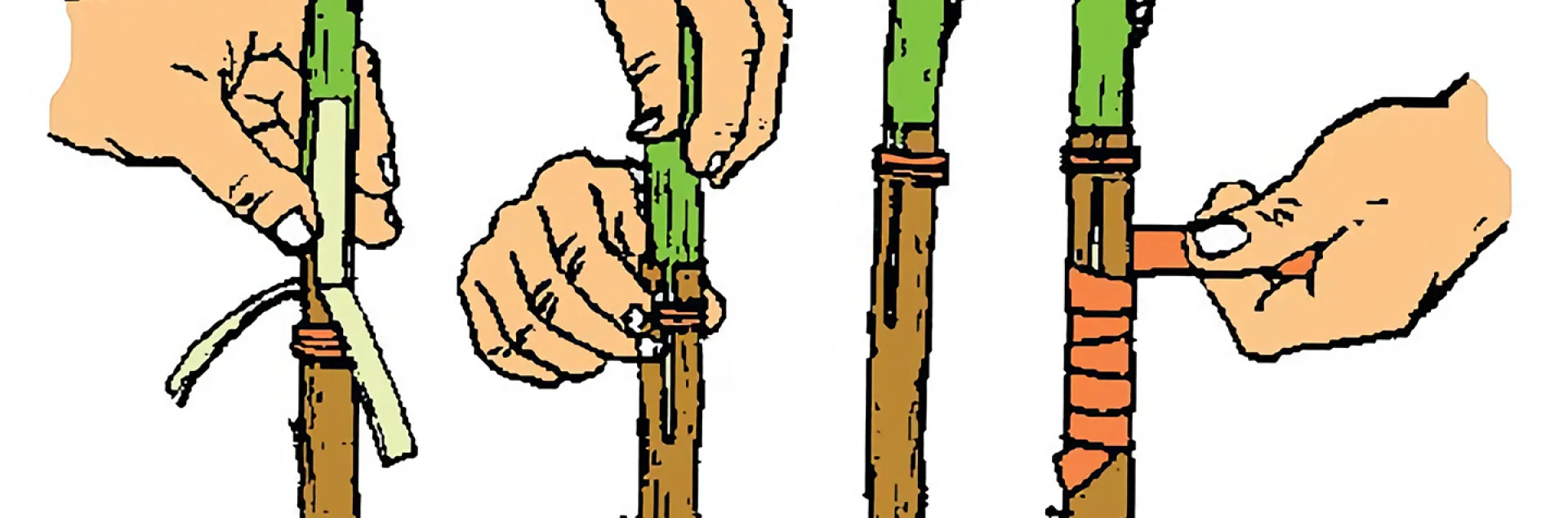
Plant and tree grafting is an ancient and worldwide practice. I was fascinated on a recent trip to the Mekong Delta in Vietnam by a demonstration of jackfruit tree grafting by a family nursery supplying trees to nearby Saigon markets. What struck me most about this demonstration, half a planet away from Contra Costa, was how remarkably similar their grafting techniques appeared to our own. Would you like to try this fun and interesting practice in your own backyard garden?
Grafting is the process of joining two trees or plants to grow as a single entity. In most cases, one plant provides the roots, root crown, and lower trunk, collectively known as the rootstock, while another plant provides the upper leafing, flowering, and fruiting parts, known as the scion. The goal is to create a single unified plant that takes advantage of the best qualities of each half. For example, a rootstock may offer disease resistance and hardiness, while the scion offers diverse fruit varieties in a single plant or tree.
History of Tree Grafting
Tree grafting is an ancient horticultural practice that dates back thousands of years. Early evidence suggests that grafting techniques were used in China and the Mediterranean as early as 2000 B.C.E. Ancient Greek and Roman texts describe the art of joining two plants to improve fruit quality and yield. This method offered early farmers the ability to propagate desirable fruit varieties and develop disease-resilient orchards, shaping the diversity of fruit trees we enjoy today. Benefits of grafting have included:
- Soil-borne disease resistance
- Improved growth from vigorous rootstock
- Adaptability to unique or varying growing conditions
- Increased fruit yields and variety in limited spaces
- Faster tree maturity to its fruit-producing stage
A well-known current example of successful commercial grafting is the apple tree. Almost all popular apple varieties, such as 'Honeycrisp,' 'Fuji,' and 'Granny Smith,' are cultivated by grafting branches of these varieties onto robust, disease-resistant rootstocks, ensuring consistent fruit quality and tree vigor. Commercial citrus trees are almost always grafted as well. For example, growers or suppliers frequently graft sweet orange scions onto disease-resistant rootstocks to produce abundant, healthy fruit even in challenging soils. Over the centuries, grafting has evolved with improved techniques and tools, remaining a professional skill in commercial operations.
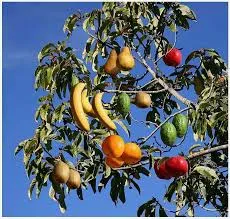
But what about the backyard gardener? Is grafting becoming a lost home gardening art? In the 1950s and ’60s, home gardening hobbyists grew fascinated by grafting. Only today’s most dedicated enthusiasts find enjoyment with, for example, grafting “fruit salad” trees. These trees, grown typically for confined spaces, bear several types of stone fruits like plums, peaches, and apricots on a single tree each season. If you adopt a few simple grafting techniques, you, too, can develop your own fruit salad trees.
Tips for Successful Grafting
Tree grafting can be fun and easy if you follow these steps:
- Choose a healthy, disease-resistant, robust rootstock that is compatible with your choice of scion tree parts. Your knowledgeable garden center staff can help you with this important step.
- Choose one or multiple scion branches from existing healthy fruit trees in your own yard or from a garden center. Branches are typically available at the same time as bare-root trees in late winter or early spring (very soon!). You can also purchase healthy fruit tree scions online.
- Use clean, sharp grafting tools to make precise cuts for a snug fit between the graft surfaces. Various joining techniques exist, but the most common and successful home gardening techniques are “Whip and Tongue” for young tree whole trunk grafting of two similar-sized parts, and “T-bud” for adding new scion branches of one inch or less in diameter to an existing fruit tree.
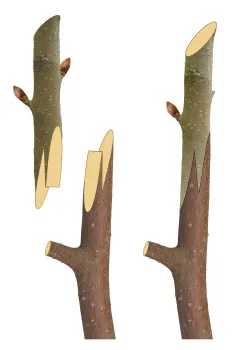
- For the whip-and-tongue technique (see diagram),
- Diagonally cut the end of the rootstock trunk at about a 60-degree angle.
- Cut a long groove or “tongue” into the middle of the rootstock trunk and down about one inch.
- Make a similar but mirror-image diagonal cut of about 60 degrees at the base of your scion trunk, then cut a similar tongue groove into the middle of the scion to fit into the rootstock cut.
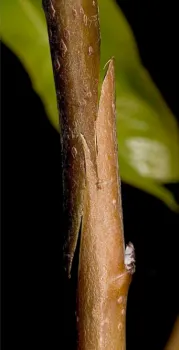
- For a T-bud graft (see diagram),
- Make a T-shaped cut in the existing fruit tree branch where you would like the new bud branch to grow (A & B).
- Cut off a single bud under the cambium layer (green, growing tissue just beneath the bark) or a short length of branch with a couple of buds (C).
- Narrow the thicker end of the bud or branch into a sliver (C).
Insert the bud or sliver into the T-cut on the existing tree branch (D)
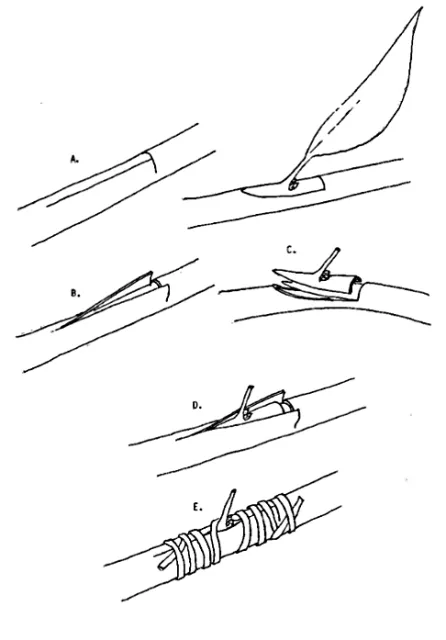
T-budding diagram. Courtesy of UCANR.
- Align the cambium layers of both pieces as closely as possible to encourage a successful fusion. The cambium is the thin layer just beneath the bark that transports water and nutrients throughout the plant.
- Secure the graft union tightly with grafting tape or a rubber band, ensuring there are no gaps for drying out or infection (E). Seal any exposed cut surfaces with grafting wax or a tree wound dressing to prevent moisture loss and infection.
- Keep the grafted plant in a sheltered location out of direct sun and wind until new growth appears, indicating a successful union. This typically takes 30-40 days in mild weather. You should choose a good time of year, typically spring, with little chance of extremely hot or cold weather. Monitor moisture levels, avoiding both waterlogging and dry soil surrounding the rootstock during the healing process.
- In 60-90 days, your new rootstock and scion-grafted combo will be ready to transplant into its forever home.
UCANR provides literally dozens of grafting technique videos on their YouTube channel at. Just search for “UCANR grafting videos.” Many are for professionals, but others are introductory videos for home gardening enthusiasts. Here is a UCANR comprehensive guide to Grafting methods, as well as a Stone Fruits tree grafting guide. For a 60-year-old classic lesson on grafting techniques, check out Grafting Techniques.
With time, good technique, and a little imagination, your garden will be home to some interesting and productive fruit trees sure to delight you and amaze your friends and neighbors.