
Article and Photos by Annette Wyrick, UC Master Gardener of Placer County
From The Curious Gardener, Winter 2021
Water reduction in the most recent years prompted lawn removal in the median strip through my neighborhood. Now this space is planted with a much more interesting low water use plant palette among the existing mature trees. Large swathes of vibrant violet flowers last from spring through fall. These flowers have caught the attention of many residents, and they are asking for the name of the plant, so they can plant it too. There are quite a few plants that bloom throughout one or more seasons.
Plants flower after they reach maturity as part of their reproduction phase. Plants vary in the amount of time needed to reach maturity. Once a plant is mature, the shoots tips can be induced to produce flowers. The length of time from induction to bloom can vary from a few weeks to several months. Avoid pruning the shoot tips during this time to obtain the most flowers. For example, a spring blooming plant may have initiated buds the previous summer and should not be pruned until after flowering.
Some factors that influence a plant’s ability to bloom are nutrient availability, soil moisture, temperature, day length, light intensity, pruning/deadheading, and weather. In many cases, it is a combination of these that determine when plants initiate and end flowering. Many annual and perennial plants will lengthen their bloom period when deadheaded. Deadheading is the practice of removing spent flowers, so the plant’s energy is diverted into producing more flowers instead of seeds. Other plants, such as Verbena canadensis used in the median strip, will bloom a very long time without this chore as long as their environmental needs are met.
Here are some additional plants you should consider for a long bloom season:
Moonshine yarrow, Achillea millefolium ‘Moonshine’: An evergreen perennial with gray green foliage and bright yellow flowers from spring to fall. This plant has a mature size of 1-3' tall and wide and prefers full sun with very little water. This plant likes to be deadheaded to extend the bloom season. USDA Hardiness Zone: 3-9
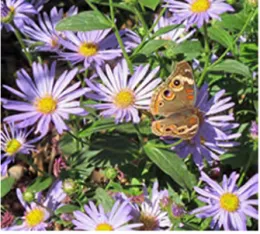
Blue aster, Aster x frikartii ‘Monch’: An herbaceous perennial with dark green foliage and light purple flowers from summer to fall reaching 1-3' tall and wide. This plant needs moderate water and full sun. Deadheading will lengthen flowering. This plant is named a rising star in the UC Davis Arboretum and is deer resistant and attracts pollinators. USDA Hardiness Zone: 6-10
San Miguel Island pink buckwheat, Eriogonum grande var. rubescens: An evergreen California native shrub with a prostrate habit reaching 1-2' tall and 3' wide. Dark pink flowers are held above gray green foliage and fade to a rusty orange from summer to fall. This plant prefers part to full sun and requires very low water. This plant is highly attractive to pollinators. USDA Hardiness Zone: 8-10
Rozanne cranesbill, Geranium ‘Rozanne’: An herbaceous perennial with medium purple flowers from spring to fall reaching 1' tall and 2' wide. This plant needs moderate water with well-drained soil and prefers morning sun and afternoon shade in a hot climate. This plant looks lovely spilling out of a container or mingling with other plants as a ground cover. USDA Hardiness Zone: 2-10
Hybrid Lenten rose, Helleborus x hybridus: An evergreen perennial with a mature size of 1-3' tall and wide. This plant prefers part to full shade with moderate water. Many different hybrids are available with varying flower color that begins in late winter. The flower color will slowly fade as the flowers dry out, but they will remain on the plant and still look pretty. The flowers dangle so it is best used in a container or when the view is from below the plant. Please note all plant parts are toxic. USDA Hardiness Zone: 4-9
Radiation lantana, Lantana camara ‘Radiation’: An evergreen shrub with a mature size of 3-6' tall and wide. This plant is covered in saturated orange flowers from spring to fall and prefers full sun with low water. It can be used to quickly fill in a bare area in the landscape and does well planted on a slope or in reflected heat. Please note this plant is frost sensitive. USDA Hardiness Zone: 9-11
Homestead purple verbena, Verbena canadensis ‘Homestead Purple’: An evergreen perennial ground cover with vibrant purple flowers in spring through fall and green foliage. This plant likes partial to full sun and low water. As a ground cover it may reach 1-3' tall and up to 5' wide. USDA Hardiness Zone: 8-10
References
Pittenger, Dennis R. California Master Gardener Handbook. UCANR Publication 3382.
VanDerZanden, Ann Marie. Environmental Factors Affecting Plant Growth. Oregon State University. January 2008. https://extension.oregonstate.edu/gardening/techniques/environmental-factors-affecting-plant-growth
Life After Lawn 45 Plants to Color Your Empty Canvas. UC Davis Arboretum and Public Garden. n.d. https://arboretum.ucdavis.edu/sites/g/files/dgvnsk1546/files/inline-files/life_after_lawn_plants.pdf