
Halloween is coming, and it’s more than just a day to go about in funny, sometimes frightening costumes, eating snack-sized candy bars, and, of course, carving pumpkins! Halloween is also a good day to appreciate some rather haunting, terrifically scary plants! The magnificent plant world contributes to unusual, macabre, strange-looking things that grow.
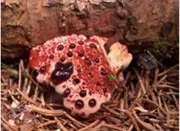
Photo Credit: Bernypisa [CC BY-SA 3.0], via Wikimedia Commons.
For instance, take a look at Hydnellum peckii, known as bleeding tooth fungus. The name alone is a bit daunting. This unusual mushroom earns the name because of a thick red fluid that oozes through pores on the outer surface of the cap, giving the appearance of blood seeping through its pores! How cool is that? The mushroom is found predominantly in the Pacific Northwest, and in Europe—and can be found among mossy coniferous forests. Although it appears to be highly toxic, it is not—but it is inedible because of the very bitter taste.
What better way to decorate a ghostly haunted mansion other than to include some black bat flowers, blades of blood or perhaps a corpse flower? Wouldn’t that be thrilling? The very stunning, but slightly startling, black bat flowers (Tacca chantrieri) are from sub-tropical regions and grow from tubers somewhat like yams. Black bat-shaped bracts are similar to petals but the true flower lies within the bracts. These are surrounded by several long, drooping, whisker-like bracteoles giving the appearance of whiskers.
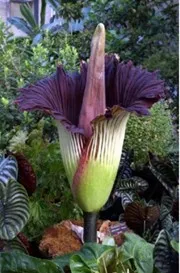
The astonishing corpse flower is very interesting, rare—and, yes— smelly. Amorphophallus titanum, also known as the corpse flower or stinky plant, is a tropical plant which grows naturally near rain forests. This special plant is actually on the list of endangered plants, although several may be found at botanic gardens and university conservatories. The titan arum (another name of the corpse flower) earns its name as corpse flower—when it blooms, it smells like rotting meat.
The good thing is that the smell attracts insects and beetles which are important pollinators for this unusual giant flower. It takes years for the plant to bloom. While some bloom every 5 to 7 years, one at North Carolina State University took 13 years to bloom for the first time. In July, 2021 the plant was predicted to bloom again. Brandon Huber, Ph.D., a horticulturalist at the University, named one of the titans “Lupin” for Remus Lupin, a werewolf from the Harry Potter series.
The second of Huber’s three titans is named “Wolfgang”, and the third is yet to be named. For more information, check the website at North Carolina State University https://cals.ncsu.edu/corpse-flower-nc-state/.

Closer to home, but speaking of smelly plants, garlic—also known as the stinking rose—is easy to grow and can be started now for late summer harvest. Folklore suggests that because of its strong odor, garlic wards off evil spirits and repels vampires—a good thing to plant this fall! Garlic (Allium sativum) is related to onions, shallots and leeks which are also in the genus Allium.
References
Valadez, Donna Navarro. It’s a BOO-tiful Time for Ghouls in the Garden! UC Master Gardener Statewide Blog. October 28, 2019. https://ucanr.edu/blogs/blogcore/postdetail.cfm?postnum=38606