UC ANR is committed to providing an accessible and inclusive web experience for all users. If you encounter an accessibility barrier or need content in an alternative or remediated accessible format, please contact anraccessibility@ucanr.edu.
After the destructive LNU Complex Fire burned through farms and ranches where Morgan Doran lives and works, he immediately volunteered to help families and local authorities take care of animal victims.
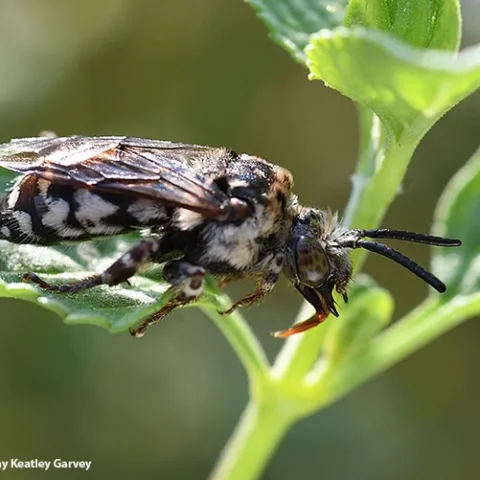
Ever seen a cuckoo bee? They're also called parasitic bees or "kleptoparasites" or "cleptoparasitises." They cannot carry pollen (no apparatus) and do not construct their nests. They lay their eggs in the nests of their hosts and then eat the food meant for the hosts.
Jay Rosenheim is a legend around the UC Davis Department of Entomology and Nematology. He's known for his scientific intellect, his research, his publications, his dedication, his commitment, his enthusiasm, his caring, and his kindness.
UC Davis Distinguished Professor Jay Rosenheim of the Department of Entomology and Nematology is a newly elected Fellow of the 7000-member Entomological Society of America (ESA).
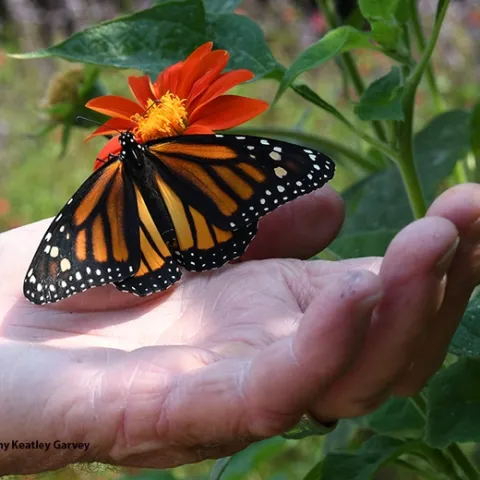
Welcome to the world of monarchs, Greta! We don't normally name the monarch butterflies we rear, but we decided that the first one reared from an egg "The Greg Way" would be named for Greg--naturalist Greg Kareofelas, associate at the Bohart Museum of Entomology, UC Davis.
What do honey bee colonies do when a raging wildfire heads straight toward their hives (bee boxes)? No, the bees do not abscond with their queen and relocate, says Norman Gary, emeritus professor of entomology at the University of California, Davis.
Six UC Cooperative Extension research projects were awarded funding ranging from $100,000 to $250,000 each from the California Department of Food and Agriculture Healthy Soils Program.
If you think there's a butterfly invasion in the three-county area of Yolo, Solano and Sacramento, wait until you hear what Art Shapiro, distinguished professor evolution and ecology at the University of California, Davis, says about that.
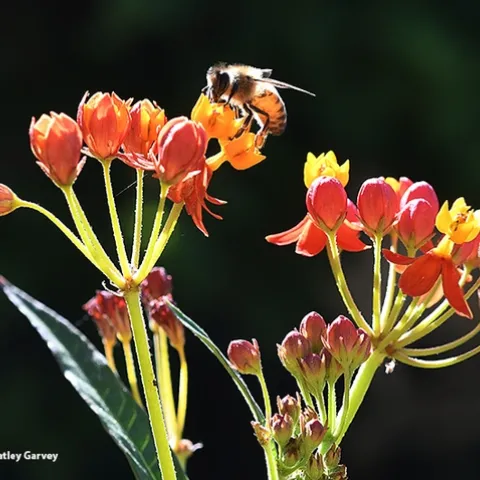
Honey bees just can't get enough of our tropical milkweed, Asclepias curassavica. We plant three species of milkweed (the host plant for the monarchs), but both the monarchs and the honey bees gravitate toward A. curassavica, a non-native.