A Natural Solution for California's Herds: African Catfish Peptides

California's cattle producers and agricultural communities are all too familiar with the rising challenge of antibiotic resistance, making common bacterial infections harder to treat in livestock. But imagine a future where we could tackle these infections with a natural, powerful alternative. Our research points to just that: antimicrobial peptides (AMPs) found in African catfish.

We're really excited about these peptides because African catfish thrive in pathogen-rich freshwater, naturally producing these robust immune compounds in their skin mucus as a defense. This natural origin makes them highly appealing alternatives to synthetic drugs.

Predicted Safety and Potent Action

One of the most compelling aspects of these AMPs is their predicted safety for mammals. Our initial computer analyses suggest that various catfish AMPs are generally recognized as safe (GRAS). We predict they'll be absorbed in the human intestine without causing liver, brain, or heart toxicity. Furthermore, lab tests on a promising peptide, NACAP-II, confirmed it was non-hemolytic, meaning it didn't damage rabbit red blood cells—a strong indicator of its potential safety for mammalian cells.

Beyond safety, these peptides demonstrate effectiveness against problematic bacteria. One study revealed NACAP-II's strong activity against Extended-Spectrum Beta-Lactamase (ESBL)-producing Escherichia coli—a critical concern for both animal and human health due to its resistance to many common antibiotics. Another peptide, ACAP-IV, also showed antibacterial activity against E. coli and Staphylococcus aureus. We believe these AMPs work by directly disrupting bacterial cell membranes, a mechanism that makes it harder for bacteria to develop resistance compared to how they resist traditional antibiotics.

Primary Image
Lenya smiles and looks at whatever a man in a cowboy hat is pointing at on his phone.
ANR Employee News: Article

Donor retention results in repeat donations

August 29, 2023
By Pamela S Kan-Rice
It seems we are always in pursuit of the shiny new thing. In the world of fundraising, that often translates to the quest for new donors and new dollars.
View Article
UCCE in the County of San Luis Obispo: Article

How to Control California Ground Squirrels & Gophers !

August 29, 2023
How to Control California Ground Squirrels & Gophers ! A Free Workshop for Commercial Agriculture Friday, September 29,2023 8:30am11:00am In-Person at Heilmann Regional Park, Atascadero, Blue Oak Area Topics covered: Gophers Squirrel Biology IPM Plan Using Bait, Carbon Monoxide and more options Vert...
View Article
Primary Image
Women with Hat Sitting Under Tree by nick.amoscato is licensed under CC BY 2.0.
Under the Solano Sun: Article

Among the Trees

August 29, 2023
As I busily go about on my daily round of errands during these late summer daysthe heat radiating with every step-- I become ever more grateful for the life-affirming trees among us and all that they provide.
View Article
Kern County: Article

Kern UCCE/DWR Weekly Crop Water Use Report 08-28-2023

August 28, 2023
Please see below link to access "How To Use Weekly Crop Water Use (ET) Reports to Assist Farm Water Management" How to Use Weekly Crop Water Use Report Please see below link to access "Weekly ET Report 08-28-2023" ET Report 08-28-2023 Please see disclaimer link below: University of California Divisi...
View Article
Primary Image
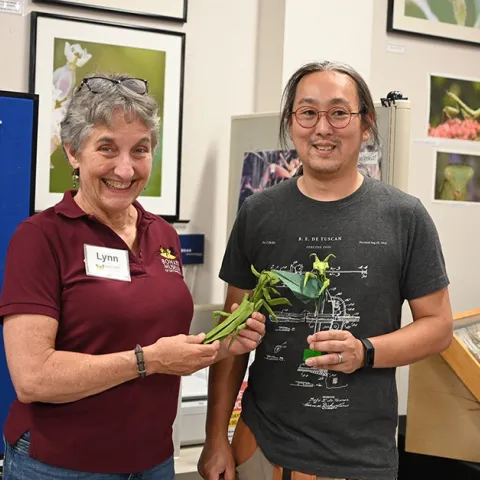
For the Bohart Museum open house on praying mantises, Kevin Murakoshi of Davis crafted these intricate origami praying mantises. With him is UC Davis distinguished professor Lynn Kimsey, director of the Bohart Museum. Murakoshi, a UC Davis alumnus and former UC Davis employee (computer research specialist), is the principal solutions architect at Amazon Web Services. (Photo by Kathy Keatley Garvey)
Bug Squad: Article

Magical Mantis Moments

August 28, 2023
By Kathy Keatley Garvey
It was a "Magical Mantis Kind of Day" when the Bohart Museum of Entomology hosted an open house last Sunday afternoon, Aug. 27, on praying mantises.
View Article