A Natural Solution for California's Herds: African Catfish Peptides

California's cattle producers and agricultural communities are all too familiar with the rising challenge of antibiotic resistance, making common bacterial infections harder to treat in livestock. But imagine a future where we could tackle these infections with a natural, powerful alternative. Our research points to just that: antimicrobial peptides (AMPs) found in African catfish.

We're really excited about these peptides because African catfish thrive in pathogen-rich freshwater, naturally producing these robust immune compounds in their skin mucus as a defense. This natural origin makes them highly appealing alternatives to synthetic drugs.

Predicted Safety and Potent Action

One of the most compelling aspects of these AMPs is their predicted safety for mammals. Our initial computer analyses suggest that various catfish AMPs are generally recognized as safe (GRAS). We predict they'll be absorbed in the human intestine without causing liver, brain, or heart toxicity. Furthermore, lab tests on a promising peptide, NACAP-II, confirmed it was non-hemolytic, meaning it didn't damage rabbit red blood cells—a strong indicator of its potential safety for mammalian cells.

Beyond safety, these peptides demonstrate effectiveness against problematic bacteria. One study revealed NACAP-II's strong activity against Extended-Spectrum Beta-Lactamase (ESBL)-producing Escherichia coli—a critical concern for both animal and human health due to its resistance to many common antibiotics. Another peptide, ACAP-IV, also showed antibacterial activity against E. coli and Staphylococcus aureus. We believe these AMPs work by directly disrupting bacterial cell membranes, a mechanism that makes it harder for bacteria to develop resistance compared to how they resist traditional antibiotics.
Primary Image
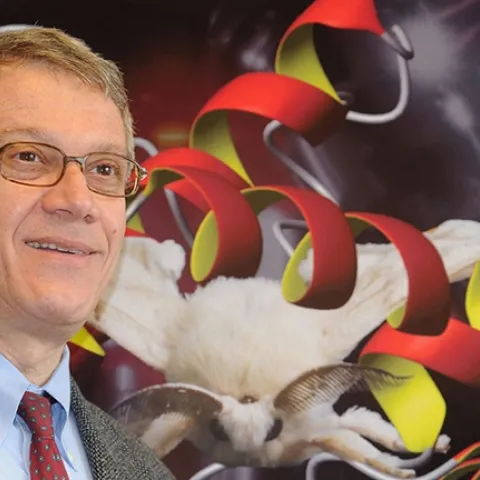
Eric Mussen, Extension apiculturist, at the Harry H. Laidlaw Jr. Honey Bee Research Facility. This image is from 2010. (Photo by Kathy Keatley Garvey)
Entomology & Nematology News: Article

Dr. Eric Carnes Mussen: May 12, 1944 -- June 3, 2022

June 5, 2022
By Kathy Keatley Garvey
Celebrated honey bee authority Dr. Eric Carnes Mussen, an internationally known 38-year California Cooperative Extension apiculturist and an invaluable member of the UC Davis Department of Entomology and Nematology faculty, died Friday, June 3 from liver cancer. He was 78. Dr.
View Article
Primary Image
Young apple trees bearing fruit (Wikimedia Commons, geograph.org.uk)
Napa Master Gardener Column: Article

An apple (tree) a day

June 4, 2022
Last January I decided to pull out the thicket of wild blackberries that took up 25 percent of the backyard.
View Article
UCCE in Santa Barbara County: Article

Announcing FREE Garden Talk, 7PM Monday, 6/06

June 3, 2022
The UC Master Gardeners of Santa Barbara County invite you to join us for a free, online Garden Talk on Monday, June 6th from 7:00-8:00PM. UC Master Gardeners Janet Rogers and Trudy Adair-Verbais will share a research-based presentation, Chickens in the Garden and the Cycle of Soil.
View Article
Primary Image
Water wise plant garden. (Ellen Zagory, UC Davis Arboretum and Public Garden)
The Stanislaus Sprout: Article

Water Thrifty Gardening Class Tuesday, June 14, 2022

June 3, 2022
By Anne E Schellman
If you are mystified by your irrigation system, curious about the steps to convert your landscape to drip irrigation, and want to see gorgeous photos of low water use plants, please join our FREE, in-person class! Where: Stanislaus County Agricultural Center, Harvest Hall, OUTDOORS.
View Article
UC Master Gardener Program of Contra Costa County: Article

Spring Garden Tasks

June 3, 2022
Here is your spring garden and landscape to-do list ...
View Article
UC Master Gardener Program of Riverside County: Article

Garden Views, 2022.05 - May/June 2022

June 3, 2022
In this issue: Pam Elias describes the composting project at West County Grow Lab; Susan Bookman posts Composting on a Balcony from the West County Helpline Archive; Mary Ann Egan recounts how Desert MGs Learn to Compost; Brad Hardison explains volunteering options for Youth and School Gardens; Marc...
View Article