A Natural Solution for California's Herds: African Catfish Peptides

California's cattle producers and agricultural communities are all too familiar with the rising challenge of antibiotic resistance, making common bacterial infections harder to treat in livestock. But imagine a future where we could tackle these infections with a natural, powerful alternative. Our research points to just that: antimicrobial peptides (AMPs) found in African catfish.

We're really excited about these peptides because African catfish thrive in pathogen-rich freshwater, naturally producing these robust immune compounds in their skin mucus as a defense. This natural origin makes them highly appealing alternatives to synthetic drugs.

Predicted Safety and Potent Action

One of the most compelling aspects of these AMPs is their predicted safety for mammals. Our initial computer analyses suggest that various catfish AMPs are generally recognized as safe (GRAS). We predict they'll be absorbed in the human intestine without causing liver, brain, or heart toxicity. Furthermore, lab tests on a promising peptide, NACAP-II, confirmed it was non-hemolytic, meaning it didn't damage rabbit red blood cells—a strong indicator of its potential safety for mammalian cells.

Beyond safety, these peptides demonstrate effectiveness against problematic bacteria. One study revealed NACAP-II's strong activity against Extended-Spectrum Beta-Lactamase (ESBL)-producing Escherichia coli—a critical concern for both animal and human health due to its resistance to many common antibiotics. Another peptide, ACAP-IV, also showed antibacterial activity against E. coli and Staphylococcus aureus. We believe these AMPs work by directly disrupting bacterial cell membranes, a mechanism that makes it harder for bacteria to develop resistance compared to how they resist traditional antibiotics.
Primary Image
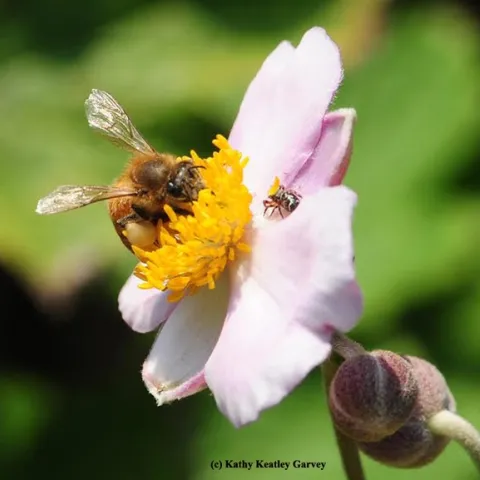
Hover fly, Eristalis hirta, on zinnia. (Photo by Kathy Keatley Garvey)
Bug Squad: Article

Lovin' the Zinnias

November 5, 2013
By Kathy Keatley Garvey
Orange zinnias not only brighten our autumn days but glorify our gardens. And when there's a bug on the zinnias, all the better.
View Article
UC Weed Science (weed control, management, ecology, and minutia): Article

Saving glyphosate

November 5, 2013
By Franz J Niederholzer, John A Roncoroni
Saving Glyphosate Glyphosate, the active ingredient in Roundup, is the most commonly used herbicide in California. Highly effective, safe for the user and the environment, and now inexpensive, glyphosate is a valuable weed management tool.
View Article
Primary Image
This photo of a bee foraging on a zinnia, taken in the Haagen-Dazs Honey Bee Haven, graces the front and back covers of "Bee Friendly: A Planting Guide for European Honeybees and Australia Native Pollinators." (Photo by Kathy Keatley Garvey)
Bug Squad: Article

All the Way from Down Under

November 4, 2013
By Kathy Keatley Garvey
One of the most prominent and distant--as in far away--visitors to the Hagen-Dazs Honey Bee Haven, the half-acre bee friendly garden on Bee Biology Road, UC Davis, was Mark Leech of Launceston, Tasmania, Australia.
View Article
UC Weed Science (weed control, management, ecology, and minutia): Article

Medusahead and Milestone work continues

November 4, 2013
By Guy Kyser
After making a bunch of extension presentations, and following our 2012 publication of Preemergent control of medusahead on California annual rangelands with aminopyralid (Rangeland Ecology & Management 65:418-425), Ive talked with quite a few ranchers who have successfully used Milestone preemergen...
View Article
Primary Image
broad mite on fruit

Predatory Mites Controlling Citrus Broad Mite

November 4, 2013
By Ben A Faber
We have recently had an outbreak of citrus broad mite (Polyphagotarsonemus latus) in lemons. Broad mites feed on fruit and leaves, preferring young fruit up to about 1 inch (2.5 cm) in diameter that are located on the inside of the canopy or on the inward facing side of outer fruit.
View Article
Cooperative Extension Ventura County: Article

November/December 2013 Cloverlines

November 2, 2013
In this issue... Equine Play Day, Science Night, Beverage Guidelines, Anna's Reading Room at Ormond Pointe, Food Faire & Fashion Revue, new section... It's that time of year! and much more.
View Article
Primary Image
Skull shares the habitat of the giant cave cockroah (Blaberus gigante). (Photo by Kathy Keatley Garvey)
Bug Squad: Article

Things That Go Bump and Boo in the Night

November 1, 2013
By Kathy Keatley Garvey
It was about things that go bump and boo in the night during the annual Bohart Museum Society's Halloween party. The society's annual Halloween party in the Bohart Museum of Entomology, UC Davis, showcased a combination of insects and costumes.
View Article