A Natural Solution for California's Herds: African Catfish Peptides

California's cattle producers and agricultural communities are all too familiar with the rising challenge of antibiotic resistance, making common bacterial infections harder to treat in livestock. But imagine a future where we could tackle these infections with a natural, powerful alternative. Our research points to just that: antimicrobial peptides (AMPs) found in African catfish.

We're really excited about these peptides because African catfish thrive in pathogen-rich freshwater, naturally producing these robust immune compounds in their skin mucus as a defense. This natural origin makes them highly appealing alternatives to synthetic drugs.

Predicted Safety and Potent Action

One of the most compelling aspects of these AMPs is their predicted safety for mammals. Our initial computer analyses suggest that various catfish AMPs are generally recognized as safe (GRAS). We predict they'll be absorbed in the human intestine without causing liver, brain, or heart toxicity. Furthermore, lab tests on a promising peptide, NACAP-II, confirmed it was non-hemolytic, meaning it didn't damage rabbit red blood cells—a strong indicator of its potential safety for mammalian cells.

Beyond safety, these peptides demonstrate effectiveness against problematic bacteria. One study revealed NACAP-II's strong activity against Extended-Spectrum Beta-Lactamase (ESBL)-producing Escherichia coli—a critical concern for both animal and human health due to its resistance to many common antibiotics. Another peptide, ACAP-IV, also showed antibacterial activity against E. coli and Staphylococcus aureus. We believe these AMPs work by directly disrupting bacterial cell membranes, a mechanism that makes it harder for bacteria to develop resistance compared to how they resist traditional antibiotics.

Primary Image
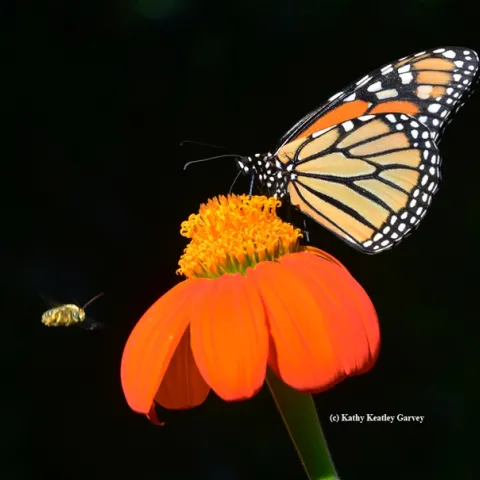
A drone fly heads for a Sparkle and Shine blossom. (Photo by Kathy Keatley Garvey)
Bug Squad: Article

Sparkle and Shine!

October 25, 2013
By Kathy Keatley Garvey
Poet Gertrude Stein, who coined "A rose is a rose is a rose," probably would have liked it. Julia Child, maybe not.
View Article
Primary Image
mandarin

Citrus Rootstock Trial

October 25, 2013
By Ben A Faber
'Bitters', 'Carpenter' and 'Furr' trifoliate hybrids are three new citrus rootstocks released in August 2009 by the University of California Riverside. These three rootstocks are hybrids of Sunki mandarin x Swingle trifoliate orange.
View Article
Primary Image
This Western bumble bee was found on Mt. Shasta on Aug. 15, 2012. (Photo by Kathy Keatley Garvey)
Bug Squad: Article

Western Bumble Bee Making a Comeback

October 24, 2013
By Kathy Keatley Garvey
Incredible. Absolutely incredible. The Western bumble bee (Bombus occidentalis) seems to be making a comeback of sorts in some parts of the West. Reporter Michelle Nijhuis, in an Oct.
View Article
Primary Image
avocado

Avocado Meetings

October 24, 2013
By Ben A Faber
California Avocado Growers Seminar Series 2013 Presented by: California Avocado Society, Inc.
View Article
Colusa County: Article

November 2013

October 24, 2013
Make-it, Take-it Craft Expo, Goat Educational Day, Final New Leader Orientation...
View Article
Primary Image
Mead! It all begins with the honey bee. (Photo by Kathy Keatley Garvey)
Bug Squad: Article

Like to Learn How to Make Mead?

October 23, 2013
By Kathy Keatley Garvey
There's a "me" in mead. There also could be a "u" in mead, as in "you." There's definitely a honey bee, as without the bee and the honey, there's no mead.
View Article
Primary Image
image 18933
IGIS: Article

FUEGO — A concept for a fire detection satellite

October 23, 2013
By Maggi Kelly
A nice press release about our new paper on the concepts behind a fire detection satellite with perhaps the coolest acronym yet: FUEGO Fire Urgency Estimator in Geosynchronous Orbit. From Bob Sanders.
View Article
Primary Image
PSHB damage

A Caution on Free Mulch

October 23, 2013
By Ben A Faber
The polyphagous shothole borers (Euwallacea sp.) that spread fungal diseases (Fusarium sp. and possibly Graphium sp.) to susceptible trees in Los Angeles County have now been found in mid and northern Orange County and western San Bernardino County.
View Article
Primary Image
Valley carpenter bee foraging on a passion flower. (Photo by Kathy Keatley Garvey)
Bug Squad: Article

Behold, the Gold!

October 22, 2013
By Kathy Keatley Garvey
When you visit the Hagen-Dazs Honey Bee Haven on Bee Biology Road, University of California, Davis, be sure to check out the passionflower vine clinging to the fence. You'll see female Valley carpenter bees (Xylocopa varipuncta) seemingly speckled with gold dust.
View Article