A Natural Solution for California's Herds: African Catfish Peptides

California's cattle producers and agricultural communities are all too familiar with the rising challenge of antibiotic resistance, making common bacterial infections harder to treat in livestock. But imagine a future where we could tackle these infections with a natural, powerful alternative. Our research points to just that: antimicrobial peptides (AMPs) found in African catfish.

We're really excited about these peptides because African catfish thrive in pathogen-rich freshwater, naturally producing these robust immune compounds in their skin mucus as a defense. This natural origin makes them highly appealing alternatives to synthetic drugs.

Predicted Safety and Potent Action

One of the most compelling aspects of these AMPs is their predicted safety for mammals. Our initial computer analyses suggest that various catfish AMPs are generally recognized as safe (GRAS). We predict they'll be absorbed in the human intestine without causing liver, brain, or heart toxicity. Furthermore, lab tests on a promising peptide, NACAP-II, confirmed it was non-hemolytic, meaning it didn't damage rabbit red blood cells—a strong indicator of its potential safety for mammalian cells.

Beyond safety, these peptides demonstrate effectiveness against problematic bacteria. One study revealed NACAP-II's strong activity against Extended-Spectrum Beta-Lactamase (ESBL)-producing Escherichia coli—a critical concern for both animal and human health due to its resistance to many common antibiotics. Another peptide, ACAP-IV, also showed antibacterial activity against E. coli and Staphylococcus aureus. We believe these AMPs work by directly disrupting bacterial cell membranes, a mechanism that makes it harder for bacteria to develop resistance compared to how they resist traditional antibiotics.
Primary Image
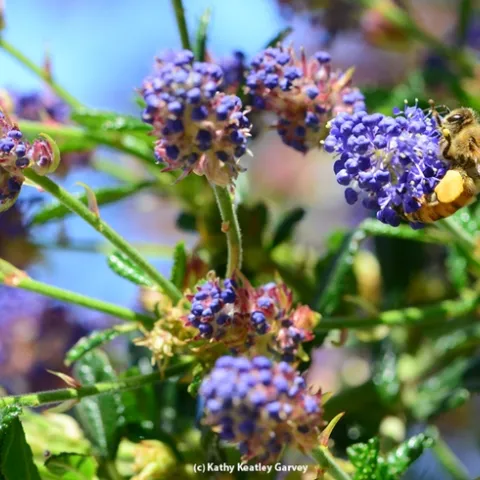
A West Coast Lady at the Berkeley Marina. (Photo by Kathy Keatley Garvey)
Bug Squad: Article

An Admiral at the Marina

July 2, 2013
By Kathy Keatley Garvey
There's nothing like seeing an admiral at a marina. That would be the Red Admiral butterfly, Vanessa atalanta, at the Berkeley marina. It's often very common in the urban Bay Area, says butterfly expert Art Shapiro, professor of evolution and ecology at the University of California, Davis.
View Article
Primary Image
DSC 0282
Conservation Agriculture: Article

Travels along Elkhorn Avenue

July 2, 2013
By Jeffrey P Mitchell
For the past 20 years, I have taken Elkhorn Avenue just about every day from my home in Kingsburg out west to the small town of Five Points where I work.
View Article
Primary Image
CASI team discussion with members of the UC Davis Agricultural Sustainability Institute.
Conservation Agriculture: Article

CASI representatives visit with ASI and ANR in Davis

July 2, 2013
By Jeffrey P Mitchell
Nine representatives of the Conservation Agriculture Systems Innovation (CASI) Center recently met with leaders of two important University of California groups on the UC Davis campus to introduce CASI initiatives and to seek closer collaboration between CASI and these partner UC groups.
View Article
Primary Image
Crab spider with its kill, a cabbage white butterly. (Photo by Kathy Keatley Garvey)
Bug Squad: Article

A Bad Day for a Butterfly

July 1, 2013
By Kathy Keatley Garvey
It was a bad day for a butterfly. We stopped by the Ruth Risdon Storer Garden, part of the UC Davis Arboretum, at noon today as triple-digit temperatures climbed to a scorching 103.
View Article
UC Weed Science (weed control, management, ecology, and minutia): Article

Herbicides and Volatile Organic Compounds

July 1, 2013
By Cheryl A Reynolds
Its that time of year again when hot weather fuels the creation of ozone, or smog. Some herbicides emit volatile organic compounds (VOCs) that contribute to ozone formation. Using herbicides that release VOCs may be restricted in certain California locations between May 1 and October 31.
View Article
Cooperative Extension Ventura County: Article

July/Aug. 2013 Cloverlines

June 30, 2013
In this issue... 100 Blankets Project, Youth Building Incentives, Cross Clubbing, 4-H Centennial Celebrations, Enrollments, and much more.
View Article
Primary Image
Bee fly, a bombyliid, hovers like a helicopter. Note the long tongue. (Photo by Kathy Keatley Garvey)
Bug Squad: Article

A Bee Fly!

June 28, 2013
By Kathy Keatley Garvey
Have you ever seen a bee fly, a member of the family Bombylidae? It's about the size of some bees. It buzzes like a bee. But you can quickly tell it's not a bee by its behavior.
View Article