A Natural Solution for California's Herds: African Catfish Peptides

California's cattle producers and agricultural communities are all too familiar with the rising challenge of antibiotic resistance, making common bacterial infections harder to treat in livestock. But imagine a future where we could tackle these infections with a natural, powerful alternative. Our research points to just that: antimicrobial peptides (AMPs) found in African catfish.

We're really excited about these peptides because African catfish thrive in pathogen-rich freshwater, naturally producing these robust immune compounds in their skin mucus as a defense. This natural origin makes them highly appealing alternatives to synthetic drugs.

Predicted Safety and Potent Action

One of the most compelling aspects of these AMPs is their predicted safety for mammals. Our initial computer analyses suggest that various catfish AMPs are generally recognized as safe (GRAS). We predict they'll be absorbed in the human intestine without causing liver, brain, or heart toxicity. Furthermore, lab tests on a promising peptide, NACAP-II, confirmed it was non-hemolytic, meaning it didn't damage rabbit red blood cells—a strong indicator of its potential safety for mammalian cells.

Beyond safety, these peptides demonstrate effectiveness against problematic bacteria. One study revealed NACAP-II's strong activity against Extended-Spectrum Beta-Lactamase (ESBL)-producing Escherichia coli—a critical concern for both animal and human health due to its resistance to many common antibiotics. Another peptide, ACAP-IV, also showed antibacterial activity against E. coli and Staphylococcus aureus. We believe these AMPs work by directly disrupting bacterial cell membranes, a mechanism that makes it harder for bacteria to develop resistance compared to how they resist traditional antibiotics.
UC Weed Science (weed control, management, ecology, and minutia): Article

Shoreline drizzle applications for control of yellowflag iris

November 5, 2012
By Guy Kyser
Yellowflag iris (Iris pseudacorus L.), native to Europe, is an emergent invasive of pond margins, ditches, and other wetland sites in much of the United States. It forms dense stands which displace native sedges and rushes, reducing waterfowl habitat and water flow.
View Article
Primary Image
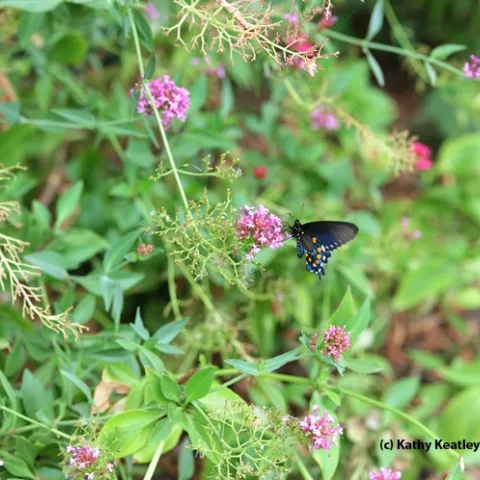
Western tiger swallowtail is one of the butterflies listed in Melissa Whitaker's app. (Photo by Kathy Keatley Garvey)
Bug Squad: Article

Spotlighting Butterflies

November 2, 2012
By Kathy Keatley Garvey
If you want to learn about butterflies, "there's an app for that." And a free one, at that.
View Article
UC Weed Science (weed control, management, ecology, and minutia): Article

JOB OPENING // Assistant Professor and Extension Turfgrass Specialist

November 2, 2012
By Gale Perez
University of Nebraska-Lincoln Institute of Agriculture and Natural Resources Position Announcement October 22, 2012 Assistant Professor and Extension Turfgrass Specialist Department of Agronomy and Horticulture University of Nebraska-Lincoln, Institute of Agriculture and Natural Resources (IANR), D...
View Article
Primary Image
Western yellowjacket (Vespula penyslvanica) heading toward a red-hot poker (but this variety is yellow). (Photo by Kathy Keatley Garvey)
Bug Squad: Article

It's No Vegetarian

November 1, 2012
By Kathy Keatley Garvey
Bee specialists like to point out that the yellowjacket is a carnivore and the honey bee is a vegetarian. They are, indeed.
View Article
Cooperative Extension Ventura County: Article

November/December 2012 Clover Lines

November 1, 2012
In this issue... 4-H & Gratitude, New Club Happenings Schedule, All-Star Walking Path Tour, Science Night with Robots, and much more.
View Article
Primary Image
Harlequin cabbage bug feeding on cabbage. (Photo by Kathy Keatley Garvey)

A Bug That's Perfect for Halloween

October 31, 2012
By Kathy Keatley Garvey
If there ever were a bug just perfect for Halloween, that would be the orange and black Harlequin cabbage bug, Murgantia histrionica, also known as a calico bug or fire bug. Its brilliant, distinctive colors bring back memories of a circus clown.
View Article
Primary Image
Aedes aegypti transmits the deadly dengue. (Photo by James Gathany, Centers for Disease Control and Prevention)

An Important Message

October 30, 2012
By Kathy Keatley Garvey
It's Halloween tomorrow (Wednesday) but what's really frightening is Aedes aegypti, a mosquito that transmits the deadly dengue. According to the World Health Organization (WHO), dengue is the world's most rapidly spreading mosquito-transmitted disease. Some 2.
View Article