A Natural Solution for California's Herds: African Catfish Peptides

California's cattle producers and agricultural communities are all too familiar with the rising challenge of antibiotic resistance, making common bacterial infections harder to treat in livestock. But imagine a future where we could tackle these infections with a natural, powerful alternative. Our research points to just that: antimicrobial peptides (AMPs) found in African catfish.

We're really excited about these peptides because African catfish thrive in pathogen-rich freshwater, naturally producing these robust immune compounds in their skin mucus as a defense. This natural origin makes them highly appealing alternatives to synthetic drugs.

Predicted Safety and Potent Action

One of the most compelling aspects of these AMPs is their predicted safety for mammals. Our initial computer analyses suggest that various catfish AMPs are generally recognized as safe (GRAS). We predict they'll be absorbed in the human intestine without causing liver, brain, or heart toxicity. Furthermore, lab tests on a promising peptide, NACAP-II, confirmed it was non-hemolytic, meaning it didn't damage rabbit red blood cells—a strong indicator of its potential safety for mammalian cells.

Beyond safety, these peptides demonstrate effectiveness against problematic bacteria. One study revealed NACAP-II's strong activity against Extended-Spectrum Beta-Lactamase (ESBL)-producing Escherichia coli—a critical concern for both animal and human health due to its resistance to many common antibiotics. Another peptide, ACAP-IV, also showed antibacterial activity against E. coli and Staphylococcus aureus. We believe these AMPs work by directly disrupting bacterial cell membranes, a mechanism that makes it harder for bacteria to develop resistance compared to how they resist traditional antibiotics.
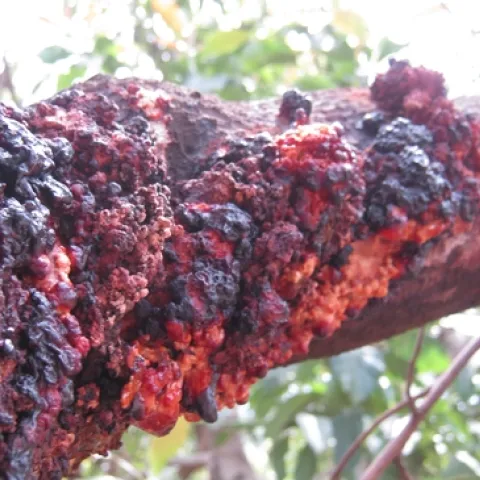
Colusa County: Article

Sacramento Valley Almond News

October 18, 2012
Introduction to Almond Production meetings Pocket Gopher Management for Autumn Annual Almond Conference moved to Sacramento Hull Rot Leaf Blight Navel Orangeworm Weed Management...
View Article
Primary Image
Syrphid fly (right) circles a blanket flower, unaware of the jumping spider. (Photo by Kathy Keatley Garvey)
Bug Squad: Article

A Bug-Eat-Bug World

October 17, 2012
By Kathy Keatley Garvey
It's a bug-eat-bug world out there. Today we watched a syrphid fly, aka "hover fly" and "flower fly," circling a blanket flower (Gaillardia) and then touching down to sip a little nectar. Syrphids are called "hover flies" for good reason. They "hover" over a blossom, helicoperlike.
View Article
Primary Image
Leaffooted bug nymphs, Leptoglossus clypealis. (Photo by Kathy Keatley Garvey)
Bug Squad: Article

Well, Hello There!

October 16, 2012
By Kathy Keatley Garvey
At first they appeared on our pomegranate tree, our 85-year-old pomegranate tree. Then they migrated over to our passion flower vine, Passiflora, where we're trying to rear Gulf Fritillary butterflies (Agraulis vanillae). They're leaffooted bug nymphs, Leptoglossus clypealis.
View Article
UC Weed Science (weed control, management, ecology, and minutia): Article

Proper Herbicide Application Timing Critical in Seedling Alfalfa

October 16, 2012
Many growers have good intentions when it comes to controlling weeds in seedling alfalfa but often fields end up being treated beyond the optimum window. Proper application timing is critical for successful weed control in seedling alfalfa.
View Article
UC Weed Science (weed control, management, ecology, and minutia): Article

JOB OPENING // Plant Health and Field Testing Assistant Research Scientist

October 16, 2012
By Gale Perez
Job Code: MBI 158 http://www.marronebioinnovations.com/company/careers/careers-plant-health-and-field-testing-assistant-research-scientist-job-code-mbi-158/ Marrone Bio Innovations (MBI) is a global provider of natural products serving the ever expanding agricultural and water markets.
View Article
UC Weed Science (weed control, management, ecology, and minutia): Article

A Glyphosate Replacement for Johnsongrass Control?

October 16, 2012
By Douglas Munier
If glyphosate is no longer effective at controlling perennial johnsongrass, but there is a low cost herbicide which is just as effective on johnsongrass with the same proven safety record, but is only going to be effective for a few years, would you use it? How would you use it?
View Article
UC Weed Science (weed control, management, ecology, and minutia): Article

Rangeland weed control and pesticide regs workshop

October 16, 2012
By Gale Perez
The Tuolumne County Agricultural Commissioner and UC Cooperative Extension are offering a FREE WORKSHOP on rangeland weed control and pesticide regs.
View Article
Primary Image
Praying mantis, accidentally splashed with water, tries to remove the droplets. (Photo by Kathy Keatley Garvey)
Bug Squad: Article

No Preying When You're Sprayed

October 15, 2012
By Kathy Keatley Garvey
One thing's for certain--a praying mantis does not like to get wet. If it were human, it would not dip a toe in the water and yell to its friends: "C'mon in, the water's fine!" Water is not fine--not to a praying mantis.
View Article
Primary Image
Honey bee on a cenizo, Leucophyllum frutescens. (Photo by Kathy Keatley Garvey)
Bug Squad: Article

Plants, Pollinators and UC Davis

October 12, 2012
By Kathy Keatley Garvey
If you've never been to a UC Davis Arboretum plant sale, you should. The last plant sale of the year will take place Sunday, Oct. 14 from 9 a.m. to 1 p.m. at the Arboretum Teaching Nursery on Garrod Drive.
View Article
Primary Image
Close-up of a Smerinthus cerisyi caterpillar. (Photo by Kathy Keatley Garvey)
Bug Squad: Article

What's That Caterpillar?

October 11, 2012
By Kathy Keatley Garvey
What's that caterpillar? This little fellow (or gal) was munching--quite contentedly, thank you--on the leaves of an aspen tree. The homeowner didn't take too kindly to the critter defoliating his prized tree, newly purchased in Oregon and newly planted in Vacaville, Calif.
View Article