A Natural Solution for California's Herds: African Catfish Peptides

California's cattle producers and agricultural communities are all too familiar with the rising challenge of antibiotic resistance, making common bacterial infections harder to treat in livestock. But imagine a future where we could tackle these infections with a natural, powerful alternative. Our research points to just that: antimicrobial peptides (AMPs) found in African catfish.

We're really excited about these peptides because African catfish thrive in pathogen-rich freshwater, naturally producing these robust immune compounds in their skin mucus as a defense. This natural origin makes them highly appealing alternatives to synthetic drugs.

Predicted Safety and Potent Action

One of the most compelling aspects of these AMPs is their predicted safety for mammals. Our initial computer analyses suggest that various catfish AMPs are generally recognized as safe (GRAS). We predict they'll be absorbed in the human intestine without causing liver, brain, or heart toxicity. Furthermore, lab tests on a promising peptide, NACAP-II, confirmed it was non-hemolytic, meaning it didn't damage rabbit red blood cells—a strong indicator of its potential safety for mammalian cells.

Beyond safety, these peptides demonstrate effectiveness against problematic bacteria. One study revealed NACAP-II's strong activity against Extended-Spectrum Beta-Lactamase (ESBL)-producing Escherichia coli—a critical concern for both animal and human health due to its resistance to many common antibiotics. Another peptide, ACAP-IV, also showed antibacterial activity against E. coli and Staphylococcus aureus. We believe these AMPs work by directly disrupting bacterial cell membranes, a mechanism that makes it harder for bacteria to develop resistance compared to how they resist traditional antibiotics.
Primary Image
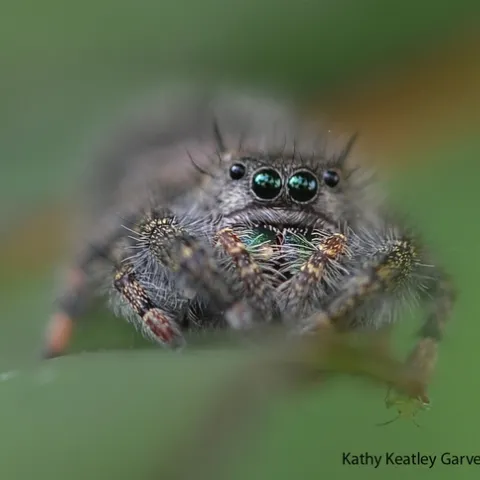
Immune system of the tiny Drosophila plays a big role in host defense. (Photo by Kathy Keatley Garvey)

We All Have It: Innate Immunity

December 14, 2011
By Kathy Keatley Garvey
What do flies have in common with us? For one thing, an innate immune system mechanism to detect and fight off invaders that threaten our health. Four scientists, including two Nobel Laureates, will discuss host defense at a UC Davis symposium on Wednesday, Jan. 25 in the UC Davis Conference Center.
View Article
Primary Image
Adult female of Drosophila simulans
E-Journal of Entomology and Biologicals: Article

Fruit fly and fungus gnat damage to strawberry fruits

December 14, 2011
Two species of dipteran larva (maggots) were found feeding on strawberry fruits in the Santa Maria area recently. Last year, there was a minor issue of fungus gnat larvae and another species (probably Delia sp.
View Article
Primary Image
Two cellar spiders work together to capture a Tachinid fly in their web. (Photo by Kathy Keatley Garvey)

The End Is Near

December 13, 2011
By Kathy Keatley Garvey
The parasitic fly (family Tachinidae) never had a chance. It went from floral visitor to spider prey to spider dinner when it made a single solitary mistake: it inadvertently fell into a sticky web.
View Article
Primary Image
A ladybug in the winter. (Photo by Kathy Keatley Garvey)

Winter Wonderland for Insects

December 12, 2011
By Kathy Keatley Garvey
You've probably already "put a bug" in Santa's ear, telling him what you want. But have you ever thought of putting a bug on your holiday card? If you're an entomologist, absolutely. If you like insects, probably. If you're not a bug lover, no.
View Article
Primary Image
soil salinity irrigation
Topics in Subtropics: Article

Products that make Your Avocados Grow Better?

December 12, 2011
Horticulture is the cultivation of plants as ornamentals or for the production of food. When things go wrong (plants grow poorly or not at all), horticulturists sometimes turn to products that can cure, revitalize, invigorate, stimulate or enhance the growth of their plant or crop.
View Article
UC Weed Science (weed control, management, ecology, and minutia): Article

Purple alert: common pokeweed

December 12, 2011
By Guy Kyser
A neighbor asked me to identify a robust perennial that keeps coming up in his garden. It had long, tropical-looking leaves and floppy racemes with small white flowers. This was a new one for me. Turned out it was common pokeweed (Phytolacca americana), a native of eastern North America.
View Article
Primary Image
Close-up of aphids and ants at the Haagen-Dazs Honey Bee Haven at UC Davis.This is a Formica moki, a native ant. (Photo by Kathy Keatley Garvey)

The School of Ants

December 9, 2011
By Kathy Keatley Garvey
You like ants, right? Of course you do. But probably not as much as Andrea Lucky, the "Queen of Ants." (Or as much as Phil Ward, her major professor at UC Davis or Alex Wild, the Illinois-based biologist and insect photographer who also studied with Ward.
View Article
Primary Image
Italian honey bee on Senecio from the Asteraceae or daisy family. (Photo by Kathy Keatley Garvey)

Just Chillin'

December 8, 2011
By Kathy Keatley Garvey
The temperature on the UC Davis campus stood solidly at 56 degrees this afternoon. The less-than-ideal weather didn't seem to deter several Italian honey bees from foraging in a flower bed behind the Laboratory Sciences Building on the central campus.
View Article
Primary Image
Varied carpet beetle larva-ventral side
Pest News: Article

Carpet beetles

December 8, 2011
Someone recently brought specimens of what they thought were bed bugs. Actually they are larvae of carpet beetle. Here is a brief note about them. Carpet beetles belong to the Coleopteran family of Dermestidae, which are commonly known as dermestid or skin beetles.
View Article