A Natural Solution for California's Herds: African Catfish Peptides

California's cattle producers and agricultural communities are all too familiar with the rising challenge of antibiotic resistance, making common bacterial infections harder to treat in livestock. But imagine a future where we could tackle these infections with a natural, powerful alternative. Our research points to just that: antimicrobial peptides (AMPs) found in African catfish.

We're really excited about these peptides because African catfish thrive in pathogen-rich freshwater, naturally producing these robust immune compounds in their skin mucus as a defense. This natural origin makes them highly appealing alternatives to synthetic drugs.

Predicted Safety and Potent Action

One of the most compelling aspects of these AMPs is their predicted safety for mammals. Our initial computer analyses suggest that various catfish AMPs are generally recognized as safe (GRAS). We predict they'll be absorbed in the human intestine without causing liver, brain, or heart toxicity. Furthermore, lab tests on a promising peptide, NACAP-II, confirmed it was non-hemolytic, meaning it didn't damage rabbit red blood cells—a strong indicator of its potential safety for mammalian cells.

Beyond safety, these peptides demonstrate effectiveness against problematic bacteria. One study revealed NACAP-II's strong activity against Extended-Spectrum Beta-Lactamase (ESBL)-producing Escherichia coli—a critical concern for both animal and human health due to its resistance to many common antibiotics. Another peptide, ACAP-IV, also showed antibacterial activity against E. coli and Staphylococcus aureus. We believe these AMPs work by directly disrupting bacterial cell membranes, a mechanism that makes it harder for bacteria to develop resistance compared to how they resist traditional antibiotics.
Primary Image
The sign at the Harry H. Laidlaw Jr. Honey Bee Research Facility. (Photo by Kathy Keatley Garvey)

Some International Publicity

November 15, 2011
By Kathy Keatley Garvey
The Harry H. Laidlaw Jr. Honey Bee Research Facility, UC Davis, and its adjacent honey bee garden, the Hagen-Dazs Honey Bee Haven, received an international shot of publicity when My Extreme Animal Phobia aired last Friday on the Animal Planet Channel.
View Article
Primary Image
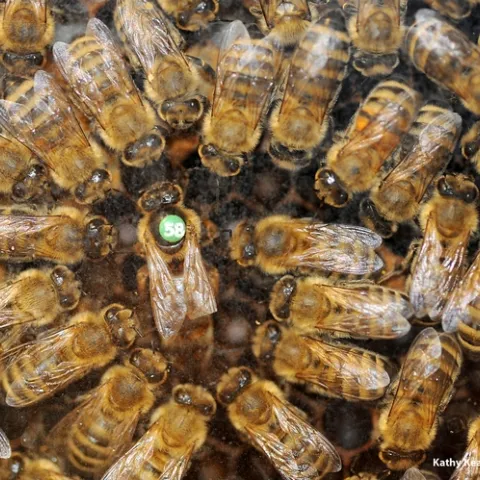
Newly emerged worker bee from the Harry H. Laidlaw Jr. Honey Bee Research Facility at UC Davis.

A Gathering of Beekeepers

November 14, 2011
By Kathy Keatley Garvey
Let it bee. But the California State Beekeepers Association (CSBA) certainly won't. When the beekeepers and their affiliates gather today (Monday, Nov. 14) through Thursday, Nov.
View Article
UC Weed Science (weed control, management, ecology, and minutia): Article

California Weed Science Society Journal articles

November 13, 2011
By Brad Hanson
Today I thought I'd put in a plug for the California Weed Science Society (CWSS) annual meeting to be held January 23-25, 2012 in Santa Barbara. Information on the meeting can be found in the October newsletter at: http://www.cwss.org/PDF/CWSS_Fall_2011_Newsletter.
View Article
Primary Image
This was scrawled on a Briggs Hall blackboard during an annual UC Davis Picnic Day. (Photo by Kathy Keatley Garvey)

'Bugs Rule' at ESA Meeting

November 11, 2011
By Kathy Keatley Garvey
Someone scrawled "Bugs Rule" on a Briggs Hall blackboard during a recent UC Davis Picnic celebration. A delightful drawing of a bug accompanied the proclamation. Bugs do rule, and they'll rule at the 59th annual meeting of the Entomological Society of America (ESA), to take place Nov.
View Article
Primary Image
Apiculturist/bee wrangler Norman Gary, emeritus professor of entomology at UC Davis. (Photo by Kathy Keatley Garvey)

So, You Have This Bee Phobia...

November 10, 2011
By Kathy Keatley Garvey
Are you afraid of bees? Not apiculturist Norman Gary, emeritus professor of entomology at UC Davis and a professional bee wrangler. He worked behind the scenes in a new Animal Planet program, My Extreme Animal Phobia, scheduled to be broadcast Friday, Nov. 11 at 10 p.m.
View Article
Primary Image
Biologist Martha Weiss of Georgetown University studies Lepidopteran learning and memory.

Butterflies Are Good Learners

November 9, 2011
By Kathy Keatley Garvey
Butterflies are good learners--just ask Martha Weiss. Weiss, associate professor of biology at Georgetown University, Washington, D.C.
View Article
Primary Image
Madagascar hissing cockroach crawls up the arm of Mick Dunning, 6, of Davis. (Photo by Kathy Keatley Garvey)

For the Love of Bugs

November 8, 2011
By Kathy Keatley Garvey
"Where is the love for bugs?" science writer Rachel Nuwer asked in a recent article published in the New York Times. Well, there is that "ick" factor.
View Article
Primary Image
Lynn Kimsey with a gigantic "warrior wasp" she discovered on the island of Sulawesi, Indonesia. (Photo by Kathy Keatley Garvey)

Discovering Warrior Wasps

November 7, 2011
By Kathy Keatley Garvey
Lynn S. Kimsey is an entomologist, and has been one for most of her life. So begins the National Science Foundation's recent LiveScience feature on the UC Davis entomologist. It's an interesting piece.
View Article