A Natural Solution for California's Herds: African Catfish Peptides

California's cattle producers and agricultural communities are all too familiar with the rising challenge of antibiotic resistance, making common bacterial infections harder to treat in livestock. But imagine a future where we could tackle these infections with a natural, powerful alternative. Our research points to just that: antimicrobial peptides (AMPs) found in African catfish.

We're really excited about these peptides because African catfish thrive in pathogen-rich freshwater, naturally producing these robust immune compounds in their skin mucus as a defense. This natural origin makes them highly appealing alternatives to synthetic drugs.

Predicted Safety and Potent Action

One of the most compelling aspects of these AMPs is their predicted safety for mammals. Our initial computer analyses suggest that various catfish AMPs are generally recognized as safe (GRAS). We predict they'll be absorbed in the human intestine without causing liver, brain, or heart toxicity. Furthermore, lab tests on a promising peptide, NACAP-II, confirmed it was non-hemolytic, meaning it didn't damage rabbit red blood cells—a strong indicator of its potential safety for mammalian cells.

Beyond safety, these peptides demonstrate effectiveness against problematic bacteria. One study revealed NACAP-II's strong activity against Extended-Spectrum Beta-Lactamase (ESBL)-producing Escherichia coli—a critical concern for both animal and human health due to its resistance to many common antibiotics. Another peptide, ACAP-IV, also showed antibacterial activity against E. coli and Staphylococcus aureus. We believe these AMPs work by directly disrupting bacterial cell membranes, a mechanism that makes it harder for bacteria to develop resistance compared to how they resist traditional antibiotics.
Primary Image
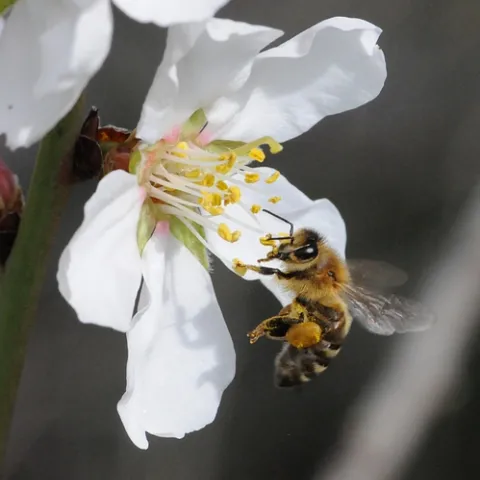
HONEY BEE wings in motion. The bee can fly a distance of two to two-and-a-half miles. (Photo by Kathy Keatley Garvey)
Bug Squad: Article

Inside the World of Bees

August 20, 2009
By Kathy Keatley Garvey
Gleanings from the Western Apicultural Society's 31st annual conference, being held in Healdsburg this week under the direction of president Eric Mussen, Extension apiculturist and member of the UC Davis Department of Entomology faculty: Honey bees can fly a distance of about two to two-and-a-half m...
View Article
Primary Image
HONEY BEES are nectaring outside the Western Apicultural Society conference in Healdsburg. The key subject at the conference: bee health. (Photo by Kathy Keatley Garvey)
Bug Squad: Article

Helping the Honey Bees

August 19, 2009
By Kathy Keatley Garvey
The Western Apicultural Society (WAS) conference, taking place this week in the Dry Creek Inn, Healdsburg, is drawing a lot of interest. Extension Apiculturist Eric Mussen, member of the UC Davis Department of Entomology, is finishing his yearlong term as president of WAS.
View Article
Primary Image
FIERY SKIPPER (Hylephila phyleus) nectaring catmint. (Photo by Kathy Keatley Garvey)
Bug Squad: Article

Fighter Jet

August 18, 2009
By Kathy Keatley Garvey
Look for the fiery skipper (Hylephila phyleus) in your garden. It's likely sharing your catmint, lavender and sage with honey bees and other pollinators. It's the only one holding a "fighter-jet" position.
View Article
Primary Image
WITH TONGUE EXTENDED, Anthophora urbana heads for lavender. It's known as a rapid forager. (Photo by Kathy Keatley Garvey)
Bug Squad: Article

Tiny Bee

August 17, 2009
By Kathy Keatley Garvey
It's smaller than a honey bee. And faster and louder. Anthophora urbana, a solitary, ground-nesting bee, frequents our garden to nectar the catmint, lavender and sage. Sometimes the forager's buzz is so loud that it's startling.
View Article
Primary Image
THIS IMAGE of the Western Tiger Swallowtail is by naturalist/photographer Greg Kareofelas, who took this in east Davis last week. Butterfly experts hadn't seen this butterfly in the Davis area for 15 years until this year.

Tiger by the Tail

August 14, 2009
By Kathy Keatley Garvey
Talk about a tiger by the tail. That would be the Western Tiger Swallowtail (Papilio rutulus). It's returned to the Davis area after a 15-year hiatus.
View Article
Primary Image
SIGN in front of the Harry H. Laidlaw Jr. Honey Bee Research Facility at UC Davis honors the legendary geneticist. The ceramic sculpture at the site (sign and walls) is the work of Davis artist Donna Billick and entomologist-artist Diane Ullman. (Photo by Kathy Keatley Garvey)

The Bees Have It

August 13, 2009
By Kathy Keatley Garvey
The bees have it. That would be honey bees and native bees. The UC Davis Department of Entomology has just launched its new bee biology Web site.
View Article
Primary Image
EXTENSION APICULTURIST Eric Mussen (left) of the UC Davis Department of Entomology faculty shares information with Pennsylvania State Uniersity entomologist Dennis van Engelsdorp at the 2007 meeting of the Entomological Society of America. UC Davis and Penn State receive research funds in a project launched by Haagen-Dazs. (Photo by Kathy Keatley Garvey)

The Buzz About CCD

August 12, 2009
By Kathy Keatley Garvey
Entomologists, geneticists and virologists are still searching for the cause of colony collapse disorder (CCD). Yes, they're still searching, and no, there' s no known cause yet. CCD is a mysterious phenomonen characterized by adult bees abandoning the hive.
View Article
Primary Image
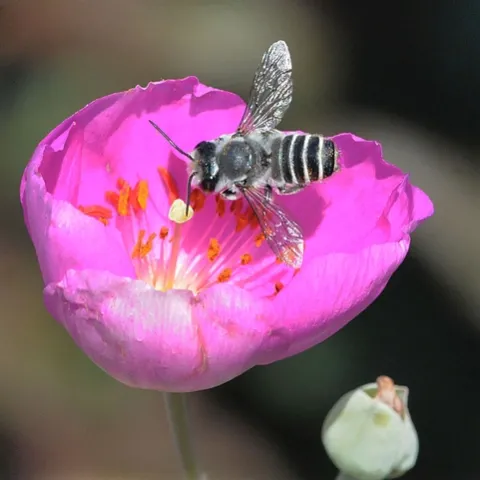
CARPENTER BEE nectars a rock purslane. (Photo by Kathy Keatley Garvey)

In the Pink

August 11, 2009
By Kathy Keatley Garvey
Thunder boomed across the garden. The carpenter bee (Xylocopata tabaniformis orpifex) meant business. She headed straight for the slowly opening rock purslane (Calandrinia grandiflora). Never mind that the petals hadn't quite unfolded.
View Article
Primary Image
HONEY BEE, with tongue extended, heads for catmint (Nepeta faassenii). This will be among the plants in the half-acre Häagen-Dazs Honey Bee Haven, to be open to the public Oct. 16 on Bee Biology Road, UC Davis. (Photo by Kathy Keatley Garvey)

'Mint' Condition

August 10, 2009
By Kathy Keatley Garvey
Honey bees love catmint as much as cats love catnip. Fact is, catmint and catnip belong to the same family: the mint family or Lamiaceae. The family also includes such aromatic celebrities as peppermint, sage, thyme, lavender, basil and oregano. So, when the Hagen-Dazs Honey Bee Haven opens Oct.
View Article
Primary Image
THIS HONEY BEE, sipping water from a leaf, is safe and secure--but not if hordes of Rasberry crazy ants find her. (Photo by Kathy Keatley Garvey)

Beleaguered Bee, Crazy Ant

August 7, 2009
By Kathy Keatley Garvey
It's a crazy world out there. Now our beleaguered honey bee has a new foe: the Rasberry crazy ant, Paratrechina sp. nr. pubens. The Rasberry crazy ant is driving Texans crazy.
View Article