A Natural Solution for California's Herds: African Catfish Peptides

California's cattle producers and agricultural communities are all too familiar with the rising challenge of antibiotic resistance, making common bacterial infections harder to treat in livestock. But imagine a future where we could tackle these infections with a natural, powerful alternative. Our research points to just that: antimicrobial peptides (AMPs) found in African catfish.

We're really excited about these peptides because African catfish thrive in pathogen-rich freshwater, naturally producing these robust immune compounds in their skin mucus as a defense. This natural origin makes them highly appealing alternatives to synthetic drugs.

Predicted Safety and Potent Action

One of the most compelling aspects of these AMPs is their predicted safety for mammals. Our initial computer analyses suggest that various catfish AMPs are generally recognized as safe (GRAS). We predict they'll be absorbed in the human intestine without causing liver, brain, or heart toxicity. Furthermore, lab tests on a promising peptide, NACAP-II, confirmed it was non-hemolytic, meaning it didn't damage rabbit red blood cells—a strong indicator of its potential safety for mammalian cells.

Beyond safety, these peptides demonstrate effectiveness against problematic bacteria. One study revealed NACAP-II's strong activity against Extended-Spectrum Beta-Lactamase (ESBL)-producing Escherichia coli—a critical concern for both animal and human health due to its resistance to many common antibiotics. Another peptide, ACAP-IV, also showed antibacterial activity against E. coli and Staphylococcus aureus. We believe these AMPs work by directly disrupting bacterial cell membranes, a mechanism that makes it harder for bacteria to develop resistance compared to how they resist traditional antibiotics.
Primary Image
BAXTER HOUSE, built in 1938, went up in flames on June 30 in a UC Davis firefighters' control burn. The grounds will now be a quarter-acre field of wildflowers called The Campus Buzzway. (Photo by Kathy Keatley Garvey)
Bug Squad: Article

It's All the Buzz

September 16, 2009
By Kathy Keatley Garvey
Rising soon from the ashes of the Baxter House fire will be the soothing colors of the Campus Buzzway. It's a story that began in May 1938 with a farmhouse-turned-lab-turned-eyesore. It will end with the honey bees' version of "A Field of Dreams"--the Campus Buzzway.
View Article
Primary Image
HONEY BEE, packing pollen, heads into a patch of Argentine rain lilies (Zephyranthes candida) in the White Garden, UC Davis Arboretum. (Photo by Kathy Keatley Garvey)
Bug Squad: Article

It's Raining Rain Lilies

September 15, 2009
By Kathy Keatley Garvey
It's raining rain lilies in the Carolee Shields White Flower Garden of the UC Davis Arboretum. The Argentine Rain Lily (Zephyranthes candida), also known as the White Rain Lily, White Fairy Lily and White Zephyr Lily, is drawing a few honey bees, but the bees like the lavender and sage best.
View Article
Primary Image
BLACK-FACED BUMBLE BEE, Bombus californicus, nectars salvia in the Storer Garden, UC Davis. This salvia is Salvia officinalis, cultivar Berggarten. (Photo by Kathy Keatley Garvey)
Bug Squad: Article

Warding Off Evil

September 14, 2009
By Kathy Keatley Garvey
If you stuff your turkey with sage, chances are it's Salvia officinalis. Not the turkey, the sage.
View Article
Primary Image
BLACK SOLDIER FLY or Hermetia illucens, about three-fourths of an inch long, heads for bark mulch. (Photo by Kathy Keatley Garvey)

Soldiering Along

September 11, 2009
By Kathy Keatley Garvey
If you're into composting, chances are you've seen this one. Common name: black soldier fly (BSF). Scientific name: Hermetia illucens. Before you say "yecch"--wait! This is considered a beneficial insect because its larvae are quite desirable in compost piles.
View Article
Primary Image
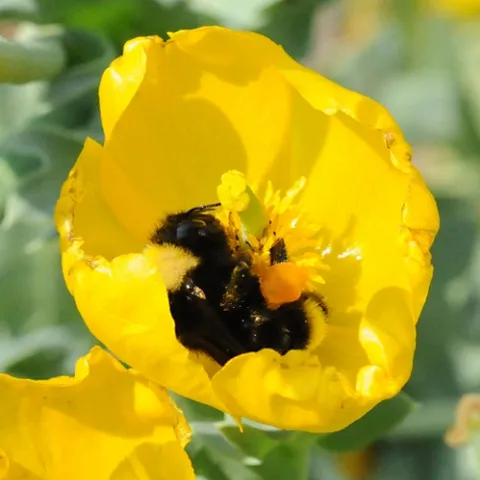
YELLOW-FACED bumble bee inside a rock purslane blossom. (Photo by Kathy Keatley Garvey)

Unexpected Visitor

September 10, 2009
By Kathy Keatley Garvey
It's time to pop open a bottle of champagne and do a happy dance. Finally, finally, we saw a yellow-faced bumble bee (Bombus vosnesenskii) in our yard. After a 20-year absence.
View Article
Colusa County: Article

January 2007

September 10, 2009
South Sacramento Valley Almond Meeting Announcement Sutter/Yuba/Colusa Walnut Day Announcement...
View Article
Primary Image
CARPENTER BEE (Xylocopa tabaniformis orpifex) robs nectar from a salvia (sage) by slitting the corolla. A carpenter bee is too big to enter the tubelike blossom. (Photo by Kathy Keatley Garvey)

Two Nectar Robbers

September 9, 2009
By Kathy Keatley Garvey
You've probably seen carpenter bees engage in the practice known as "nectar robbing." Due to their large size, they cannot enter tubelike blossoms such as salvia (sage), so they slit the base of the corolla. They rob the nectar without pollinating the flower.
View Article
Primary Image
POLLEN-PACKING honey bee nectaring gaura. (Photo by Kathy Keatley Garvey)

Gaura! Gaura! Gaura!

September 8, 2009
By Kathy Keatley Garvey
Pollen-packing honey bees dangling from gaura (Gaura linheimeri) are a joy to photograph. Gaura, native to Louisiana, Texas and Mexico, is a long-stemmed plant with a burst of pinkish-white petals that resemble whirling butterflies.
View Article
Primary Image
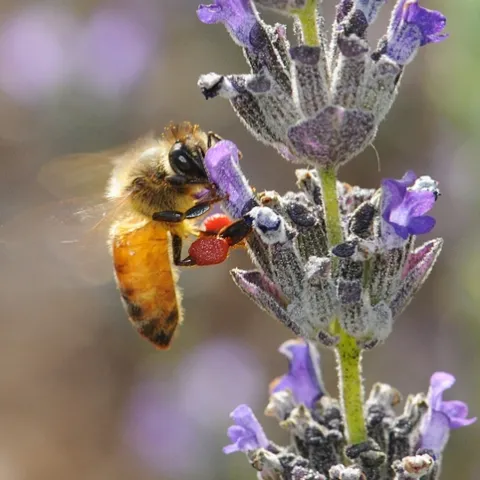
ITALIAN HONEY BEE forages for nectar on lavender. (Photo by Kathy Keatley Garvey)

Golden Moments

September 7, 2009
By Kathy Keatley Garvey
Don't know if silence is GOLDEN, but Italian honey bees definitely are. Early morning Saturday, I watched a bee the color of liquid gold nectaring the lavender in our yard. A golden opportunity to capture her brilliance. She won't live long.
View Article
Primary Image
FEMALE carpenter bee (Xylocopata tabaniformis orpifex) visits a day lily. (Pkoto by Kathy Keatley Garvey)

Day Visitor

September 4, 2009
By Kathy Keatley Garvey
Carpenter bees (Xylocopata tabaniformis orpifex) can't get enough of the day lilies in our yard. In the early morning, they buzz into the patch of day lilies to forage for nectar and pollen. When they're finished, it's easy to tell where they've been: they're covered with telltale yellow pollen.
View Article