A Natural Solution for California's Herds: African Catfish Peptides

California's cattle producers and agricultural communities are all too familiar with the rising challenge of antibiotic resistance, making common bacterial infections harder to treat in livestock. But imagine a future where we could tackle these infections with a natural, powerful alternative. Our research points to just that: antimicrobial peptides (AMPs) found in African catfish.

We're really excited about these peptides because African catfish thrive in pathogen-rich freshwater, naturally producing these robust immune compounds in their skin mucus as a defense. This natural origin makes them highly appealing alternatives to synthetic drugs.

Predicted Safety and Potent Action

One of the most compelling aspects of these AMPs is their predicted safety for mammals. Our initial computer analyses suggest that various catfish AMPs are generally recognized as safe (GRAS). We predict they'll be absorbed in the human intestine without causing liver, brain, or heart toxicity. Furthermore, lab tests on a promising peptide, NACAP-II, confirmed it was non-hemolytic, meaning it didn't damage rabbit red blood cells—a strong indicator of its potential safety for mammalian cells.

Beyond safety, these peptides demonstrate effectiveness against problematic bacteria. One study revealed NACAP-II's strong activity against Extended-Spectrum Beta-Lactamase (ESBL)-producing Escherichia coli—a critical concern for both animal and human health due to its resistance to many common antibiotics. Another peptide, ACAP-IV, also showed antibacterial activity against E. coli and Staphylococcus aureus. We believe these AMPs work by directly disrupting bacterial cell membranes, a mechanism that makes it harder for bacteria to develop resistance compared to how they resist traditional antibiotics.
Primary Image
A LONE FLY visits a flower in the Storer Garden, UC Davis Arboretum, on Feb. 27, 2009. The common housefly is known to transfer at least 100 different pathogens and carry about 6.6 million bacteria on its body at a single time, according to UC Davis forensic entomologist Bob Kimsey. (Photo by Kathy Keatley Garvey)

Flies 'n Superbugs

March 16, 2009
By Kathy Keatley Garvey
It wasn't too surprising. Reuters posted a story online today about flies spreading drug-resistant "superbugs" from chicken droppings.
View Article
Primary Image
UC EXTENSION APICULTURIST Eric Mussen with a bee observation hive at the 2008 Dixon May Fair. The exhibit, featuring question-and-answer-sessions with Mussen, just won second place in a Western Fairs Association competition. (Photo by Kathy Keatley Garvey)

A Honey of an Award

March 13, 2009
By Kathy Keatley Garvey
A honey bee exhibit at the 133rd annual Dixon May Fair featuring Cooperative Extension Apiculturist Eric Mussen has just won a top regional honor. The exhibit, housed appropriately in the floriculture building, won second place in the Western Fairs Associations non-competitive exhibit category.
View Article
Primary Image
VARROA MITE on drone. (Photo by Kathy Keatley Garvey)

Mighty Mite

March 12, 2009
By Kathy Keatley Garvey
The BBC this week examined colony collapse disorder (CCD), a mysterious phenomonen characterized by bees abandoning their hives. The adult bees buzz off, leaving the brood and stored food behind. They do not return.
View Article
Primary Image
DARWIN--This piece at the Pence Gallery, Davis, is the work of ceramic artist Nuala Creed of Petaluma. Of her art she says: “As he sits holding butterflies and the jawbone of an animal, the chimp gazes directly at the viewer. His offering to us, his next of kin, is his curiosity of the natural world. His intelligence is shown by his inquisitiveness. His name is Darwin, in honor of Charles Darwin, whose work helped us realize that we humans are not above nature, but are of nature. The chimp may be asking us

Analyze This!

March 11, 2009
By Kathy Keatley Garvey
A chimpanzee holds a monarch butterfly in a ceramic art work titled Darwin. Human hands cradle insects and assorted objects in a ceramic work titled Analyze This. Those are just two of the art works featured in a juried show under way at the Pence Gallery, 212 D St., Davis.
View Article
Primary Image
This is a photo of Pterostichus lama, which UC Berkeley scientist Kipling "Kip" Will describes as "the largest carabid beetle in California and as big as any in North America." It was taken by one of his students, Ainsley Seago.

Largest Carabid Beetle in California

March 10, 2009
By Kathy Keatley Garvey
Tomorrow's a good day to learn about carabid beetles. Kipling "Kip" Will, associate professor of insect systematics, Department of Environmental Science, Policy and Management at UC Berkeley, will discuss his research at a noon seminar, Wednesday, March 11 in 122 Briggs Hall, UC Davis.
View Article
Primary Image
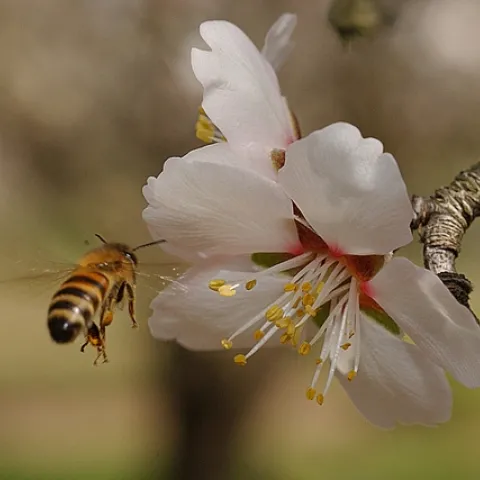
A HONEY OF A BEE, packed with pollen, heads for the nectarine blossoms. (Photo by Kathy Keatley Garvey)

Better than Cotton Candy

March 9, 2009
By Kathy Keatley Garvey
The skies brightened last weekend and the rain-weary honey bees returned to the nectarine blossoms in our yard They were in the pink again! Capturing images of the bees gathering nectar and pollen is more fun than eating cotton candy at a county fair. Springlike day. Radiant pink flowers.
View Article
Primary Image
POLLEN LOAD--A pollen-packing bee at the Harry H. Laidlaw Jr. Honey Bee Research Facility visits an almond blossom. This photo was taken March 5. (Photo by Kathy Keatley Garvey)

Pistol Packin' Mamas

March 6, 2009
By Kathy Keatley Garvey
Pistol packin mamas have nothing on honey bees. Have you ever seen the pollen load that a honey bee carries? What's pollen? It's the fine, powder-like material produced by the anthers of flowering plants, or the grains that contain the male reproductive cells of a seed plant.
View Article
Primary Image
SUSAN COBEY shows a frame to the students in her 2008 class, "The Art of Queen Rearing." (Photo by Kathy Keatley Garvey)

BYOV--And That Means?

March 5, 2009
By Kathy Keatley Garvey
The honey bee population is declining throughout the world, but not the interest in the art of queen rearing. The annual class taught by bee breeder-geneticist Susan Cobey, manager of the Harry H. Laidlaw Jr.
View Article