A Natural Solution for California's Herds: African Catfish Peptides

California's cattle producers and agricultural communities are all too familiar with the rising challenge of antibiotic resistance, making common bacterial infections harder to treat in livestock. But imagine a future where we could tackle these infections with a natural, powerful alternative. Our research points to just that: antimicrobial peptides (AMPs) found in African catfish.

We're really excited about these peptides because African catfish thrive in pathogen-rich freshwater, naturally producing these robust immune compounds in their skin mucus as a defense. This natural origin makes them highly appealing alternatives to synthetic drugs.

Predicted Safety and Potent Action

One of the most compelling aspects of these AMPs is their predicted safety for mammals. Our initial computer analyses suggest that various catfish AMPs are generally recognized as safe (GRAS). We predict they'll be absorbed in the human intestine without causing liver, brain, or heart toxicity. Furthermore, lab tests on a promising peptide, NACAP-II, confirmed it was non-hemolytic, meaning it didn't damage rabbit red blood cells—a strong indicator of its potential safety for mammalian cells.

Beyond safety, these peptides demonstrate effectiveness against problematic bacteria. One study revealed NACAP-II's strong activity against Extended-Spectrum Beta-Lactamase (ESBL)-producing Escherichia coli—a critical concern for both animal and human health due to its resistance to many common antibiotics. Another peptide, ACAP-IV, also showed antibacterial activity against E. coli and Staphylococcus aureus. We believe these AMPs work by directly disrupting bacterial cell membranes, a mechanism that makes it harder for bacteria to develop resistance compared to how they resist traditional antibiotics.
Primary Image
IN THE LAB--UC Davis evolutionary ecologist Andrew Forbes works in the lab. His research on the apple maggot and a parasitic wasp will be published Feb. 6 in the journal Science. (Photo by Kathy Keatley Garvey)
Bug Squad: Article

Biodiversity Creates Biodiversity

February 5, 2009
By Kathy Keatley Garvey
Biodiversity creates biodiversity. That point comes through loud and clear when you read the scientific paper on the apple maggot/parasitic wasp research led by UC Davis evolutionary ecologist Andrew Forbes. The news embargo lifted at 11 a.m. today and the research will be published Friday, Feb.
View Article
Primary Image
THE YOUNG AND THE RESTLESS--The nymph (bright red) of the soapberry bug scurries down a tree trunk. (Photo by James Moerhke)
Bug Squad: Article

Shoulder to Shoulder

February 4, 2009
By Kathy Keatley Garvey
Vacaville resident James Moehrke was out geocaching last weekend in the Vaca Valley Parkway-East Monte Vista Avenue area of the city when he spotted some red-shouldered black bugs. "There were many clusters, probably thousands of individuals, in the trees and a few on the ground," he recalled.
View Article
Primary Image
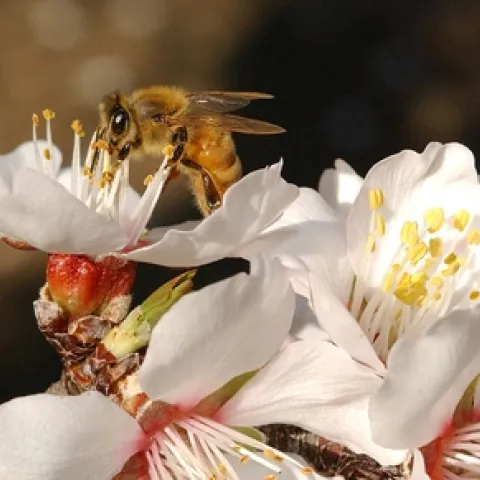
HONEY BEE ON DAPHNE--The daphne is known for its scented flowers--but beware those poisonous berries. (Photo by Kathy Keatley Garvey)
Bug Squad: Article

No Pork Barrel Politics Here

February 2, 2009
By Kathy Keatley Garvey
Honey bee insurance buzzed into the news Feb. 1 when Sen. Mitch McConnell, R-Ky., appeared on the CBS Show, "Face the Nation" and blasted the state of the economy and President Obama's economic stimulus plan.
View Article
Primary Image
PERFECT CAKE FOR AN ENTOMOLOGIST--What's a perfect birthday cake for an insect scientist? One with bugs. (Photo by Kathy Keatley Garvey)
Bug Squad: Article

The Bug Stops Here

January 30, 2009
By Kathy Keatley Garvey
Its Friday, so it must be Friday lite When youre hosting a birthday party for an entomologist, you have to think bugs. Thats the rule. Its written right there in the Entomological Society of Americas official guidebook, Chapter 10, Page 387, Line 38. (OK, I made that up.
View Article
Primary Image
A hover fly or flower fly, Syrphus opinator, rests on a stem in the Storer Gardens, UC Davis. You'll be seeing more of these hover flies as the weather warms. This photo was taken Saturday, Jan. 24. (Photo by Kathy Keatley Garvey)
Bug Squad: Article

Just Hovering

January 29, 2009
By Kathy Keatley Garvey
It's often mistaken for a honey bee. It's not a honey bee. It's a hover fly or flower fly. And this one, hovering around the plants last Saturday in the Storer Gardens at the University of California, Davis, looked like a Syrphus opinator to me.
View Article
Primary Image
TENDING BEES--Michael "Kim" Fondrk of UC Davis tends his bees in a Dixon almond orchard. This photo appeared in The IPM Practitioner. (Photo by Kathy Keatley Garvey)
Bug Squad: Article

Well Said

January 28, 2009
By Kathy Keatley Garvey
UC Davis bee specialists were well represented in a recent edition of The IPM Practitioner, which landed on our desk last week. The edition, devoted to Pesticides and Honey Bee Colony Collapse Disorder, includes four photos from the UC Davis Department of Entomology.
View Article
Primary Image
SIX-PETALED FLOWER--A honey bee forages on a winter jasmine in the Storer Gardens, University of California, Davis. (Photo by Kathy Keatley Garvey)
Bug Squad: Article

Golden Moments

January 27, 2009
By Kathy Keatley Garvey
It blooms in winter and the bees love it. Winter jasmine (Jasminum nudiflorum), a rambling vine with trumpetlike yellow flowers, is charming visitors in the Storer Gardens at the University of California, Davis. The plant originates from western China.
View Article
Primary Image
GREEN EYES--The male Valley carpenter bee is a green-eyed, golden insect nicknamed the "teddy bear" carpenter bee. (Photo by Kathy Keatley Garvey)
Bug Squad: Article

Just Wanna Be Your 'Teddy Bear'

January 26, 2009
By Kathy Keatley Garvey
When you think of a teddy bear, you think of a huggable stuffed animal. Not so entomologists. When they think of a teddy bear, they think of the male Valley carpenter bee. It's a green-eyed, fluffy golden insect that's nicknamed "teddy bear." You can hug it, too.
View Article
Primary Image
RED DRAGONFLY--UC Davis entomologist Michael Parrella submitted this photograph in the Insect Salon juried photography show at the Entomological Society of America's 56th annual meeting, held last November in Reno. Photographers from around the world entered the competition. Parrella is an associate dean of agricultural sciences at the UC Davis College of Agricultural and Environmental Sciences, and professor of entomology and environmental horticulture at UC Davis. (Photo by Michael Parrella)
Bug Squad: Article

Art Show: A Fusion of Art and Science

January 23, 2009
By Kathy Keatley Garvey
If you like to combine art with science, here you go. In keeping with the theme, The Consilience of Art And Science," the Pence Gallery and the UC Davis Art/Science Fusion Program are sponsoring a juried exhibition, open to all artists and scientists.
View Article