A Natural Solution for California's Herds: African Catfish Peptides

California's cattle producers and agricultural communities are all too familiar with the rising challenge of antibiotic resistance, making common bacterial infections harder to treat in livestock. But imagine a future where we could tackle these infections with a natural, powerful alternative. Our research points to just that: antimicrobial peptides (AMPs) found in African catfish.

We're really excited about these peptides because African catfish thrive in pathogen-rich freshwater, naturally producing these robust immune compounds in their skin mucus as a defense. This natural origin makes them highly appealing alternatives to synthetic drugs.

Predicted Safety and Potent Action

One of the most compelling aspects of these AMPs is their predicted safety for mammals. Our initial computer analyses suggest that various catfish AMPs are generally recognized as safe (GRAS). We predict they'll be absorbed in the human intestine without causing liver, brain, or heart toxicity. Furthermore, lab tests on a promising peptide, NACAP-II, confirmed it was non-hemolytic, meaning it didn't damage rabbit red blood cells—a strong indicator of its potential safety for mammalian cells.

Beyond safety, these peptides demonstrate effectiveness against problematic bacteria. One study revealed NACAP-II's strong activity against Extended-Spectrum Beta-Lactamase (ESBL)-producing Escherichia coli—a critical concern for both animal and human health due to its resistance to many common antibiotics. Another peptide, ACAP-IV, also showed antibacterial activity against E. coli and Staphylococcus aureus. We believe these AMPs work by directly disrupting bacterial cell membranes, a mechanism that makes it harder for bacteria to develop resistance compared to how they resist traditional antibiotics.
Primary Image
Blue merle mini-Australian shepherds have one: a tongue. (Photo by Kathy Keatley Garvey)

Tongue-Tied

March 4, 2009
By Kathy Keatley Garvey
Blue merle mini-Australian shepherds have one. So do honey bees. What? A tongue. For a puppy, the tongue can symbolize pure happiness. For a worker honey bee: a solid work ethic.
View Article
Primary Image
SOLITARY SOAPBERRY BUG climbs a tree in the UC Davis Arboretum, a good place for nature walks and insect observations. (Photo by Kathy Keatley Garvey)
Bug Squad: Article

It Might as Well Be...Spring

March 3, 2009
By Kathy Keatley Garvey
If you like to take nature walks and lean against an occasional tree, you might rub shoulders with a red-eyed, red-shouldered bug. On warm, springlike days, soapberry bugs are exploring their territories--and doing what comes naturally.
View Article
Primary Image
Honey bee nectaring Claremont pink currant (Ribes sanguineum var. glutinosum 'Claremont') (Photo by Kathy Keatley Garvey)

Plan Bee

March 2, 2009
By Kathy Keatley Garvey
Scottish poet Robert Burns (1759-1796) lamented in his poem To a Mouse (1786) that The best laid plans of mice and men often go awry. He had just plowed into a mouse nest on his farm. The loss of life disturbed him.
View Article
Primary Image
QUEEN BUMBLE BEE--The queen bumble bees are out again, after overwintering. Entomologist Lynn Kimsey found this young queen in Briggs Hall on the UC Davis campus yesterday. (Photo by Kathy Keatley Garvey)

The Humble Bumble Bee

February 27, 2009
By Kathy Keatley Garvey
A sure sign of approaching spring... As the cold weather subsides, out come the overwintering queen bumble bees. They're gathering nectar and pollen, building their nests and laying eggs.
View Article
Primary Image
NEWBORN BEE--A newborn bee at the Harry H. Laidlaw Jr. Honey Bee Research Facility at UC Davis struggles to right herself. (Photo by Kathy Keatley Garvey)

A Wonderful Gift

February 26, 2009
By Kathy Keatley Garvey
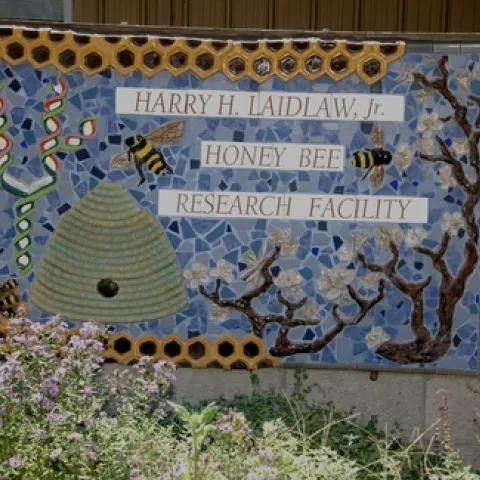
It's a wonderful gift. Hagen-Dazs last December committed $125,000 to the UC Davis Department of Entomology to establish a bee friendly garden at the Harry H. Laidlaw Jr. Honey Bee Research Facility, and today, the winner of the design competition takes center stage. The winner...drum roll, please..
View Article
Primary Image
These picture-winged flies were captured in Birds Landing in mid-February and popped into a jar for identification. (Photo by Kathy Keatley Garvey)

Picture Perfect?

February 25, 2009
By Kathy Keatley Garvey
Lots of them, but what are they? Vacaville residents Mark and Julie Vasquez began finding little flies in Birds Landing, near Rio Vista, in late January 2009. Their numbers are increasing rapidly. Theyre everywhere, said Mark.
View Article
Primary Image
BRAZILIAN-BORN ARTIST Eduardo Kac will speak Thursday night, March 5 as part of the Consilience of Art and Science colloquium, sponsored by the Art/Science Fusion Program at the University of California, Davis.

Insect.Desperto

February 24, 2009
By Kathy Keatley Garvey
Have you seen it? Insect.Desperto? Internationally renowned artist Eduardo Kac, who uses biotechnology and genetics to create provocative works, created the runtime animation, "Insect.Desperto" back in 1995. (By the way, "Desperto means awaken in Portuguese.
View Article
Primary Image
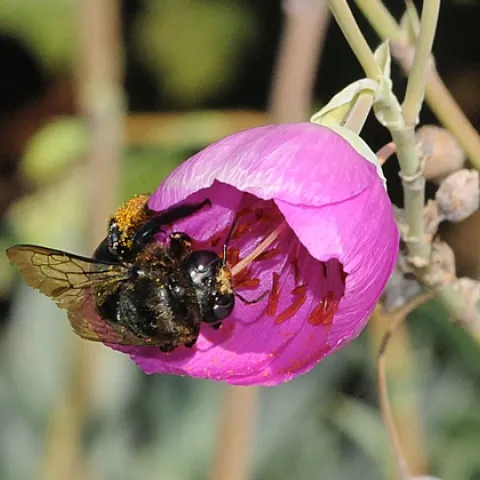
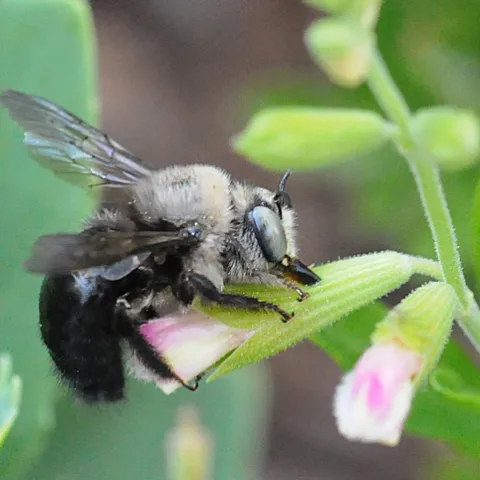
This little critter, probably a native bee, seems to be glaring at the photographer. The flower is a rock purslane (Calandrinia grandiflora). (Photo by Kathy Keatley Garvey)

Visitor in the Garden

February 23, 2009
By Kathy Keatley Garvey
The rain and wind took turns destroying the flowers in our garden last Sunday in a siege not unlike a scene from The Wrestler. The rock purslane (Calandrinia grandiflora) took a beating, but like Mickey Rourke, it will return.
View Article
Primary Image
QUEEN BEE (center with the dot) is tended by worker bees. Bees are social insects, creating a highly social organization with set duties and responsibilities. (Photo by Kathy Keatley Garvey)
Bug Squad: Article

The Bee

February 20, 2009
By Kathy Keatley Garvey
Claire Preston isn't a beekeeper but she's written an informative book titled Bee. Published in 2006 by Reaktion Books, London, it's short, simple and sweet. Especially sweet.
View Article