A Natural Solution for California's Herds: African Catfish Peptides

California's cattle producers and agricultural communities are all too familiar with the rising challenge of antibiotic resistance, making common bacterial infections harder to treat in livestock. But imagine a future where we could tackle these infections with a natural, powerful alternative. Our research points to just that: antimicrobial peptides (AMPs) found in African catfish.

We're really excited about these peptides because African catfish thrive in pathogen-rich freshwater, naturally producing these robust immune compounds in their skin mucus as a defense. This natural origin makes them highly appealing alternatives to synthetic drugs.

Predicted Safety and Potent Action

One of the most compelling aspects of these AMPs is their predicted safety for mammals. Our initial computer analyses suggest that various catfish AMPs are generally recognized as safe (GRAS). We predict they'll be absorbed in the human intestine without causing liver, brain, or heart toxicity. Furthermore, lab tests on a promising peptide, NACAP-II, confirmed it was non-hemolytic, meaning it didn't damage rabbit red blood cells—a strong indicator of its potential safety for mammalian cells.

Beyond safety, these peptides demonstrate effectiveness against problematic bacteria. One study revealed NACAP-II's strong activity against Extended-Spectrum Beta-Lactamase (ESBL)-producing Escherichia coli—a critical concern for both animal and human health due to its resistance to many common antibiotics. Another peptide, ACAP-IV, also showed antibacterial activity against E. coli and Staphylococcus aureus. We believe these AMPs work by directly disrupting bacterial cell membranes, a mechanism that makes it harder for bacteria to develop resistance compared to how they resist traditional antibiotics.


Nut Crops: Article

Pistachio orchard weed survey

March 7, 2019
UCCE researchers James Schaeffer and Kurt Hembree, and Dr. Anil Shrestha at CSU-Fresno are investigating the distribution of a newly emerging problem weed, Alkaliweed, in pistachio orchards. They would like to request your help to identify locations of this plant in the Southern San Joaquin Area.
View Article
Thrips/TSWV Western San Joaquin Co.: Article

The 2019 season opens

March 7, 2019
By Neil McRoberts
Hello. This is the first update for 2019 for the UC western flower thrips/tswv outlook for processing tomato. General outlook As a reminder, the base temperature we use for estimating thrips development is 45F.
View Article
Primary Image
Powdery mildew advancing upon a raspberry fruit. Notice the evidence of disease on the petiole. Photo courtesy Ted Swartzbaugh.
Strawberries and Caneberries: Article

Powdery mildew on raspberry fruit

March 7, 2019
By Mark P Bolda
Here's a photo submitted by reader Ted Swartzbaugh down in Ventura county of something you don't see too often. Powdery mildew in raspberry which has advanced to the fruit, and if you look close you can even see evidence of the disease on the petiole.
View Article
Fresno County 4-H: Article

March 2019 Guidelines

March 7, 2019
In This Edition: Fresno County 4-H Leaders Council & Committee Meetings, Pg. 2 State Record Book Participants, Pg. 2 Welcome Cashmir Whittle, Pg. 2 CCLS (Community Club Leaders)-Need to Know, Pg. 2 Junior Camp Counselor Planning Meeting, Pg. 3 Fresno County 4-H CampRegistration, Pg.
View Article
Thrips/TSWV status in Yolo & Colusa: Article

The 2019 season opens

March 7, 2019
By Neil McRoberts
Hello. This is the first update for 2019 for the UC western flower thrips/tswv outlook for processing tomato. General outlook As a reminder the base temperature we use for estimating thrips development is 45F.
View Article
Under the Solano Sun: Article

Garden Style Trivia

March 7, 2019
Gardening has been around for centuries an old-fashioned pleasure and also a survival skill. As Master Gardeners our task is to make recommendations ... disseminate scientifically defensible information approved by the University of California to others also interested in gardening.
View Article
Primary Image
rainbow assortment of fruits and vegetables
Food Blog: Article

Making the case for fruits and vegetables

March 7, 2019
Why do you love fruits and vegetables? Is it their bright colors? Their many shapes and varieties, the way they can makeover your plate with the seasons? The opportunity to taste local terroir in a very fresh bite of fruit or forkful of salad?
View Article
Primary Image
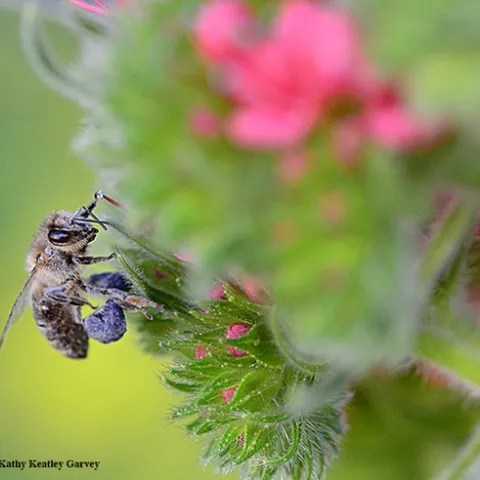
Honey bees at work. (Photo by Kathy Keatley Garvey)
Bug Squad: Article

Sharing 'The Secret Life of Bees'

March 6, 2019
By Kathy Keatley Garvey
"Where can kids learn beekeeping for free?" someone asked us last week. One of the ways is through the 4-H Youth Development Program. Who can join 4-H, which stands for head, heart, health and hands and which follows the motto, "making the best better?" It's open to all youths ages 5 to 19.
View Article