A Natural Solution for California's Herds: African Catfish Peptides

California's cattle producers and agricultural communities are all too familiar with the rising challenge of antibiotic resistance, making common bacterial infections harder to treat in livestock. But imagine a future where we could tackle these infections with a natural, powerful alternative. Our research points to just that: antimicrobial peptides (AMPs) found in African catfish.

We're really excited about these peptides because African catfish thrive in pathogen-rich freshwater, naturally producing these robust immune compounds in their skin mucus as a defense. This natural origin makes them highly appealing alternatives to synthetic drugs.

Predicted Safety and Potent Action

One of the most compelling aspects of these AMPs is their predicted safety for mammals. Our initial computer analyses suggest that various catfish AMPs are generally recognized as safe (GRAS). We predict they'll be absorbed in the human intestine without causing liver, brain, or heart toxicity. Furthermore, lab tests on a promising peptide, NACAP-II, confirmed it was non-hemolytic, meaning it didn't damage rabbit red blood cells—a strong indicator of its potential safety for mammalian cells.

Beyond safety, these peptides demonstrate effectiveness against problematic bacteria. One study revealed NACAP-II's strong activity against Extended-Spectrum Beta-Lactamase (ESBL)-producing Escherichia coli—a critical concern for both animal and human health due to its resistance to many common antibiotics. Another peptide, ACAP-IV, also showed antibacterial activity against E. coli and Staphylococcus aureus. We believe these AMPs work by directly disrupting bacterial cell membranes, a mechanism that makes it harder for bacteria to develop resistance compared to how they resist traditional antibiotics.

Primary Image
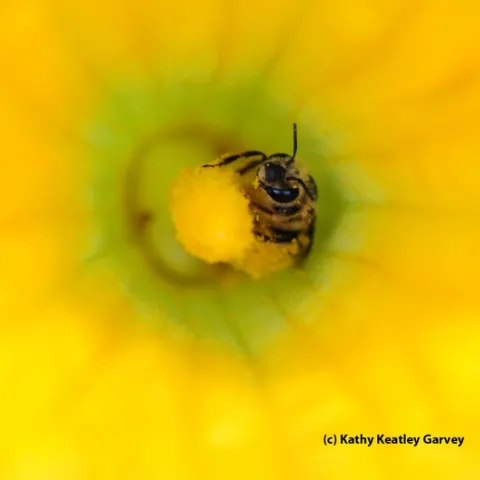
Male European wool carder bee is very territorial. Front, lavender blossoms. Back: pomegranate blossoms. (Photo by Kathy Keatley Garvey
Bug Squad: Article

So Very Territorial!

June 1, 2012
By Kathy Keatley Garvey
Whether it's coming or going, you notice this pollinator's presence. The European wool carder bee (Anthidium manicatum), so named because the female collects or cards "plant hairs" or "plant fuzz" to line her nest, is strikingly beautiful. The bee is mostly black and yellow.
View Article
UC Weed Science (weed control, management, ecology, and minutia): Article

Mighty mite may prove too much for Scotch broom

June 1, 2012
By Scott R Oneto
A recent find in Oregon has weed scientists, botanists, land managers, and plant conservationists throughout the Pacific Northwest and California really excited over a tiny insect.
View Article
Primary Image
Dan Munk (left) and Michael Dowgert, the Fresno-based director of marketing for Netafim, an irrigation company.
Conservation Agriculture: Article

Insight and optimism as the Water for Food Conference wraps up

June 1, 2012
By Jeannette Warnert
Farmers, researchers, consumers and policy makers are making progress toward addressing the challenge of producing food to feed a world population of 9 billion in 2050. The optimistic signs were everywhere on the closing day of the fourth annual Water for Food Conference in Lincoln, Neb., June 1.
View Article
Primary Image
This millipede (Xystocheir dissecta) glows under ultraviolet light. Alexander Nguyen of the UC Davis Entomology Club captured this image on Alcatraz, during one of UC Davis forensic entomologist Robert Kimsey's field trips.
Bug Squad: Article

They'll Light Up Your Life

May 31, 2012
By Kathy Keatley Garvey
Most scorpions glow under an ultraviolet light, but now a discovery on Alcatraz Island reveals that a certain species of millipedes will, too.
View Article
Cooperative Extension Ventura County: Article

June 2012 Clover Lines

May 31, 2012
In this issue... Super Field Day and So. Section Field Day Wrap-Ups, Fair Information, Enrollment Information, and so much more...
View Article
Primary Image
Egg of a California dogface butterfly. (Photo by Greg Kareofelas)
Bug Squad: Article

And Now, Your California State Insect...

May 30, 2012
By Kathy Keatley Garvey
There's always something special going on at the Bohart Museum of Entomology on the UC Davis campus. But this Sunday, June 3, something even more special "may" occur. That's "may" because a California dogface butterfly "may" emerge from its chrysalis during the Bohart open house, set from 1 to 4 p.
View Article
Primary Image
Water for Food Conference growers panel.
Conservation Agriculture: Article

Water for Food Conference speakers address issues of importance to Californians

May 30, 2012
By Jeannette Warnert
The confluence of global climate change and population growth is brewing a perfect storm that threatens the availability of sufficient fresh water to grow food to feed the world by 2025, warned Colin Chartres, the director general of the International Water Management Institute in Sri Lanka.
View Article
Primary Image
Yellow-faced bumble bee lands on The Morning Star. (Photo taken with an IPhone)
Bug Squad: Article

Bumble Bee's Daily Commute?

May 29, 2012
By Kathy Keatley Garvey
If you've ever been to Angel Island or Alcatraz Island in the San Francisco Bay, you may have seen them. Bumble bees. And sometimes if you're fishing in the Bay, a bumble bee may land on your boat.
View Article