A Natural Solution for California's Herds: African Catfish Peptides

California's cattle producers and agricultural communities are all too familiar with the rising challenge of antibiotic resistance, making common bacterial infections harder to treat in livestock. But imagine a future where we could tackle these infections with a natural, powerful alternative. Our research points to just that: antimicrobial peptides (AMPs) found in African catfish.

We're really excited about these peptides because African catfish thrive in pathogen-rich freshwater, naturally producing these robust immune compounds in their skin mucus as a defense. This natural origin makes them highly appealing alternatives to synthetic drugs.

Predicted Safety and Potent Action

One of the most compelling aspects of these AMPs is their predicted safety for mammals. Our initial computer analyses suggest that various catfish AMPs are generally recognized as safe (GRAS). We predict they'll be absorbed in the human intestine without causing liver, brain, or heart toxicity. Furthermore, lab tests on a promising peptide, NACAP-II, confirmed it was non-hemolytic, meaning it didn't damage rabbit red blood cells—a strong indicator of its potential safety for mammalian cells.

Beyond safety, these peptides demonstrate effectiveness against problematic bacteria. One study revealed NACAP-II's strong activity against Extended-Spectrum Beta-Lactamase (ESBL)-producing Escherichia coli—a critical concern for both animal and human health due to its resistance to many common antibiotics. Another peptide, ACAP-IV, also showed antibacterial activity against E. coli and Staphylococcus aureus. We believe these AMPs work by directly disrupting bacterial cell membranes, a mechanism that makes it harder for bacteria to develop resistance compared to how they resist traditional antibiotics.
Primary Image
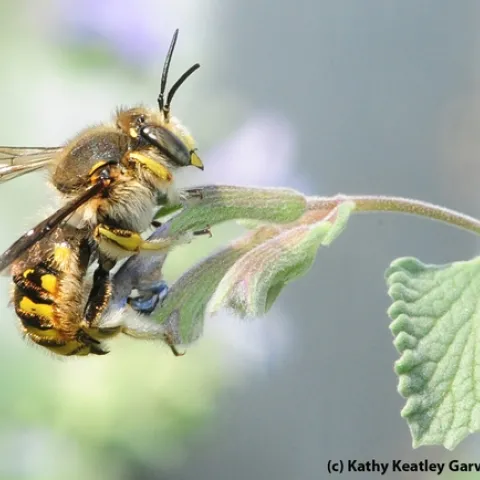
Paper wasp from the genus Mischocyttarus, goes head to head with a ladybug. (Photo by Kathy Keatley Garvey)
Bug Squad: Article

Wasp-Ladybug Encounter

February 13, 2012
By Kathy Keatley Garvey
What a spectacular paper wasp! On a visit last week to the Hagen-Dazs Honey Bee Haven on Bee Biology Road, University of California, Davis, we saw a paper wasp (genus Mischocyttarus) foraging in the fava beans with assorted ladybugs, aphids and ants.
View Article
Primary Image
Honey bees foraging in almonds on the grounds of the Laidlaw facility. (Photo by Kathy Keatley Garvey)
Bug Squad: Article

At Last, Laidlaw Almonds in Bloom

February 10, 2012
By Kathy Keatley Garvey
At last, the Laidlaw almonds are in bloom. That would be the almond trees on the grounds of the Harry H. Laidlaw Jr. Honey Bee Research Facility on Bee Biology Road at the University of California, Davis. And no one appreciates this more than the bees holed up in the 40 hives behind the facility.
View Article
Primary Image
Soil moisture table
Topics in Subtropics: Article

Making Sense of Soil Moisture Checking and Sensors

February 10, 2012
The best key to unlock efficient irrigation practice is to know exactly how much water your crop uses and replace it in a timely fashion that matches your irrigation system capacity and avoids crop stress and water logging.
View Article
Primary Image
Identification and observation is key to vertebrate pest control.
Topics in Subtropics: Article

Vertebrate Pests Causing Damage in Citrus

February 10, 2012
Vertebrate pests that have caused damage to citrus trees include rodents and small mammals, large mammals, and birds. Citrus orchards provide food and shelter for a number of these pests, and damage may be severe if the pest resides in the orchard.
View Article
UC Weed Science (weed control, management, ecology, and minutia): Article

California farmers spending $900 million annually fighting weeds

February 10, 2012
By Gale Perez
Western agricultural concerns about weed cost increases center on the growing problem of herbicide resistance. At the recent California Weed Science Society annual meeting in Santa Barbara, Calif.
View Article
Primary Image
Jamesina Scott at work. (Photo by Dave Woodward)
Bug Squad: Article

A Little Known Mosquito

February 9, 2012
By Kathy Keatley Garvey
When people think of mosquitoes, they probably never think of Aedes japonicus. It's an Asian species "generally found in Japan, Korea, the Ryukyu Archipelago (Okinawa and associated islands), Taiwan, South China, and Hong Kong," according to the Centers for Disease Control and Prevention (CDC).
View Article
UC Weed Science (weed control, management, ecology, and minutia): Article

Navigating a critical juncture for sustainable weed management

February 9, 2012
By Gale Perez
Abstract: Agricultural weed management has become entrenched in a single tacticherbicideresistant cropsand needs greater emphasis on integrated practices that are sustainable over the long term.
View Article
Primary Image
Honey bee pollinating almonds in Vacaville. (Photo by Kathy Keatley Garvey)
Bug Squad: Article

First the Tweets, then the Buzzes

February 8, 2012
By Kathy Keatley Garvey
"Almonds are one of the first crops of the season that need bee pollination," tweeted the Almond Board of California yesterday. Valentine's Day traditionally marks the beginning of almond pollination season, but it's an early spring. The almonds are blooming and the bees are buzzing.
View Article
Primary Image
Senior museum scientist Steve Heydon shows his son, James, 10, around the Bohart Museum of Entomology. (Photo by Kathy Keatley Garvey)
Bug Squad: Article

Biodiversity Reigns Supreme

February 7, 2012
By Kathy Keatley Garvey
Biodiversity--that's what it's at on Sunday, Feb. 12 at the University of California, Davis. That's when four museums or centers that engage in education and research involving insects, vertebrates or plants will host open houses. And folks will be amazed, officials promise.
View Article