A Natural Solution for California's Herds: African Catfish Peptides

California's cattle producers and agricultural communities are all too familiar with the rising challenge of antibiotic resistance, making common bacterial infections harder to treat in livestock. But imagine a future where we could tackle these infections with a natural, powerful alternative. Our research points to just that: antimicrobial peptides (AMPs) found in African catfish.

We're really excited about these peptides because African catfish thrive in pathogen-rich freshwater, naturally producing these robust immune compounds in their skin mucus as a defense. This natural origin makes them highly appealing alternatives to synthetic drugs.

Predicted Safety and Potent Action

One of the most compelling aspects of these AMPs is their predicted safety for mammals. Our initial computer analyses suggest that various catfish AMPs are generally recognized as safe (GRAS). We predict they'll be absorbed in the human intestine without causing liver, brain, or heart toxicity. Furthermore, lab tests on a promising peptide, NACAP-II, confirmed it was non-hemolytic, meaning it didn't damage rabbit red blood cells—a strong indicator of its potential safety for mammalian cells.

Beyond safety, these peptides demonstrate effectiveness against problematic bacteria. One study revealed NACAP-II's strong activity against Extended-Spectrum Beta-Lactamase (ESBL)-producing Escherichia coli—a critical concern for both animal and human health due to its resistance to many common antibiotics. Another peptide, ACAP-IV, also showed antibacterial activity against E. coli and Staphylococcus aureus. We believe these AMPs work by directly disrupting bacterial cell membranes, a mechanism that makes it harder for bacteria to develop resistance compared to how they resist traditional antibiotics.
Colusa County: Article

December 2010

November 22, 2010
I apologize for re-posting this newsletter, I added many new 4H members and wanted them to receive the current newsletter.
View Article

Non-fumigant alternatives: steam disinfestation

November 22, 2010
By Brad Hanson
Over the last few years, several of my UC Davis, CSU-Fresno, and USDA-ARS collaborators and I have been involved in research related to using steam heat to thermally disinfest soil as an alternative to methyl bromide fumigation.
View Article
Primary Image
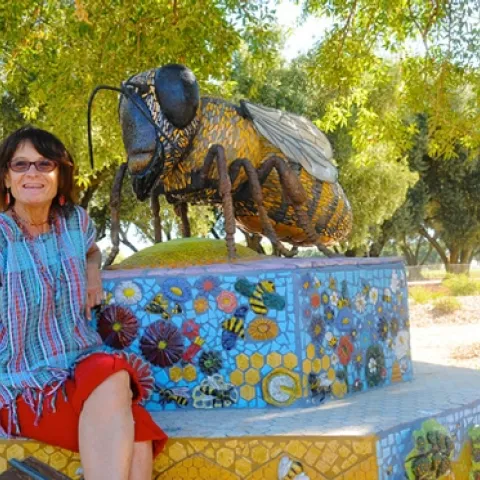
ROCK ARTIST Donna Billick, with her sculpture, "Miss Bee Haven," at the Haagen-Dazs Honey Bee Haven, Harry H. Laidlaw Jr. Honey Bee Research Facility at UC Davis. Billick will be showing some of her work at the Pence Art Gallery, Davis, Nov. 23-Dec. 23. (Photo by Kathy Keatley Garvey)
Bug Squad: Article

Sticky Business: Art of the Honey Bee

November 19, 2010
By Kathy Keatley Garvey
Honey is sticky. Bees are in a sticky situation. Now enter "Sticky Business: Art of the Honey Bee." It's an art show about honey bees that will run from Tuesday, Nov. 23 from Thursday, Dec. 23 in the Pence Art Gallery, 212 D St., Davis.
View Article
Primary Image
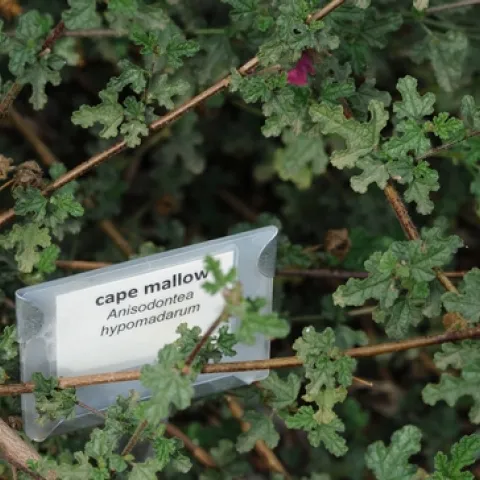
PLANTS in the Haagen-Dazs Honey Bee Haven are labeled so visitors can identify them and glean ideas what to plant in their own gardens. (Photo by Kathy Keatley Garvey)
Bug Squad: Article

Wallowing in Mallow

November 18, 2010
By Kathy Keatley Garvey
One of the spectacular plants blooming in the Hagen-Dazs Honey Bee Haven, the half-acre bee friendly garden at the University of California, Davis, is the cape mallow (Anisodontea hypomandarum), a native of South Africa.
View Article
Primary Image
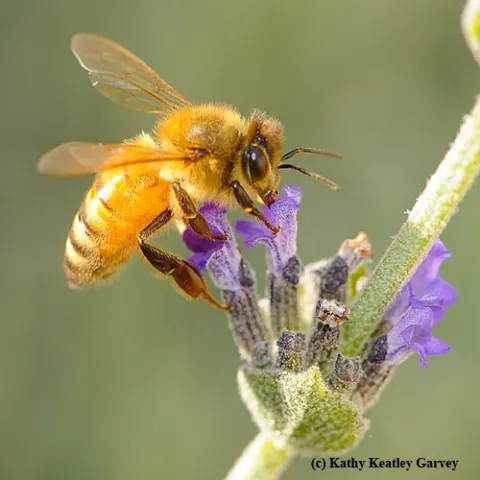
BLOND HONEY BEE, of the Cordovan subspecies of the Italian race of honey bees, nectaring on lavender. (Photo by Kathy Keatley Garvey)
Bug Squad: Article

More Precious Than Gold

November 17, 2010
By Kathy Keatley Garvey
Ever see a golden bee that takes your breath away? They're most likely Cordovans, a subspecies of the Italian race. The one below is a Cordovan, basically a bee with a color mutation that inhibits black, explains noted bee breeder-geneticist Susan Cobey.
View Article
Primary Image
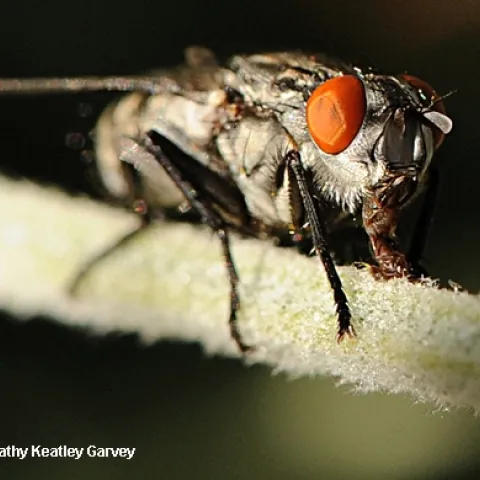
FLESH FLY, a member of the Sarcophagidae family, ejects its tongue. (Photo by Kathy Keatley Garvey)
Bug Squad: Article

Seeing Red

November 16, 2010
By Kathy Keatley Garvey
The first thing you notice about the fly is its brilliant red eyes. They stand out like the proverbial elephant in the room. But they are on a fly--a flesh fly.
View Article
Primary Image
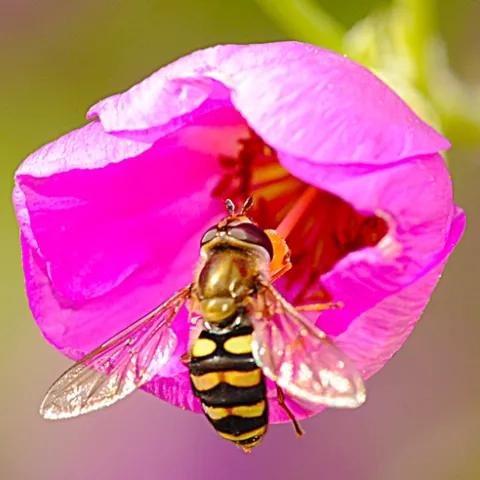
SYPRHID FLY heading inside a rock purslane blossom. (Photo by Kathy Keatley Garvey)
Bug Squad: Article

How Grand They Are

November 15, 2010
By Kathy Keatley Garvey
Aren't syrphid flies grand? Syrphid flies, aka hover flies or flower flies (family Syrphidae), are especially grand in a Calandrinia grandiflora, aka rock purslane.
View Article

Fundamentals of Weed Control: Know Your Enemy

November 14, 2010
By Brad Hanson
Recently I was reminded that there is no more important fundamental to weed control than being able to identify your weed problem. This summer, I moved to a different house and have slowly been working on little projects that arise.
View Article
Primary Image
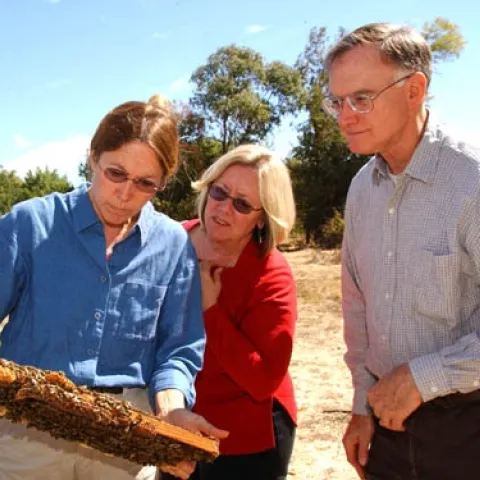
UC Davis bee breeder-geneticist Susan Cobey (far left) and UC Davis apiculturist Eric Mussen look at a bee frame with beekeeper Valerie Severson of Yuba City. (Photo by Kathy Keatley Garvey)
Bug Squad: Article

Coconut Oil to Treat Varroa Mites?

November 12, 2010
By Kathy Keatley Garvey
Is coconut oil effective in treating varroa mites, those nasty little mites that plague our honey bees? The facts aren't in, and research is ongoing.
View Article
Primary Image
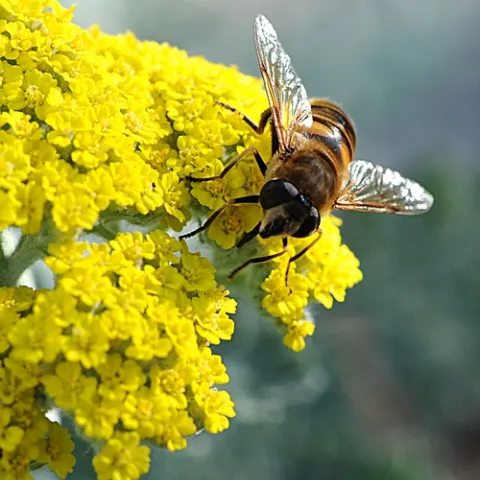
DRONE FLY (Eristalis tenax) crawls on yarrow. (Photo by Kathy Keatley Garvey)
Bug Squad: Article

Drone Fly: Good Pollinator

November 11, 2010
By Kathy Keatley Garvey
Yarrow, yarrow, yarrow. Drone fly, drone fly, drone fly. This little insect is often mistaken for a honey bee. In the adult stage, both the drone fly and honey bee nectar flowers. However, the drone fly is a syrphid fly (family Syrphidae, subfamily Eristalinae, tribe Eristalini, genus, Eristalis).
View Article