A Natural Solution for California's Herds: African Catfish Peptides

California's cattle producers and agricultural communities are all too familiar with the rising challenge of antibiotic resistance, making common bacterial infections harder to treat in livestock. But imagine a future where we could tackle these infections with a natural, powerful alternative. Our research points to just that: antimicrobial peptides (AMPs) found in African catfish.

We're really excited about these peptides because African catfish thrive in pathogen-rich freshwater, naturally producing these robust immune compounds in their skin mucus as a defense. This natural origin makes them highly appealing alternatives to synthetic drugs.

Predicted Safety and Potent Action

One of the most compelling aspects of these AMPs is their predicted safety for mammals. Our initial computer analyses suggest that various catfish AMPs are generally recognized as safe (GRAS). We predict they'll be absorbed in the human intestine without causing liver, brain, or heart toxicity. Furthermore, lab tests on a promising peptide, NACAP-II, confirmed it was non-hemolytic, meaning it didn't damage rabbit red blood cells—a strong indicator of its potential safety for mammalian cells.

Beyond safety, these peptides demonstrate effectiveness against problematic bacteria. One study revealed NACAP-II's strong activity against Extended-Spectrum Beta-Lactamase (ESBL)-producing Escherichia coli—a critical concern for both animal and human health due to its resistance to many common antibiotics. Another peptide, ACAP-IV, also showed antibacterial activity against E. coli and Staphylococcus aureus. We believe these AMPs work by directly disrupting bacterial cell membranes, a mechanism that makes it harder for bacteria to develop resistance compared to how they resist traditional antibiotics.
Primary Image
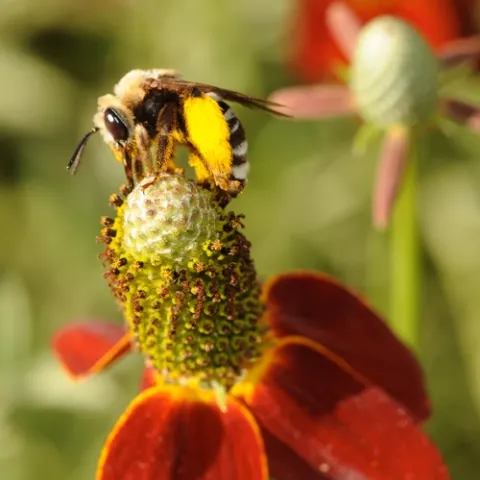
A HONEY BEE and a sweat bee share the same flower, a rock purslane. The sweat bee is probably Halictus tripartitus, according to native pollinator specialist Robbin Thorp, emeritus professor at UC Davis. (Photo by Kathy Keatley Garvey)
Bug Squad: Article

Two Bees, Two Sizes

November 5, 2009
When a sweat bee and a honey bee share the same flower, the size difference is quite distinct. We took this photo of a honey bee on a rock purslane (Calandrinia grandiflora) blossom.
View Article
Primary Image
GOLDEN ONE--A honey bee, a social insect, nectars lavender. From Nov. 5-11, Häagen-Dazs will donate $1 per Tweet (up to $500 a day) Nov. 5-11 for honey bee research at UC Davis through social networking on www.twitcause.com. (Photo by Kathy Keatley Garvey)
Bug Squad: Article

Helping Honey Bee Research

November 4, 2009
Bees buzz. People "Tweet." Well, many people do. It's generous of the Hagen-Dazs brand to donate $1 per Tweet (up to $500 per day) from Nov. 5 through Nov. 11 to support honey bee research at the University of California, Davis.
View Article
Primary Image
HOVER FLY lands on red buckwheat (Eriogonum grande rubescens) and sips nectar. (Photo by Kathy Keatley Garvey)
Bug Squad: Article

Seeing Red--On Buckwheat

November 3, 2009
Butterflies, honey bees and hover flies can't get enough of red buckwheat. Tight clusters of pink blossoms, coupled with gray-green foliage, grace red buckwheat (Eriogonum grande rubescens), a California native. It's good for the insects and good for the gardener. It's drought-tolerant.
View Article
Primary Image
NEW BROOCH--Nanase Nakanishi, a UC Davis student who plans to become a veterinarian, cares for this rose-haired tarantula at the Bohart Museum. It's one of the live insects in the museum, which houses more than seven million specimens. (Photo by Kathy Keatley Garvey)
Bug Squad: Article

Everything's Coming Up Roses

November 2, 2009
Everything's coming up roses at the Bohart Museum of Entomology on the UC Davis campus. Roses? Make that rose-haired tarantulas. See, the Bohart not only houses some seven million insect specimens in its quarters in 1124 Academic Surge, but they have a few live ones, too.
View Article
Primary Image
MALE--This is the male light brown apple moth, Epiphyas postvittana. (Photo courtesy of David Williams, principal scientist, Perennial Horticulture, Department of Primary Industries, Victoria, Australia.)
Bug Squad: Article

LBAM: What's the Status?

October 30, 2009
Remember the ravenous light brown apple moth (LBAM) and all the controversy? The invasive agricultural pest, from Down Under, soars high on the agenda at the Northern California Entomology Societys meeting on Thursday, Nov. 5 in Concord. Also on the agenda: honey bee regulatory research.
View Article
Primary Image
robertpageuc
Bug Squad: Article

It All Bee-Gan at UC Davis

October 29, 2009
The "honey bee reproductive ground plan" hypothesis that originated two decades ago at the University of California, Davis with bee geneticist Robert E Page Jr. (right) is drawing international attention.
View Article
Colusa County: Article

July 2008

October 29, 2009
Top-dressing, rice leafminer, armyworms...
View Article
Primary Image
THIS MALE green metallic sweat bee, Agapostemon texanus, is nectaring a Seaside daisy, the Erigeron glaucus Wayne Roderick. (Photo by Kathy Keatley Garvey)
Bug Squad: Article

Something Quite Magical

October 28, 2009
There's something so magical and captivating about the metallic green sweat bee. Shouldn't it be yellow? No. Is it a bee? Yes. Does it attract attention? Definitely.
View Article
Primary Image
CHEMICAL ECOLOGISTS Walter Leal (left), professor and former chair of the UC Davis Department of Entomology, and postdoctoral researcher Zain Syed, at work in the Walter Leal lab. (Photo by Kathy Keatley Garvey)
Bug Squad: Article

The SWAT Team

October 27, 2009
Chemical ecologist Walter Leal, professor and former chair of the UC Davis Department of Entomology, and his postdoctoral researcher Zain Syed have done it again. In August of 2008, they discovered the secret mode of the insect repellent, DEET.
View Article
Primary Image
SHARING A LAVENDER are an Italian bee (left) and a Carniolan bee, two races of the species Apis mellifera. (Photo by Kathy Keatley Garvey)
Bug Squad: Article

Racing for the Lavender

October 26, 2009
A bee is a bee is a bee? Poet Gertrude Stein ("a rose is a rose is a rose") could have said that. True, there's only one species of honey bee in the United States--Apis mellifera, the Western or European honey bee--but there are several races.
View Article