A Natural Solution for California's Herds: African Catfish Peptides

California's cattle producers and agricultural communities are all too familiar with the rising challenge of antibiotic resistance, making common bacterial infections harder to treat in livestock. But imagine a future where we could tackle these infections with a natural, powerful alternative. Our research points to just that: antimicrobial peptides (AMPs) found in African catfish.

We're really excited about these peptides because African catfish thrive in pathogen-rich freshwater, naturally producing these robust immune compounds in their skin mucus as a defense. This natural origin makes them highly appealing alternatives to synthetic drugs.

Predicted Safety and Potent Action

One of the most compelling aspects of these AMPs is their predicted safety for mammals. Our initial computer analyses suggest that various catfish AMPs are generally recognized as safe (GRAS). We predict they'll be absorbed in the human intestine without causing liver, brain, or heart toxicity. Furthermore, lab tests on a promising peptide, NACAP-II, confirmed it was non-hemolytic, meaning it didn't damage rabbit red blood cells—a strong indicator of its potential safety for mammalian cells.

Beyond safety, these peptides demonstrate effectiveness against problematic bacteria. One study revealed NACAP-II's strong activity against Extended-Spectrum Beta-Lactamase (ESBL)-producing Escherichia coli—a critical concern for both animal and human health due to its resistance to many common antibiotics. Another peptide, ACAP-IV, also showed antibacterial activity against E. coli and Staphylococcus aureus. We believe these AMPs work by directly disrupting bacterial cell membranes, a mechanism that makes it harder for bacteria to develop resistance compared to how they resist traditional antibiotics.

Primary Image
SWAMP SUNFLOWER (Helianthus angustifolius) graces the entrance to the Harry H. Laidlaw Jr. Honey Bee Research Facility at the University of California, Davis. (Photo by Kathy Keatley Garvey)
Bug Squad: Article

Bees Love This Late Bloomer

January 1, 2010
By Kathy Keatley Garvey
The swamp sunflower that graces the entrance to the Harry H. Laidlaw Jr. Honey Bee Research Facility, University of California, Davis, does quadruple duty. It's stunningly beautiful. It's strong and sturdy. It's a late bloomer. And the honey bees love it.
View Article
Primary Image
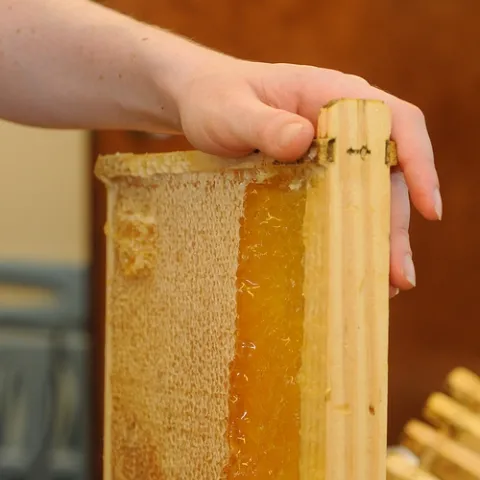
HONEY EXTRACTION at the Harry H. Laidlaw Jr. Honey Bee Research Facility, UC Davis. (Photo by Kathy Keatley Garvey)
Bug Squad: Article

A Taste of Honey

December 31, 2009
By Kathy Keatley Garvey
Honey! Say that at the American Honey Producers' Association (AHPA) convention Jan. 5-9 in Sacramento, and it's not a term of endearment. It's an occupation, a calling and a passion. This is their 41st annual convention and the talk is serious about the declining honey bee population.
View Article
Primary Image
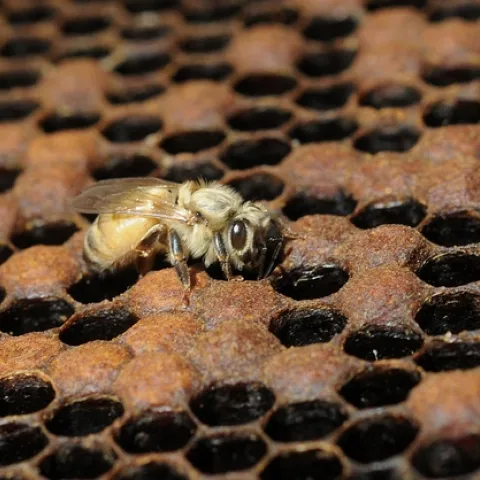
A NEWLY EMERGED BEE at the Harry H. Laidlaw Jr. Honey Bee Research Facility at the University of California, Davis. (Photo by Kathy Keatley Garvey)
Bug Squad: Article

A Victory for the Bees

December 30, 2009
By Kathy Keatley Garvey
It's being hailed by environmental groups as "a victory for the bees." A U.S. federal judge has ruled that the insecticide, spirotetramat, must be pulled from the shelves because it could be dangerously toxic to America's declining honey bee population. Starting Jan.
View Article
Primary Image
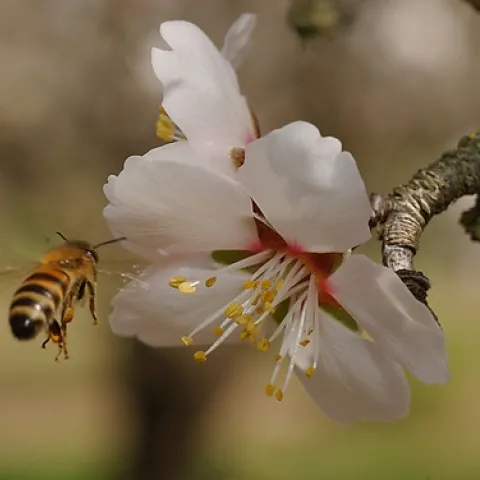
HONEY BEE makes a beeline to an almond blossom on the grounds of the Harry H. Laidlaw Jr. Honey Bee Research Facility at the University of California, Davis. California's annual almond pollination begins in February. (Photo by Kathy Keatley Garvey)
Bug Squad: Article

Waiting for the Almond Blossoms

December 30, 2009
By Kathy Keatley Garvey
Soon beekeepers from around the country will be trucking their bees to California for the annual almond pollination. California has some 700,000 acres of almonds, with each acre requiring two hives for pollination. But an article in the Dec.
View Article
Primary Image
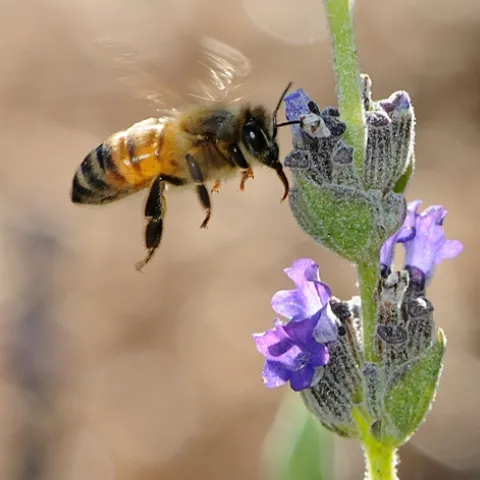
TONGUE EXTENDED in anticipation of nectar, a honey bee heads for lavender. Using the Pavlov dog method, bees can be trained to stick out their tongue, or proboscis, when they smell explosives. (Photo by Kathy Keatley Garvey)
Bug Squad: Article

Bomb-Sniffing Bees?

December 28, 2009
By Kathy Keatley Garvey
The attempt to down an airline over Detroit, Mich., on Christmas Day with a chemical explosive strapped inside a passenger's underwear may spur new interest in honey bees as bomb-sniffing detectives. It brings to mind scientist Robert Wingo's recent talk at UC Davis.
View Article
Primary Image
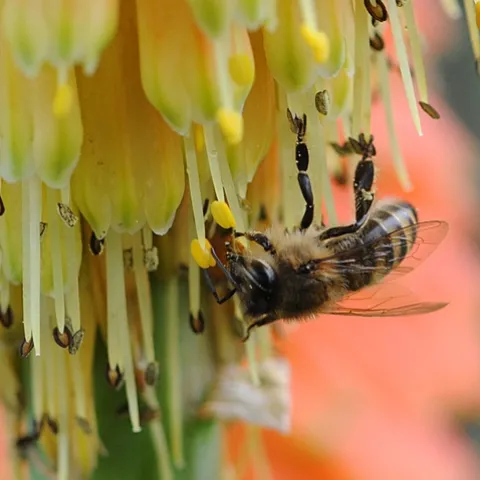
A SOLITARY HONEY BEE forages among the Christmas Cheer, also known as Knipofia "Christmas Cheer' or "red-hot poker." (Photo by Kathy Keatley Garvey)
Bug Squad: Article

Good Dose of Christmas Cheer

December 25, 2009
By Kathy Keatley Garvey
Definitely a good dose of Christmas Cheer! In the plant world, that would be the Kniphofia Christmas Cheer," also known as "red-hot poker." On a visit last week to the Storer Garden, UC Davis Arboretum, we encountered a lone honey bee foraging among the Christmas Cheer.
View Article
Primary Image
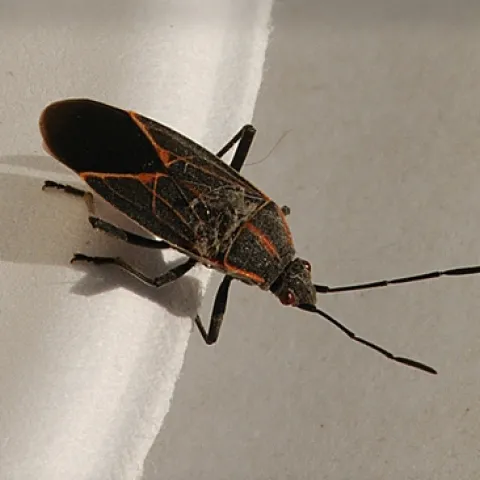
BOXELDER BUG likes to overwinter in homes and garages. (Photo by Kathy Keatley Garvey)
Bug Squad: Article

Not a Creature Was Stirring?

December 24, 2009
By Kathy Keatley Garvey
'Twas the night before Christmas When all through the house Not a creature was stirring Not even a mouse... --'Twas the Night Before Christmas by Clement Clarke Moore (1779-1863) No, but maybe a boxelder bug (Boisea trivittatus).
View Article
Primary Image
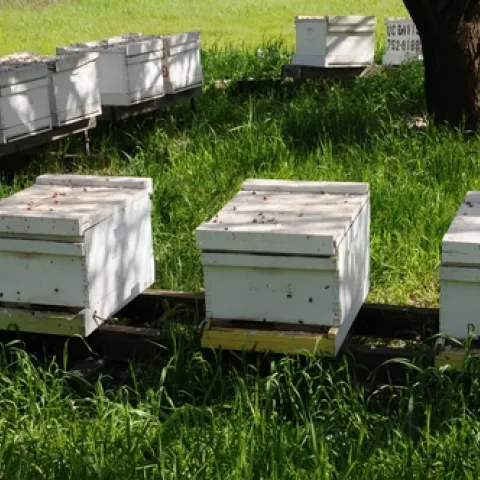
BEEKEEPING INDUSTRY is grateful to the Rev. Lorenzo Langstroth for inventing the moveable frame honey bee hive. These hives are at the Harry H. Laidlaw Jr. Honey Bee Research Facility at the University of California, Davis. (Photo by Kathy Keatley Garvey)
Bug Squad: Article

We Owe L. L. Langstroth

December 23, 2009
By Kathy Keatley Garvey
When the U.S. Postal Service Citizens' Stamp Advisory Committee meets in January 2010, let's hope the group supports the proposal for a Lorenzo Langstroth commemorative stamp. The Rev.
View Article
Primary Image
HONEY BEE cleaning her tongue was one of the images accepted in the international juried show, Insect Salon, affiliated with the Entomological Society of America. (Photo by Kathy Keatley Garvey)

Posing Prettily--and Not So Prettily

December 22, 2009
By Kathy Keatley Garvey
Every year the Entomological Society of America (ESA) invites its members and other interested persons to enter the Insect Salon juried photo competition. It's a highly competitive event, drawing photographs from around the world. The non-profit Peoria (Ill.) Camera Club coordinates it.
View Article
Primary Image
THIS SIGN at the entrance to the Harry H. Laidlaw Jr. Honey bee Research Facility is the work of Davis artist Donna Billick. The hole in the skep leads to a bee hive attached to the back of the sign. (Photo by Kathy Keatley Garvey)

Guarding the Turf

December 21, 2009
By Kathy Keatley Garvey
If you look closely at the colorful ceramic sign at the Harry H.Laidlaw Jr. Honey Bee Research Facility on Bee Biology Road, University of California, Davis, you'll see an entrance to a bee hive. Entrance? Right. There's a hole in the skep, which tunnels to a hive in back of the sign.
View Article