California's Conservation Agriculture Systems Innovation (CASI) Center, in partnership with Sustainable Conservation and the USDA Natural Resources Conservation Service, has prepared its survey of tillage management acreage for 2012.
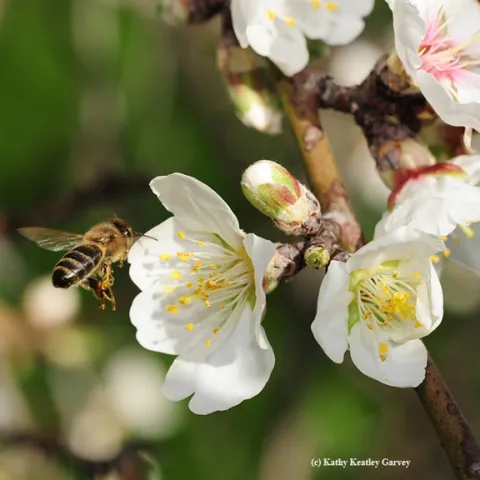
Give me an "A" (for excellence). Give me a "B" (for bee). Give me a "C" (for Cosmos). Watching honey bees collect nectar and pollen on the showy Cosmos (Cosmos bipannatus) is not to be missed.
Recent investigations conducted by UC's Conservation Agriculture Systems Innovation (CASI) Center shed light on opportunities farmers have for cutting production costs in their cropping systems by reducing tillage.
A series of satellite images from NASAs Terra satellite, which began capturing the images in 2000, has revealed the shocking decline of water levels in the Aral Sea. Terra satellite image, Aug. 15, 2001. (NASA)Terra satellite image, Aug. 19, 2004.
All students (grad, undergrad, recent graduates) interested in geospatial technology: the application for the NASA DEVELOP Program in Spring 2015 term opens this Monday, September 29th, and runs through November 7th.
Hide the cactus! There's a Mexican cactus fly in our midst. A large black fly hovers over a Mexican sunflower (Tithonia) in our bee garden and then drops down to sip some nectar. At first glance it looks like a carpenter bee but this one hovers like a syrphid fly, aka flower fly or hover fly.
This article was originally prepared for the CWSS Research Update and News (September 2014 edition). You can see it and several other articles at the CWSS website.
SRTM 3 Arc-Second (approx. 90m) SRTM 1 Arc-Second (approx. 30m) Landsat 7 December 17, 2000 Just in time for class on topography and rasters tomorrow: new high res shuttle DEM data is being released for Africa. The image above shows the Niger River Delta in 90m res, 30m res, and landsat.