
California's unique geology, topography (mountains and valleys) and climate create one of the most biologically diverse regions in the world. There are about 52 conifer species in California, 14 of which are endemic and only occur naturally within the State. Oaks woodlands cover 10 percent of the state, and in addition, are a key ecological component of conifer forests.
The forests we see are the product of the long legacy of use first by Native Americans, then settlers working with the environment to shape forests into the unique ecosystems we find today.
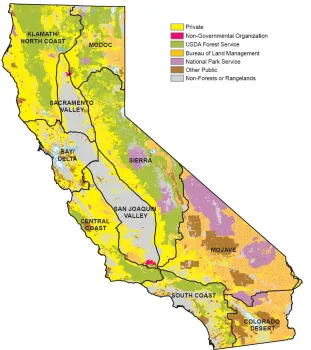
Approximately 33 million acres of forest in California are owned by different public and private entities.
- 58% (19 million acres) is owned by federal, state, and tribal agencies. This includes (but is not limited to) the USDA Forest Service, USDI Bureau of Land Management, National Park Service, tribes, and California Department of Forestry and Fire Protection (CALFIRE).
- 27% (9 million acres) is owned by famiy forest landowners. This 2006 US Forest Service publication on the Family Forest Owners of the United States summarizes the National Woodland Owner Survey of the estimated 10 million family forest owners who collectively own 35% of the nation's forest lands.
- 15% (5 million acres) is owned by industrial timber companies
Today, California forests face a number of threats
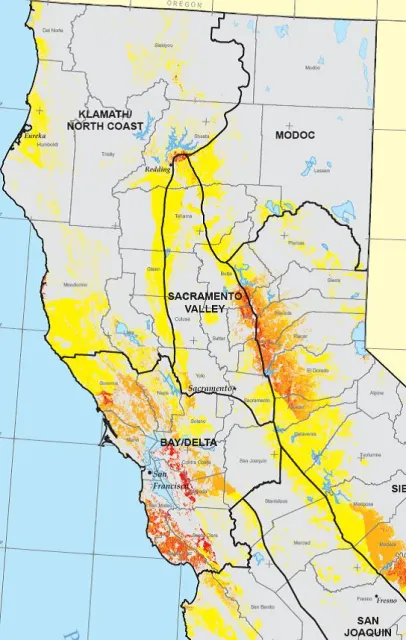
The greatest threat of forests today is driven by conversion to non-forests from large disturbance events and land use conversion to agricultural and residential land uses. While standing forest volume continues to increase on both private and public forest lands, we are witnessing a significant increase in the occurrence of large wildfires. At the same time, California’s forests are feeling the impacts of population growth. Urbanization, development and parcelization in rural areas are changing land use away from forests. CAL FIRE's 2010 Forest and Rangeland Program assessment found that blue oak woodland to be the habitat type in California with the most acres at risk from development.
Managing California's forests to withstand the threats of conversion and population growth requires partnerships between forest land owners, agencies, research institutions and the public. For example, strategies to address wood products infrastructure loss have often involved collaboration between all four.
A strategic goal of the University of California Division of Agriculture and Natural Resources is to help sustain the resilience of the forest ecosystems of California by working in partnership to provide research based information on forest ecosystems and growth, vegetation management, wildlife, plants, insects and disease, wildfire, streams, roads, climate and policies to help reduce these threats. We hope to help landowners improve their stewardship of forest lands and educate the public on management of public forests in California.
The California Department of Forestry and Fire Protection (CAL FIRE), Fire and Resource Assessment Program (FRAP) prepares periodic reports detailing the conditions in California's forest and range ecosystems and working landscapes. The Forests and Rangelands Assessment links together state requirements for natural resource inventories and strategies, and the federal government's desire to rely more heavily on these state programs in determining priorities for funding.
- California's Forests and Rangelands: 2017 Assessment – This assessment by CAL FIRE describes California’s forest and rangeland conditions and trends, and the priority landscapes in need of protection from climate change, wildfire, development, pests and diseases.
The USFS Pacific Southwest Region (R5) also frequently prepares evaluations of the status and trend of social, economic, and ecological conditions on the more than 20 million acres of public forests and grasslands across California. Monitoring efforts have results show that national forests in California have been weakened by chronic stress from climate change as well as climate-amplified disturbances like insect infestation, disease, and wildfire. Of note, effective 06/04/2025, many websites under the control of the USFS was placed under review and content may change or be unavailable. The results and data from these efforts may be found via interactive features such as dashboards and searchable maps.
- California's Forest Resources 2001-2010 – This report describes the status of California’s forest resources based upon Forest Inventory and Analysis (FIA) plots throughout the state. PNW-GTR-913 -USFS