
Vegetable Gardening - Handbook for Beginners
Chapter 2.1.
Soil structure
Garden soil provides plants with air, water, and mineral nutrients. Soil in good physical condition (good structure or tilth) can hold and provide plant roots with adequate quantities of nutrients, water, and air; it will drain well and be easy to work without becoming sticky when wet or crusted when dry.
Soil alkalinity and acidity is measured on a pH scale, with 7.0 being neutral, below 7 tending toward acidic, and above 7.0 tending toward alkaline. Though different plants prefer different pH levels, most vegetables prefer slightly acidic soils - in the range of 6.2-6.8 pH. Our soil in Northern California is neutral, ranging between 6 and 7pH1.
Soil texture
Soil texture is determined by the relative proportions of sand, silt, and clay mineral particles in a given soil. It is one of the most important physical properties affecting plant growth because it determines tilth, as well as nutrient and water-holding capacities. A sandy, coarse-textured soil is often called a light soil, whereas a clay or fine-textured soil is referred to as a heavy soil. These terms reflect the relative ease of working the two soil types.
Soil texture is a good indicator of the soil’s physical properties and behavior. With experience, the texture of a soil can be felt and determined simply by rubbing moist soil between thumb and forefinger and noticing its characteristics: how it ribbons, or is pushed out into a thin strip, how it hangs together, and how sticky, smooth, or gritty it is.
The feel method of examining a moist soil gives an approximate measure of particle-size. Coarse and fine sand particles have a marked to moderate gritty feel and do not form cohesive balls. Silt feels smooth when dry and silky (slippery) when wet. Clay soils are sticky and plastic (able to be molded) when wet and hard and compact when dry. Organic matter makes a soil feel smoother, as if it has a higher silt content. The twelve soil textural classes can be grouped into three general texture categories: coarse texture (sandy soils), medium texture (loamy soils), and fine texture (clay soils):
- Coarse (sandy soils): sand, loamy sand
- Medium (loamy soils – moderately coarse, medium, moderately fine)sandy loam, loam, silt loam, silt, clay loam, sandy clay loam, silky clay loam
- Fine (clay soils): clay, sandy clay, silty clay
Determining Soil Texture by the Feel Method
- Loamy sand, a coarse-textured soil: A cast will form when moist soil is squeezed in the hand. The cast cannot be handled without breaking; no ribbon can be formed.
- Loam, a medium-texture soil: A short ribbon can be formed with moist soil. The ribbon will split readily and will break away when about ½“ long. A moist cast of a loam soil will bear some handling.
- Clay loam, a medium-textured soil: A ribbon can be formed easily in moist soil. This ribbon is moderately strong, but will break away when it is ¾” long. A moist cast of a clay loam soil will bear moderately handling.
- Clay, a fine-textured soil: A strong ribbon can be formed in moist soil. The ribbon often will be more than one inch long. A moist cast will bear considerable handling.
Effect of Soil Texture on Plant Growth
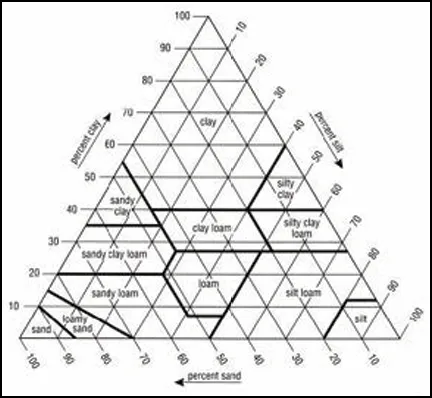
The coarser the soil texture is, the faster the soil warms up in the spring. A sandy soil may give the gardener a few days advantage in the planting date because of better soil temperature conditions for germination and early seedling growth.
Water-holding properties are determined largely by the distribution of particle sizes in the soil. Soils with finer texture (higher percentages of silt and clay) hold more water and nutrients than coarser-textured soils (higher percentages of sand). Sandy soils have rapid water infiltration and good aeration but low water-holding and nutrient storage capacities. Loam, sandy loam, and silt loam, which contain about 5-10% organic matter are said to be the best soils for home garden cultivation because they provide a mixture of sand, silt and clay that retains sufficient water but also permits infiltration and percolation.2
Trace Elements in Urban Soils
Trace elements occur naturally in all areas and soils of the world. Indeed, some are essential for humans, plants, and animals. We always ingest them to some extent in food and water, and we breathe them in the air. Their concentrations are naturally low and usually not hazardous in non-urban areas with little or no environmental disturbance and past or present human activity. However, any place subjected to human activity is likely to have trace elements at elevated levels in the environment, particularly in the soil. While there is generally no cause for alarm, in some cases, these trace elements may accumulate to a level where it would be advisable to take measures that ensure they will not pose a health risk.
Potentially harmful trace elements, especially heavy metals, can accumulate in the soil and on plants, and may pose a potential health risk to people who breathe or, especially, swallow contaminated soil or eat contaminated vegetables. Although plants always absorb trace elements to some extent, in nearly all instances the quantities they take up are too insignificant to cause alarm. The potential harm is from trace elements deposited on leafy vegetables from dust, splashing water, and the air or are in the soil and cling to root crops like carrots and beets. In these instances, thorough washing of vegetables usually eliminates them. Lead is perhaps the most prevalent and problematic trace element in urban gardens but others, such as cadmium and arsenic, are often present.
Testing Urban Soils Testing soils in urban gardens is always a good idea. Not only will it reveal which trace elements are present and their concentrations but also where they are located in the garden. An added benefit of testing the soil is the opportunity to gather information about basic nutrient levels at the site. Many companies offer soil-testing services. Sometimes university cooperative extension services can provide you with a list of soil testing companies. When collecting soil samples it is important to follow the instructions the soil testing company provides. It is a good idea to collect samples from several places at the garden site. For example, if individual gardening beds are 20 by 20 feet it would be appropriate to keep soil from each bed as a separate individual sample. However, several collections from different points in one bed could be mixed together to form a composite sample for that bed.
Testing Urban Soils
Testing soils in urban gardens is always a good idea. Not only will it reveal which trace elements are present and their concentrations but also where they are located in the garden. An added benefit of testing the soil is the opportunity to gather information about basic nutrient levels at the site. Many companies offer soil-testing services. Sometimes university cooperative extension services can provide you with a list of soil testing companies.
When collecting soil samples it is important to follow the instructions the soil testing company provides. It is a good idea to collect samples from several places at the garden site. For example, if individual gardening beds are 20 by 20 feet it would be appropriate to keep soil from each bed as a separate individual sample. However, several collections from different points in one bed could be mixed together to form a composite sample for that bed.
How to Eliminate or Reduce Exposure To Trace Elements
There is no cause for alarm if tests show that there are concentrations of trace elements above those levels that one would expect in urban soils. There are several procedures that can reduce or eliminate these elements or exposure to them so that they are not harmful.
- Thoroughly remove and properly dispose of refuse from urban garden sites before planting. Be especially vigilant for old painted wood, tires, galvanized metal, and batteries.
- Always wash hands thoroughly after working or playing in urban soils. Thorough hand washing is especially important for children who are more susceptible to trace elements.
- Consider using gloves, especially for children.
- Thoroughly wash all vegetables and fruits and peel root crops like beets, radishes, and carrots before eating. Discard older, outer leaves of leafy vegetables.
- Dilute pockets of higher than normal concentrations of trace elements by digging and spreading the soil over a large area in the garden or by adding additional, clean soil and thoroughly mixing it with the contaminated soil. It is generally not feasible to dig contaminated soil from the garden and dispose of it off site. Such soil would be considered toxic waste and strict rules and regulations govern its disposal.
- Since most potentially hazardous trace elements are found in the upper one to two inches of uncultivated or undisturbed soil, it is always a good idea to cultivate soil deeply, to at least eight inches deep if possible, before planting to dilute the contaminated soil with clean soil below.
- Locate plantings, especially leafy crops, as far away as practical from streets. As much as 75 feet would be good. Utilize barriers, such as walls, fences, and hedges, to help to block automobile exhaust and dust from coming into the site from streets and roads.
- Maintain soil pH near 7, or neutral, and ensure phosphate levels are adequate.
- Use large amounts of organic matter, like composts and humus, to amend the soil.
- Mulch with leaves, woodchips, hay, newspaper, or other material to reduce dust.
- Consider planting in raised beds or containers using uncontaminated soil.
- Consider having separate gardening shoes and clothes with long sleeves and pants, especially for children, which are not brought into the house.
- Locate child play sites in uncontaminated areas and/or cover the ground around play areas with an impermeable, artificial play surface, sand, or wood chips.3
Fertilizing
Vegetable crops primarily need nitrogen; they also need phosphorus and potassium. Many California soils are rich in available potassium. Phosphorus levels have been increasing due to the addition of fertilizers.4 It is best to test your soil before adding products containing these nutrients.5 Fertilizers come in either organic forms (i.e. manures, composts) or inorganic chemical forms. Often, a combination of the two forms is desirable and gives better results than either one used alone. Organic fertilizers usually provide a number of plant-essential mineral elements in low concentrations along with certain nonfertilizer compounds that aid in improving soil structure. If you use manure, apply it several weeks or even months before planting and work it well into the soil, allowing adequate time for decomposition and some of the salts to leach from the soil before seeding or transplanting. One pound of dry steer or dairy manure per square foot of soil surface is usually sufficient. If you use the more concentrated poultry manure, apply it more sparingly (1 pound to 4 or 5 square feet). Also, apply commercial nitrogen fertilizer to aid decomposition and avoid tying up soil nitrogen if you use manure that contains litter (straw, shavings, sawdust, or similar materials). Chemical fertilizers are available in a wide variety of compounds and concentrations. If you amend with manure or other organic materials, only inorganic nitrogen fertilizer will be needed. The most common and probably least expensive nitrogen fertilizer suitable for home garden use is ammonium sulfate. Limit application to 1/2 to 1 pound per 100 square feet of soil. If you do not amend with manure or other organic matter, it is usually wise to apply fertilizer that contains both nitrogen and phosphorus before planting, such as ammonium phosphate (16-20-0 or 11-48-0). Commonly used inorganic fertilizers containing potassium include 5-10-5, 5-10-10, 8-16-16, and 12-12-12. Apply 1 to 2 pounds per 100 square feet. Apply fertilizer before or at the time seeds or plants are planted and again when seedlings or plants have grown 3 or 4 inches. If no manure is applied, additional applications of nitrogen are often needed for crops growing longer than four months. Apply fertilizer by broadcasting it or by applying it as a narrow band buried along side of the plant or seed row. If broadcasted, work it into the soil immediately and water the area well. If banded, normal watering will dissolve the fertilizer toward the seed or plant row6.
The three most important nutrients in fertilizers are Nitrogen (N), Phosphorus (P), and Potassium (K):
| Nutrient | Purpose | Organic Sources | Inorganic Sources |
|---|---|---|---|
| Nitrogen | Promotes healthy leaves and stems; gives rich green color | Blood meal, Worm meal, Cottonseed meal, Manure, Bean and peas, Cover crops | Ammonium sulfate Ammonium nitrate Urea |
| Phosphorus | Promotes flower/fruit growth and seed formation, plus good stems and roots; necessary for photosynthesis | Bone Meal | Single super phosphate |
| Potassium | Promotes flower/fruit growth and quality, plus good stems and roots; overall plant health | Sulfate of Potash Magnesia (Sul-Po-Mag) Greensand | Potassium sulfate |
Use of mulch
Sulfate of Potash Magnesia (Sul-Po-Mag) Greensand Potassium sulfate Most plants, but particularly vegetables, grow best in well-drained soil. A 2 - 4” layer of compost or manure mixed in to a depth of at least 10” will help achieve this. A 3 - 4” layer of mulch or organic matter covering the garden surface throughout the year enables optimum plant and root growth by:
- reducing crusting and cracking of the soil surface
- holding in moisture
- encouraging earthworms, moderating soil temperatures for optimum root growth, improving the soil as it decomposes
- preventing weeds from germinating
Organic mulches, which include compost, wood chips, grass clippings, rice hulls, bark, straw, sawdust, leaves, and other similar materials, reduce moisture loss. In addition to their value for moisture conservation, they can be tilled into the soil after cropping to improve the organic content. Organic mulches are also helpful in controlling weeds7.
Natural inorganic mulches include sand, gravel, and pebbles. They do not provide organic matter for soil, but do conserve moisture. If using a rock mulch, consider placing a landscape fabric underneath to create a layer between the mulch and the soil and prevent rock pieces from sinking into the soil. Black plastic has been used to improve weed control, but it restricts air and water movement. Synthetic mulches, which are manufactured materials that are called geotextile or landscape fabrics, have been developed to replace black plastic in the landscape. Geotextiles are porous and allow water and air to pass through them, overcoming the major disadvantage of black plastic.
Mulch decreases evaporation from the soil by 70% or more; allowing you to water less often. Keep mulch several inches away from tree trunks and plant stems to enable good air circulation. Water well before applying mulch, or you will insulate dry soil rather than moist soil. Let grass clippings dry out a bit before piling them (or just spread them thinly), or they will clump into a mat that stinks and is impervious to later watering.
Footnotes
- Fabrice DeClerck, Michael J Singer, UC Davis. California Agriculture 57(2):39. DOI: 10.3733/ ca.v057n02p39. April-June 2003.
- Fabrice DeClerck, Michael J Singer, UC Davis. California Agriculture 57(2):39. DOI: 10.3733/ ca.v057n02p39. April-June 2003.
- Hodel, Donald R., and Andrew C. Chang, Trace Elements and Urban Gardens, University of California Cooperative Extension: Los Angeles 2007.
- Fabrice DeClerck, Michael J Singer, UC Davis. California Agriculture 57(2):40. DOI: 10.3733/ca.v057n02p40. April-June 2003
- Soil Tests: https://ucanr.edu/program/uc-small-farms-network/soil-tests
- Pittenger, Dennis R. Soil and Water Management for Vegetable Gardens. Riverside, California: University of California Coopera tive Extension, 2003.
- Mulches / Home and Landscape / UC Statewide IPM Program (UC IPM)
Previous ← Chapters → Next or Return to the Table of Contents of this Handbook.