

Research Brief • March 2025 • Download PDF (202 KB)
Background
In March 2023, an online survey gathered insights from Colorado foodservice directors (FSDs) about their experiences implementing school meals during the 2022-23 school year (SY) after the federal waivers allowing school meals to be served free of charge to all students ended. A total of 41 FSDs and other foodservice personnel responded to the survey, representing 22% of Colorado school districts.
Characteristic | % of Sample |
Foodservice Directors | 78% |
Other School Nutrition Personnel | 22% |
Urban or Suburban | 39% |
Small Enrollment Size (<2,500 students) | 56% |
No CEP or Provisions 1 or 2 | 60% |
40% or more students eligible for Free or Reduced-Price Meals | 58% |
Key Findings
The end of the federal waivers allowing meals to be served free of charge to all students was associated with negative impacts on meal participation, finances, and operations
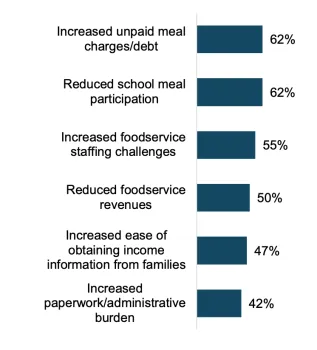
Over half of FSDs reported a rise in unpaid meal charges (62%), reduced meal participation (62%), and increased staffing challenges (55%), while half reported reduced food service revenues (50%). Many also reported an ease of obtaining income information from families (47%) and increased administrative burden (42%) (Figure 1).
Income verification posed challenges, with fewer families returning meal applications
All the FSDs reported using direct certification for determining eligibility for free or reduced-price meals. Among the FSDs that reported using traditional meal applications (92%), the mean return rates were estimated at around half (54%). Those using alternative income forms (39%) reported even lower return rates at 33%. Most districts (69%) reported offering online application options to streamline the process, and 51% reported lower return rates compared to pre-pandemic levels.
Multiple factors helped support Colorado FSDs during the SY 2022-23
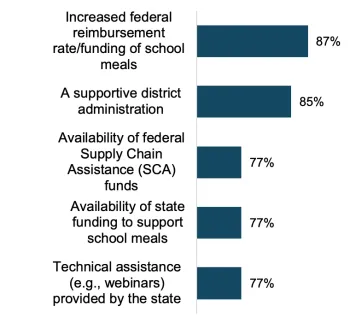
The top factors that helped support SFAs include increased federal reimbursement rates (87%), support from district administration (85%), federal Supply Chain Assistance Funds (77%), state funding (77%), and state technical assistance (77%) (Figure 2).
FSDs faced many challenges in implementing school meal programs in the SY 2022-23
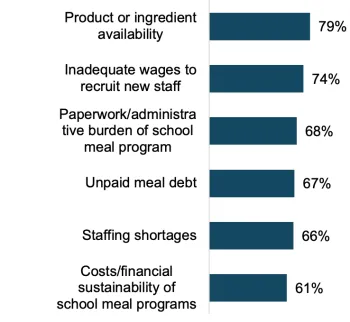
Operational challenges also existed, with 79% struggling with product availability, 74% with inadequate wages, and 69% with administrative burden. Other challenges included unpaid meal debt (67%), staffing shortages (66%), and financial sustainability issues (61%) (Figure 3).
FSDs reported some challenges with cafeteria operations
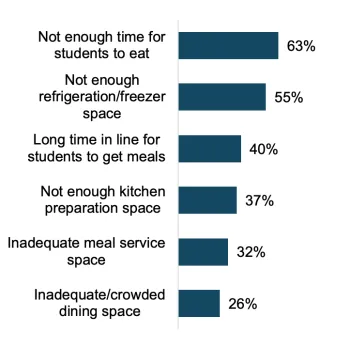
Over half of SFAs reported challenges with inadequate time-to-eat for students (63%) and refrigeration or freezer space (55%) (Figure 4). Other challenges in the cafeteria included long lines for students to get the food (40%) and inadequate spaces for kitchen preparation (37%) and meal service (32%).
FSDs reported concerns about the financial sustainability of school meal programs.
Only about a quarter of respondents reported that current reimbursements covered the full cost of producing breakfast (26%) and lunch (24%). Suggested reimbursement rates to meet federal standards were $3.16 for breakfast and $4.53 for lunch. To consistently include fresh, local produce, the suggested rates were higher: $3.50 for breakfast and $4.89 for lunch.
The maximum federal reimbursements for free breakfast and free lunch at the time were $2.67 and $4.58, respectively.
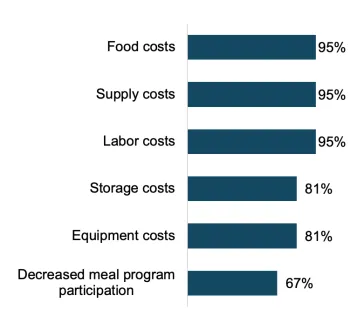
FSDs who reported that the current reimbursement wasn’t enough to cover the costs of producing the meals identified the factors impacting their financial deficit
Almost all SFAs (95%) reported that the costs of food, supplies, and labor impacted their revenues (Figure 5). Most SFAs also reported storage (81%) and equipment costs (81%), as well as decreased student participation in meal programs (67%), as factors impacting their revenues.
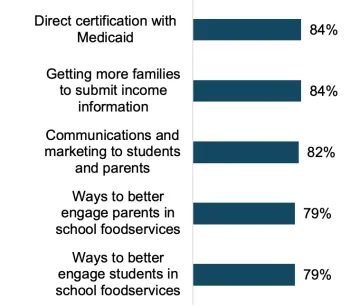
FSDs identified additional technical assistance and training that could benefit their SFA
Most SFAs reported needing help with direct certification (84%), getting more families to submit income information (84%), communicating with students and parents (82%), and finding ways to better engage students and parents in school foodservices (79%) (Figure 6).
Colorado FSDs reported perceived barriers to student participation in school meals
Top barriers include students preferring meals from home (68%) or skipping meals (51%). Almost half (46%) of FSDs reported students getting tired of the options, finding portions insufficient, and not having enough time to eat as additional barriers to student participation.
Conclusion
The 2022-23 FSD survey highlighted significant impacts and challenges faced by Colorado schools in the post-pandemic era. The transition away from federal waivers allowing school meals to be served free of charge to all students negatively affected meal participation, school foodservice financial stability, and operational procedures. Effective communication and support from federal and state programs have helped maintain effective school meal programs. The findings emphasize the need for continued financial support and operational adjustments to ensure the success of school meal programs in Colorado.
Acknowledgements: The Nutrition Policy Institute, University of California Division of Agriculture and Natural Resources, is funded to conduct an evaluation of California’s Universal School Meals through CA SB 170 (2021), CA SB 154 (2022), and CA SB 101 (2023). We thank the school nutrition personnel who took the time to respond to the survey. For more information, visit NPI's School Meals for All website.
Suggested Citation: Zuercher M, Esparza E, Ritchie L, Gosliner W. Research Brief: Colorado Food Service Director Survey Findings: Experiences transitioning from meals free of charge for all students. Nutrition Policy Institute, University of California, Agriculture and Natural Resources. 3 March 2025.
University of California Agriculture and Natural Resources is an equal opportunity employer.
© 2025 UC Regents, Creative Commons 4.0 International License.
