

Research Opportunities at HREC
Background
With a land resource exceeding 5,300 acres that is rich in biological and physical diversity, and therefore typical of many environments within California’s Coast Range, HREC has been a significantly productive research site for nearly seventy years. Several areas of research that have received emphasis include the following: sheep biology and management; range improvement, particularly emphasizing vegetation management and soil fertility; wildlife science, with particular attention to Columbian black-tailed deer and to coyotes; and entomology, parasitology, and disease, with emphasis on species of public health and veterinary significance.
For example, approximately 14 tick-borne microbial agents have been detected in or isolated from wildlife or ticks at Hopland. Of these, 7 are proven or suspected causative agents of human or livestock diseases. These include the micro-organisms that cause Lyme disease, tularemia, Rocky Mountain spotted fever, ehrlichiosis, and Q-fever as well as a Colorado tick fever-like virus.
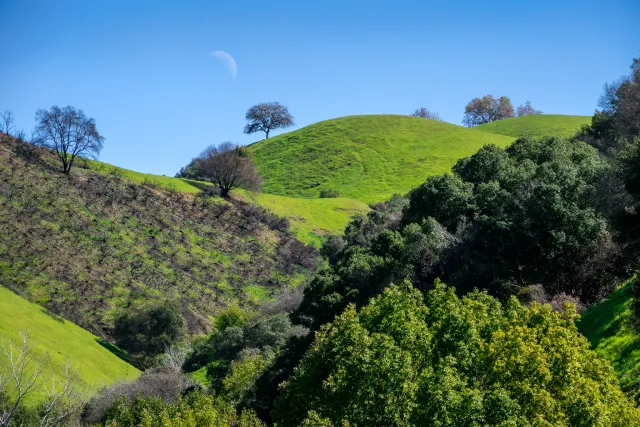
At HREC, many studies have been interdisciplinary in nature, resulting from a team effort of scientists and managers with diverse specializations. Watershed studies initiated in 1955, for example, have had components and cooperators that include studies of geology, hydrology, agronomy, range science, plant ecology, and plant physiology. A similar mix of disciplines came together to undertake brush management studies at Hopland, also beginning in the mid-1950s. The information compiled through such studies not only soon provided a basis for revised management recommendations, but it also contributed to basic knowledge about physical and biological processes.
In the past couple decades, much of the Center’s research mirrors society’s realization that sustainable management of agricultural systems and of natural resources is critical to assure the continued health of California’s environment and its people, especially in the face of mounting pressures from a changing climate.
Research and Wildlife
The Center's property supports more than 215 species of wild birds, 50 mammals, 15 reptiles, 12 amphibians, and 10 fish. The Center's Columbian black-tailed deer (Odocoileus hemionus columbianus) are one of the most intensively studied deer populations on the West Coast. Other species that have received significant research attention include meadow voles (Microtus californicus), deer mice (Peromyscus maniculatus), and coyotes (Canis latrans). The study of ranching alongside predators such as coyotes has been an important area of focus. In addition, insect and other arthropods of medical and veterinary importance have been a main focus of field studies, with particular emphasis on mosquitoes and ticks and their epidemiological roles.
The Center maintains a research sheep flock of around 340 breeding ewes that graze the majority of the Center's rangelands. Lambing generally occurs between November and February, and shearing takes place in April. Many of the Center's sheep are involved in animal science or veterinary research projects.
Techniques developed at HREC for managing North Coast rangelands by the introduction of subterranean clover and fertilization with essential nutrients have significantly increased forage productivity and quality. Other research has included plant response to grazing, fire, and other management strategies. The role of native hardwoods, especially oaks, has received recent attention, with emphasis on sustainable management of valley oak (Quercus lobata) and blue oak (Quercus douglasii) stands. Plantings of wine grapes and pears provided opportunities for closely monitored variety trials, studies of plant productivity, and development of strategies for controlling insect pests and plant diseases.
Advantages to doing research at HREC
The Hopland Research & Extension Center (HREC) provides research project access to 5,358 acres of Northern California Coast Range landscape which, unlike the UC Natural Reserve System, can be manipulated to provide field conditions matching research needs. This setting provides a rich, diversified opportunity for natural resources and agricultural research and extension programs, especially on topics pertinent to oak woodlands and rangelands of the central and northern coast of California.
Among the highlights of HREC are:
- A wide variety of elevations from 600’ to 3000’ with four principle vegetation types (grass, woodland-grass, dense woodland, and chaparral) interspersed with riparian corridors around natural springs and ponds and seasonal vernal pools. HREC also has 25 acres of irrigated pasture.
- A rich flora and fauna including more than 600 plant and 300 animal species. HREC also has one of the most intensively studied resident herds of Columbian black-tailed deer on the West Coast.
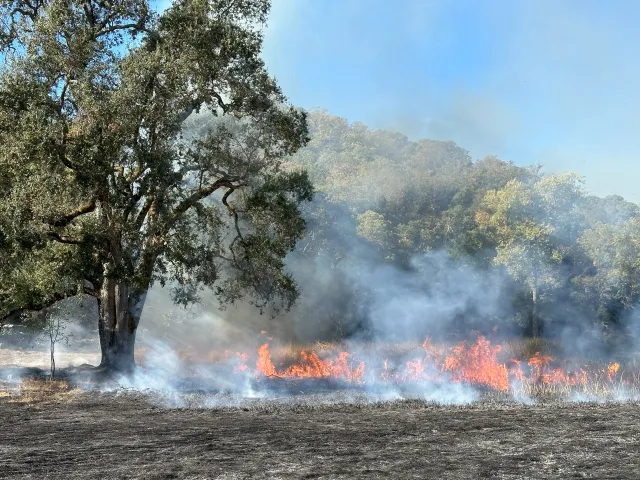
- A variety of land management regimes across a mosaic of pastures, from heavily grazed by our sheep flock to biological reserves not grazed since the 1950s, from areas which have not seen fire in decades to a wide swath burned by wildfire in July/August of 2018.
- A staff skilled in a wide variety of agricultural techniques and methods, from animal husbandry and wildlife management to irrigation and equipment fabrication, all available to assist with project tasks.
- A rich vault of previous research to reference for past data, particularly in the fields of plant and animal science, ecology, hydrology, entomology, fire science, and natural resource management.
- An extensive, well maintained road network which provides easy access to most of the Center lands.
- A conference hall for larger group events, a field lab, a newly renovated lab, a greenhouse, a large lysimeter, fully equipped shops for fabricating or repairing equipment, a fleet of vehicles and agricultural equipment to use on Center, and various warehouses available for equipment and sample storage.
- Accommodations for longer visits, ranging from dormitory style bunkhouse to private houses. We also have fiber optic speed internet and wifi service throughout our headquarters area.
Click here to view research rates.
Click here to submit your proposal.