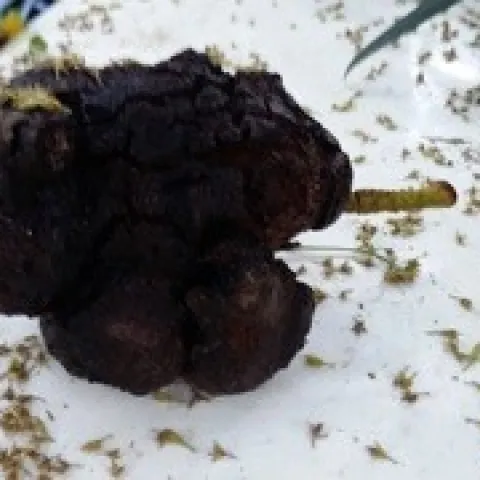
The first email has come in. Every winter when it rains, we get calls about these weird gelatinous blobs in orchards and garden beds. They can look like vomit, be yellow, green, red, or blue colors and they can actually move.
If you're looking for a holiday gift for your favorite beekeeper or a wanna-be beekeeper (hey, that person could be you!), here's something you may want to consider. Bee scientists at the Harry H. Laidlaw Jr.
The avocado is an amazing fruit. It grows on a tree and comes to maturity, reaches certain oil content and a stage at which it will ripen, but it does not ripen on the tree. It needs to be removed from the tree before it will soften.
They're still there. They. Haven't. Moved. The monarch butterflies roosting in an ash tree at the 14th disc golf course hole at the Berkeley Aquatic Park, 80 Bolivar Drive, Berkeley, seem to like it there. They've been there since mid-November. We drove to the park on Monday, Nov.
The University of California, Division of Agriculture and Natural Resources (UC ANR), Informatics and Geographic Information Systems (IGIS) Program is seeking a Statewide Program Coordinator for both local and statewide program development and delivery.
"Keep Calm and Insect On." That's the theme of the Bohart Museum of Entomology open house from 1 to 4 p.m. on Saturday, Dec. 5 in Room 1124 of the Academic Surge Building on Crocker Lane, University of California, Davis.
The roof rat (Rattus rattus), sometimes called the black rat, is a common vertebrate pest in citrus, avocado and other yummy tree orchards. It builds leaf and twig nests in fruit trees or nearby trees, or it can nest in debris piles or thick mulch on the ground.
Quick question: What critter can chew and digest Styrofoam? Drum roll...Time's up... If you answered "mealworms"--or the larval form of the darkling beetle, family Tenebrionidae--that's correct.
Western tarnished plant bug (Lygus hesperus), which is generally referred to as lygus bug, is a major pest of strawberries on the California Central Coast. Lygus bug feeding on developing berries causes fruit deformity.