

The latest cost of production study done on oranges came out recently. http://coststudyfiles.ucdavis.edu/uploads/cs_public/19/d4/19d4f1bb-408a-443e-a759-36fd53a2948f/oranges_vs_2015.
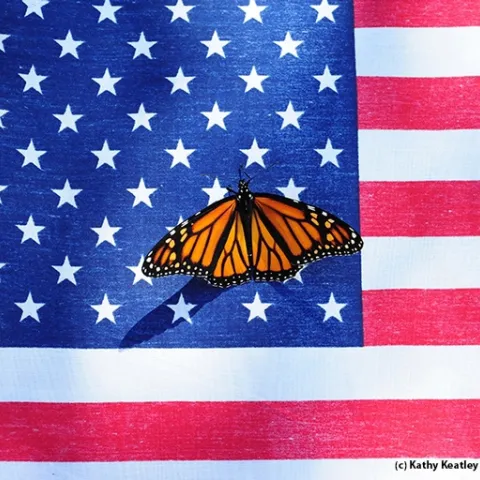
If you missed it, you should to listen to what longtime butterfly researcher Art Shapiro, distinguished professor of evolution and ecology at the University of California, Davis, says about California's monarch butterfly population.
There are something like 1,000 named varieties of avocado. Big, small, green, black, purple, round, pear-shaped, winter, summer, fall harvest, anise smelling leaves, all kinds of distinguishing features.
Cornell University evolutionary ecologist Anurag Agrawal, who received his doctorate in population biology at the University of California, Davis in 1999 under the tutelage of major professor Richard Rick Karban, is making the news with his groundbreaking research on milkweed toxicity.
Wireworms are the soil-dwelling larvae of click beetles. They feed on the seeds and roots of various crops and are a particular pest of field corn in the Sacramento-San Joaquin River Delta region (Figure 1).
That's a honey of a theme! When the 141st annual Dixon May Fair opens May 5-8, 2016 at 655 S 1st St.,Dixon, the grounds will be buzzing, in keeping with the theme, "Buzzing with Excitement." The fair is putting the "buzz" in bees and the bees in "buzz.
In summer 2015, USDA-ARS and UC Davis Dept of Plant Sciences set up a water hyacinth control study with California Department of Boating & Waterways. The goal of the study was to determine the best of several different surfactants to pair with an aquatic-use formulation of glyphosate.
To help Ventura County's citrus community better understand the nature of the ACP epidemic and the bitter lessons from Florida's failure to address it proactively Farm Bureau and the ACP-HLB Task Force will host a workshop on Dec. 2.
It's out. The newly published edition of The Hive and the Honey Bee edited by American Bee Journal editor Joe Graham, is now a reality. This is the bible of the beekeeping world, and rightfully so.
In early September 2015, the California Department of Food & Agriculture confirmed the presence of thousand cankers disease of walnut in Napa County. Access the newsletter below for additional information on this fungal disease and the beetle that moves it from tree to tree.