Project Board Help

Test PB Collection: FTE

Test dynamic

Primary Image
Presentation1
UC Rice Blog: Article

Crop Progress

August 15, 2011
By Luis Espino
Released August 15, 2011, by the National Agricultural Statistics Service (NASS), Agricultural Statistics Board, United States Department of Agriculture (USDA).
View Article
Primary Image
Hole in one--a hole signifying the emergence of a leafcutting bee (Megachile). (Photo by Kathy Keatley Garvey)
Bug Squad: Article

Hole in One

August 12, 2011
By Kathy Keatley Garvey
First you give them roots, then you give them wings. That's what's happening in our bee condo, a wooden block (nest) with drilled holes for leafcutting bees (Megachile). They flew in, laid their eggs, provisioned the nests with pollen and leaf fragments, and capped the holes. We had 11 tenants.
View Article
Primary Image
IMG 3194
UC Rice Blog: Article

Armyworms

August 12, 2011
By Luis Espino
I've been receiving reports of high armyworm populations this summer. You can always find some armyworms in rice fields, but I have rarely seen fields that needed a treatment due to armyworm injury. Defoliation caused by armyworms is not uncommon.
View Article
Primary Image
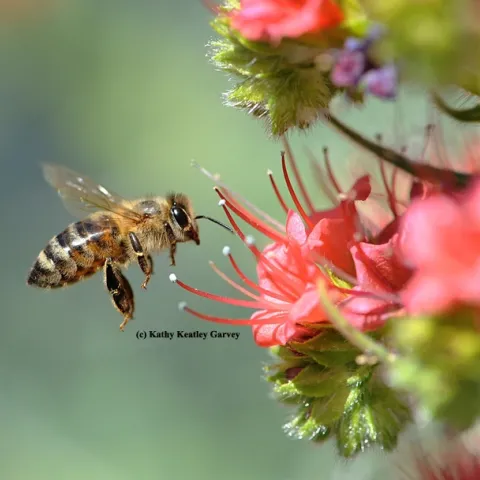
Honey bee on gallardia. (Photo by Kathy Keatley Garvey)

The Places to 'Bee'

August 11, 2011
By Kathy Keatley Garvey
The places to "bee" for beekeepers in September and November are the Big Island of Hawaii and the not-so-little-city of Rohnert Park, Calif. The Western Apicultural Society, founded by UC Davis scientists in 1978, has scheduled its annual conference for Sept.
View Article
Primary Image
Blue damselfy resting on nectarine leaf. (Photo by Kathy Keatley Garvey)
Bug Squad: Article

Up Close and Personal

August 10, 2011
By Kathy Keatley Garvey
Up close and personal, those blue damselflies (suborder Zygoptera, order Odonata) look prehistoric. Fact is, they were here before the dinosaurs. These needlelike insects add an iridescent presence as they fly awkwardy over our fish pond, catching prey.
View Article
Primary Image
Beekeeper John Miller (right, with yellow gloves and smoker) tending his hives. Copyrighted photo, 2010, by Melody Owen, used with permission.
Bug Squad: Article

The Beekeeper's Lament

August 9, 2011
By Kathy Keatley Garvey
The Beekeeper's Lament: How One Man and Half a Billion Honey Bees Help Feed America should be required reading for anyone interested in honey bees, crop pollination and migratory beekeepers. Award-winning journalist Hannah Nordhaus tells the story of migratory beekeeper John Miller of Gackle, N.D.
View Article
UC Weed Science (weed control, management, ecology, and minutia): Article

Development of a More Accurate Weed Risk Assessment Model for Potential Third Party Certification of Non-Invasive Horticultural Plants

August 9, 2011
By Joseph DiTomaso
The nursery industry has introduced thousands of ornamental plants, but only a small percentage (~1%) has escaped to become invasive and cause economic or ecological damage. Thus, the removal of these known invasives should not present a major economic hardship on the industry.
View Article
Primary Image
Honey bee on purple coneflower. (Photo by Kathy Keatley Garvey)
Bug Squad: Article

Nothin' Like a Cone

August 8, 2011
By Kathy Keatley Garvey
There's nothing quite like a cone--no, not an ice cream cone. A purple coneflower. The purple coneflower (Echinacea purpurea, family Asteraceae), looks like royalty in the Hagen-Dazs Honey Bee Haven at the University of California, Davis.
View Article
Primary Image
Rice headed
UC Rice Blog: Article

Crop Progress

August 8, 2011
By Luis Espino
Released August 8, 2011, by the National Agricultural Statistics Service (NASS), Agricultural Statistics Board, United States Department of Agriculture (USDA).
View Article