Project Board Help

Test PB Collection: FTE

Test dynamic

Primary Image
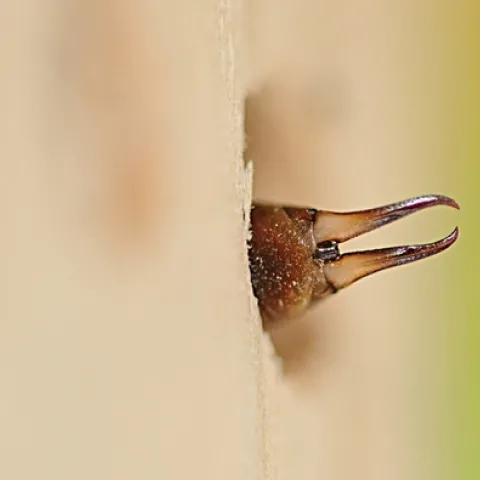
The antenna of a honey bee pokes out of an abandoned hive. Colony collapse disorder? Perhaps. (Photo by Kathy Keatley Garvey)
Bug Squad: Article

A Sad Photo

October 29, 2008
It's a sad photo. The antenna of a honey bee pokes out of an abandoned hive. Victim of colony collapse disorder (CCD)? Perhaps. Everytime I look at the bent antenna, I think of a plea for help. Help me! Help me! Please help me! This bee should have been nectaring flowers or gathering pollen.
View Article
Primary Image
NEW HEADGEAR--Eric San Gregorio, an undergraduate student majoring in entomology at UC Davis, has new headgear: a Giant New Guinea Walking Stick. (Photo by Kathy Keatley Garvey)

New Headgear

October 28, 2008
Lynn Kimsey, director of the Bohart Museum of Entomology and chair of the UC Davis Department of Entomology, said it best. "Headgear." The "headgear" was actually a Giant New Guinea Walking Stick crawling up the face of Eric San Gregorio, an undergraduate student majoring in entomology at UC Davis.
View Article
Primary Image
HOVERING--A hover fly hovers over a rock purslane (Calandrinia grandiflora). Photo by Kathy Keatley Garvey)

Hovering

October 27, 2008
Hover flies do know how to hover. Like a helicopter with spinning blades, the hover fly lingers seemingly motionless in mid-air over a flower before zeroing down to feed on the nectar. Sometimes theyre called flower flies. Sometimes syprhids.
View Article
Primary Image
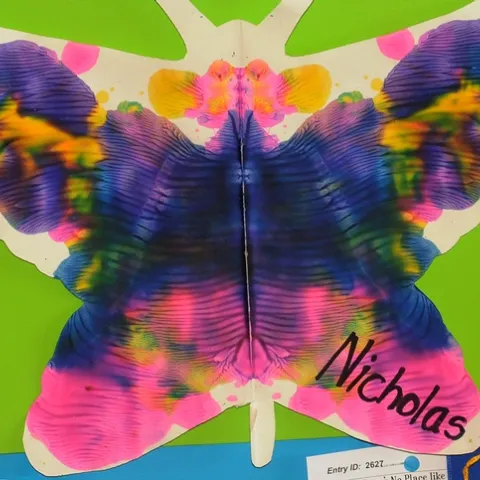
SOMETHING BUGGY HERE: These jack o'lanterns cast an eerie glow: a butterfly, honey bee and a dragonfly. (Photo by Kathy Keatley Garvey)

Light My Fire

October 24, 2008
There they sat, a row of jack o'lanterns ready for a light. Undergraduate students at the University of California, Davis, created them for the "Happy Halloween" open house, held Oct. 23 at the Bohart Museum of Entomology, 1124 Academic Surge, UC Davis.
View Article
Primary Image
THE BAD--This is the light brown apple moth, a male. The CDFA's William Roltsch will discuss "Biocontrol of Light Brown Apple Moth, a Quarantine Pest in California” at the Northern California Entomology Society meeting on Nov. 6 in Concord. (Photo courtesy of David Williams, principal scientist, Perennial Horticulture, Department of Primary Industries, Victoria, Australia.)

The Good, The Bad and the Ugly

October 23, 2008
If you're interested in insects--the good, the bad and the ugly--don't miss the Northern California Entomology Society meeting on Thursday, Nov. 6 in Contra Costa County. You don't have to be a member.
View Article
Primary Image
A yellow ladybug on sage. The ladybug (ladybird beetle) is a beneficial insect. (Photo by Kathy Keatley Garvey)

Seeing Spots

October 22, 2008
If it looks like a duck, swims like a duck and quacks like a duck, then it probably is a duck. That inductive reasoning (known as "the duck test") doesn't hold true for yellow bugs with black spots. A yellow ladybug (ladybird beetle) and a cucumber beetle look a little alike--at first glance.
View Article
Primary Image
This is a pitcher plant, Sarracenia leucophylla. It's carnivorous. The tubular leaf (left) is spent. The other two are ready to trap insects. (Photo by Kathy Keatley Garvey)

Dracula in the Garden

October 21, 2008
The red-pigmented white pitcher plant we purchased at the UC Davis Arboretum Plant Faire looks like a flamboyant coral reef. Like a hat askew, its ruffled lid hangs over the trumpet-shaped pitcher. The pitcher is actually a long, hollow tubular leaf. But looks are deceiving.
View Article
Primary Image
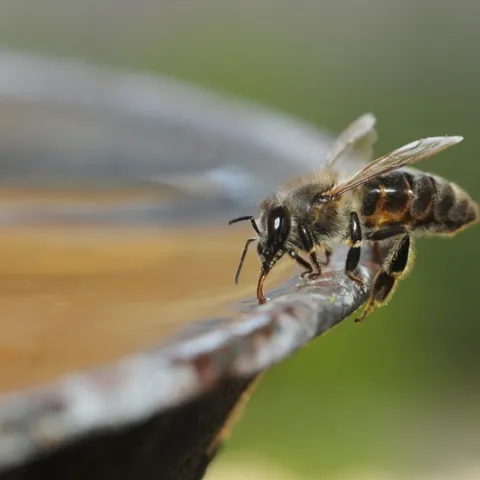
A honey bee visiting a Russian sage seems to be wearing a new hat. (Photo by Kathy Keatley Garvey)

Peek-a-Bee

October 20, 2008
Pull up a lawn chair and watch the honey bees. They're buzzing around the Russian sage, gathering nectar. So focused are they that they don't seeem to mind the photographer sharing their space. So dedicated. So committed. So industrious. Wait, a honey bee is wearing a new hat.
View Article
Primary Image
Squeeze this stress ball and out will pop either assorted bugs, worms, frogs or rats. Nanase Nakanishi, a UC Davis student majoring in animal science, and an employee at the Bohart Museum of Entomology, displays what it does. (Photo by Kathy Keatley Garvey)

Your Main Squeeze

October 17, 2008
Cmon, you know you want one. Who wouldnt want a horror skull stress ball to relieve the tension of today's world? Here's what you do. Take one stress ball. Place it in the palm of your hand and squeeze. From the eyeball socket pops out a membrane of assorted bugs.
View Article