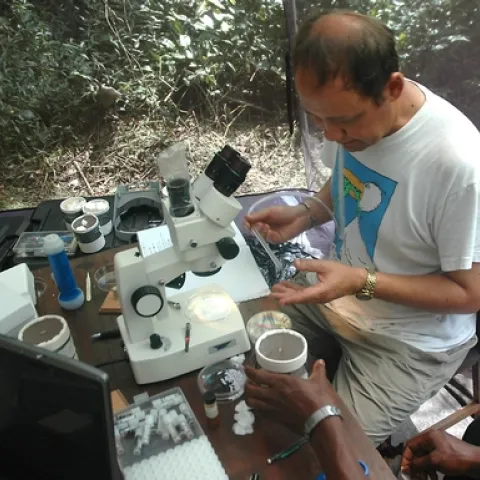
On November 9, weed biology and management information will be presented at the Salinas Valley Weed School 2010 (contact: Richard Smith). For more information check the calendar section at the UC Cooperative ExtensionMonterey County website. http://cemonterey.ucdavis.
*This was an article that Doug Munier and I put together and tweaked for a couple orchard crop newsletters in summer/fall 2010. I thought I'd repost it here for posterity...
Up close, the katydid looks as ferocious as a scary Halloween trick-or-treater. Its stance is firm. Its eyes glow menacingly. Its attitude: "Don't mess with me." We spotted this katydid on a rose in a UC Davis rose garden.
A gigantic bee sculpture and bee hive columns are major attractions at the Hagen-Dazs Honey Bee Haven at the Harry H. Laidlaw Jr. Honey Bee Research Facility at the University of the California, Davis. The grand opening of the half-acre bee friendly garden took place Sept.
There's a magnificent purple aster blooming in the bee yard at the Harry H. Laidlaw Jr. Honey Bee Research Facility, University of California, Davis. The aster, a late-bloomer, makes for a picture-perfect apiary scene...white bee boxes in the background...purple aster in the foreground...
Frank Lessiter, editor of No-till Farmer, announced that the magazine is seeking nominations for the third class of no-tillers to be named "Responsible Nutrient Management Practitioners." Winners will be honored at the 19th annual National No-Tillage Conference in Cincinnati, Ohio.
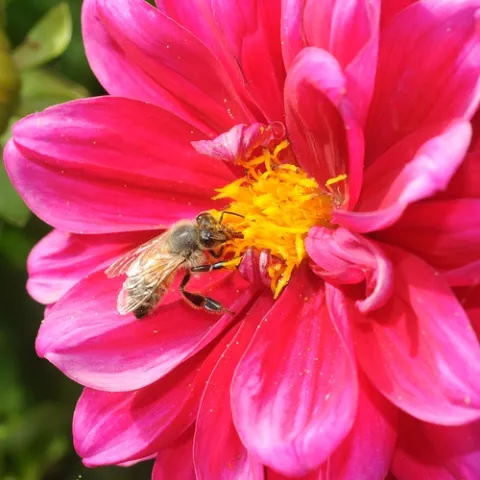
Do bees stop and smell the roses? Maybe. Honey bees gather nectar and pollen from a variety of flowers, including their favorites, the salvias, mints and lavenders. They also forage on wild roses, but usually not on commercially grown roses.