
Vegetable Gardening - Handbook for Beginners
Chapter 3.2.
Beneficial insects are insects that help limit pest damage. They reduce pest populations primarily by parasitizing or eating pests or weeds. Planting a variety of flowers, vegetables, and herbs will provide food and protection for beneficial insects as well as a conducive environment for reproduction. Providing this variety will also confine pests’ searching for their favorite crops.
The two families of flowers that attract the most beneficial insects are:
- Umbelliferae, which have many tiny flowers arranged in tight umbels. These include anise, carrot, caraway, coriander, dill, fennel, and parsley.
- Compositae, which have central disc flowers surrounded by many ray petals like a daisy or sunflower. These include black-eyed Susans, goldenrod, and strawflower.
Try using other biological controls as well:
- Plant mustard flowers to attract lacewings (for aphids) and parasitic wasps (for cabbage caterpillars and coddling moths).
- To control white flies on tomatoes, try interplanting them with french marigolds or nasturtiums.
- Encourage birds into your garden to eat the harmful insects by providing whole sunflower seedheads. Hang these on clothes hangers around your garden.
- Interplant cucumbers and beans to repel cucumber beetles and prevent the wilt diseases they carry. Also, plant Cucurbita lagenaria gourds as trap plants for cucumber beetles.
- Plant potatoes to repel squash bugs.
Here are a few natural enemies to encourage in your garden:
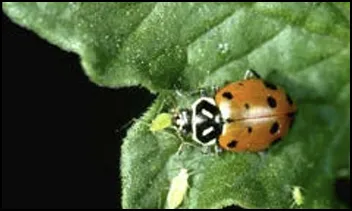
- Convergent lady beetles are used for aphid control.
- Brown Lacewings: often used to control mealybugs, psyllids, thrips, mites, whiteflies, aphids, small caterpillars, leafhoppers, and insect eggs.
For more information on biological controls and natural enemies, please visit https://ipm.ucanr.edu/home-and-landscape/biological-control-and-natural-enemies-of-invertebrates/
Previous ← Chapters → Next or Return to the Table of Contents of this Handbook.