

California native lupines are a wonderful addition to a garden. They have dramatic bloom stalks and support many insects and other critters.
A remarkable diversity
Lupines are in the pea (or legume) family, Fabaceae, which means that they fix nitrogen in the soil. In California, there are 70 lupine species and 43 varieties that are recognized by botanists, resulting in 113 taxonomic groups. Many of these native lupines are difficult to identify and occur only in particular areas in the state.
Lupines are considered moderately poisonous if large amounts are consumed, so keep that in mind when deciding where to plant them. They pose a threat to foraging livestock or farm animals, and caution should be taken when grown in areas where pets and children play, as the seeds and pods should not be eaten.
When using native lupines in gardens, there are a few lupines that work well and are commonly available at local nurseries in our area. There are both annual and perennial native lupines, which makes the choices more interesting depending on the garden characteristics.
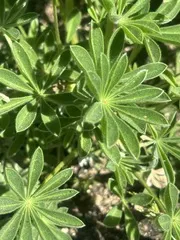
Flower colors in lupines vary from white to various shades of blue and reddish-purple. The leaves are palmately compound, meaning that multiple leaflets radiate from a single common point (resembling the palm of a hand, hence the name). These leaves add another level of interest to the overall plant form.
The plants listed below were chosen because they are generally available at Bay Area nurseries and do well in a garden settings. We are fortunate in the Bay Area to have several nurseries that carry and often specialize in California native plants.
Perennial Lupines
Perennial lupines generally form small bushes and can be reliable spring and early summer bloomers. Here are some perennial California native lupines that do well in our area and are commonly found at local native plant nurseries.
- Silver Bush Lupine / Silver Lupine (Lupinus albifrons)
This evergreen lupine with silver leaves provides year-round interest in the garden. It grows to about 3-5 feet tall and 2-3 feet wide. The large flower spikes range in color from pale blue to deep purple, and the blooms attract pollinators, particularly native bees. It thrives in full sun, in sandy or rocky, well-drained, nutrient-poor soil. It is said to be deer-resistant.

- Cobb Mountain Lupine (Lupinus sericatus)
In the wild, this lupine grows in the forest, woodlands, and chaparral. The flower cluster has several whorls of purple flowers, which bloom in the spring, and can grow up to 2 feet tall. It grows in full sun, has moderate water needs, and requires fast-draining soil. It supports birds, bees, and butterflies. - Meadow Lupine (Lupinus polyphyllus) OT
In the wild, this lupine commonly grows along streams and creeks, preferring moist habitats. So, it will require more water than some other species. It can grow up to 5 feet tall and 3 feet wide. It can be grown in containers and is deer-resistant. - Broadleaf Lupine (Lupinus latifolius)
This lupine can grow up to 7 feet tall and has flowers ranging from blue to purple. It has low water needs but requires well-drained soil. This lupine will grow in full sun, partial shade, or deep shade.
This species tends to have subspecies or varieties.
Annual Lupines
Annual lupines can be a fun addition to a garden and can also create eye-catching displays in containers. Below are some annual California native lupines that do well in our area and are commonly found at local native plant nurseries. As with the perennial lupines, the annual lupines support a variety of wildlife, including birds, bees, caterpillars, and butterflies. Generally, all the annual lupines will reseed as long as there isn’t competition from other plants, particularly non-native grasses.
- Miniature Lupine / Bicolor Lupine (Lupinus bicolor)
This is a petite wildflower, 3–16 inches tall, with clusters of blue and white spring blooms that can vary to magenta or purple. It thrives in full sun with well-drained soil. It can be sown in a mass with California poppies (as well as other annual wildflowers) for a pleasant color combination. It has moderate water needs and tolerates a variety of soils.

- Chick Lupine (Lupinus microcarpus / Lupinus microcarpus var microcarpus ) WS
This lupine grows from 4 to 31 inches tall and about 1 foot wide. It blooms in the spring, generally producing blooms in shades of pink to purple, though white and yellow forms can also occur. Several local nurseries carry one of the three recognized varieties. They want full sun and moderate water, and can tolerate slow, medium, and fast-draining soil.

- Sky Lupine (Lupinus nanus) WS
This lupine grows 4–24 inches tall and about 1 foot wide. The blooms are blue to lavender, and it blooms winter through spring. It needs full sun, moderate water, and tolerates a variety of soils, including both sandy and clay soils. - Pink Sky Lupine (Lupinus nanus ‘Pacific Pink’)
This lupine is a seed strain of the Sky Lupine, with unusual soft pink flowers. It grows 6–20 inches tall and wide. It needs well-draining soil in full sun to light shade. It is attractive to a variety of pollinators and is a larval food source for a number of butterfly and moth species. It is considered deer-resistant. - Arroyo Lupine / Succulent Lupine (Lupinus succulentus) WS
This lupine has dark green leaves with spikes of purple to blue flowers, sometimes shades of light purple, pink and white. It blooms from winter to spring, reaching 2–4 feet tall and 3 feet wide. It needs full sun and is water-tolerant, preferring moist clay or heavy soils

- Rodeo Rose Lupine (Lupinus succulentus ‘Rodeo Rose’)
This variety of Arroyo Lupine has pink flowers with bright green foliage. The flower “banners” turn dark maroon, which contrasts with the pink “wings.” It grows to 2–3 feet tall and wide. It prefers full sun and moist, heavy soils, thriving in irrigated gardens, but also tolerating drier conditions. It is an important butterfly larval host and a food source for native bees. This variety was selected for gardens by Roger Raiche, who led the California Native Plant section of the UC Botanical Garden for 23 years. During his career he discovered several new plant species— four of which were later named in his honor. - Collared Annual Lupine (Lupinus truncatus) – WS
This lupine has magenta or reddish purple flowers with a yellowish or magenta patch on the banner, blooming in winter and spring. It grows 1–2 feet tall and 1 foot wide. It can handle full sun or partial shade, with moderate water. Adaptable to a wide range of soils, it performs well in fast-, medium-, or slow-draining conditions. Its flowers attract bees and butterflies.
Growing Lupines from Seed
Like their relatives, the pea, lupines produce seeds in pods. These seeds can be easily collected and used to propagate more lupine plants, either perennial or annual. The seeds have a hard coat that benefits from treatment to improve germination. One approach is to “scarify” the seeds by lightly rubbing them with sandpaper. Another method is to pour hot water over the seeds in a container and let the seeds soak for up to 8 hours. Non-viable seeds will float to the surface and can be discarded. After soaking, the seed coat will be much softened—an indication that they are ready for planting.
Resources
- Calscape: This is a web-based database of California native plants, developed by the California Native Plant Society, which enables searching by location, as well as specific plant names. It also indicates which nurseries carry the plants. All the plants listed above were available in at least one Bay Area nursery. There is also a Garden Planner, which can help design a native garden
- Lupines of California: This field guide to California lupines in the wild has been recently updated and illustrates how many species and varieties of lupine there are in the wild, and how difficult it can be to identify them.
Return to News to Grow By