
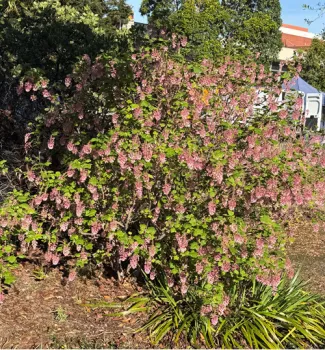
In mid-January, at the Low Water Use Demonstration Garden in Richmond, I started digging up a large area of wild onions, the personal bane of my work there. I hardly noticed the small shrub nearby. It wasn’t until a few weeks later, still digging up the wild onions, when it began to leaf out with sticky, little maple-leaf-shaped leaves that have a slightly resinous, pleasant scent, that I realized it was a wild currant.
By mid-February, it was glorious—in full bloom with pendulous trusses 3 – 4” in length of pale pink flowers, hanging like miniature lanterns on its almost-still bare branches. Little native bees were enamored. In these difficult times, it lifted my heart, and I felt a sense of awe to be a witness to its awakening, the celebration of rebirth that nurtures us every spring, since time immemorial.
Ribes sanguineum glutinosum, or wild currant or pink-flowering currant, is a small to medium-sized, well-formed shrub (4 – 6’) found throughout the North Coast Ranges in California. It is one of M. Nevin Smith’s “native treasures.” When all else in the garden is still dormant and bare, Ribes welcomes the spring. It is one of the first plants to sense the lengthening day and rising temperatures, and to leaf out and bloom.
Its beautiful flowers are popular with bees and hummingbirds. It is easily grown in the home garden, thriving in a variety of soils and climates. In warmer areas, it is advisable to place it as an understory shrub, perhaps under oaks. Its cultivation is undemanding, just a bit of tip pruning on young plants to help them fill out. It requires little summer watering, except in those areas with extreme heat. It is best to water it only occasionally, or not at all.
Ribes is practically pest-free and disease-resistant. After the bloom, Ribes bears bunches of tiny, edible black berries, but birds and other animals may get there first. Volunteers will take root. Ribes can also be easily grown from seed by collecting the ripe berries in the fall, crushing them, and then extracting the seeds by rinsing them with water and discarding the lighter skins and pulp.
In her book, Flowering Shrubs of California, Lester Rowntree (1879-1979) emphatically states that “it is impossible to fail with this shrub.” With that recommendation from the renowned, pioneering plant woman, grow it! It’s sure to become one of the best-loved shrubs in your garden.
This article is dedicated to the gifted Editor of TLD, Simone Adair, who inspired this article.
< Previous Articles Next >
Go to: Current Issue UCANR Home CoCoMGHub