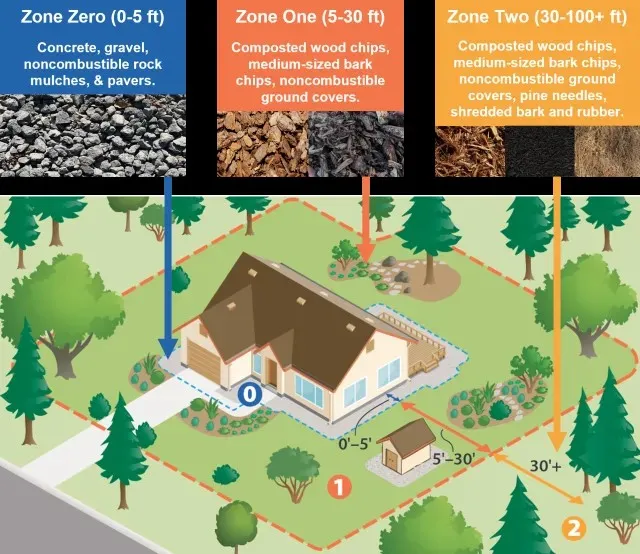
Zone 0 is an excellent location for walkways or hardscaping with pavers, rock mulch, or pea gravel. If you are not ready to remove all vegetation, the safest approach is low-growing succulents either in ceramic or stone pots (not plastic) or widely placed in gravel mulch. Topchoices include Sedum/Stonecrop and Sempervivum/Hens-and-Chicks.
There are no “fire-proof” plants. Fire resistant plants take longer to ignite. Native or drought tolerant plants are not necessarily fire-resistant. Plants are less likely to catch fire if they are properly irrigated, pruned to remove all dead material, and free of fallen leaves, needles and twigs. Particularly fire-prone plants include eucalyptus, acacia, evergreens with fine needles, pampas grass and palms.
A few other ‘quick fixes’
The following are recommended by the University of California:
- Cut tree branches that are close to the roof, or remove entire trees if necessary.
- Remove large bushes that are under trees.
- Minimize the use (depth and area) of landscaping bark and mulch.
- Do not store firewood and other burnable items in this zone.
- Keep roof and gutters clear and remove overhanging branches from nearby trees.
“Home hardening” is a term you may come across when reading about protecting your home from wildfires. Home hardening includes structural changes such as replacing wood shingle roofs with roofing that is less flammable, such as tile.
Siding is one of the items that would come under “home hardening.” If your house has siding, there’s good news and bad news. First, the bad news: Most siding is combustible, other than stucco or cement. Now, the good news: The risk posed by combustible siding may be reduced by having no combustible items at the base (such as plants, decks, etc) and having a noncombustible material separating the siding by 6 to 12 inches from combustibles at the base.
It’s also important to think about access. In order to protect your home, firefighters need to be able to reach your home with their equipment and need adequate space to work in.
That’s a lot to think about. It’s tempting to consider these tasks just another burden that we don’t have time for. But reading about the many people still displaced over a year ago by the L.A. fires makes it clear that this is something we need to do to avoid a similar fate. Each step we take increases a home’s chance of survival. Perhaps, like I have, you’ve heard stories about one house that survived unscathed while all the others around it burned to the ground. Wouldn’t you like that house to be yours?
Susan Pransky has gardened in San Diego for more than 30 years and has been a UC Master Gardener since 2012.
More resources:
- UC ANR Fire Network: https://ucanr.edu/program/uc-anr-fire-network
- County of San Diego: https://www.alertsandiego.org/en-us/preparedness/wildfire.html
- CalFire: https://www.fire.ca.gov/prepare
- Mulch Recommendations: