
What is a Backyard Orchard?
A backyard orchard is a small-scale fruit-growing area near a residence that offers benefits such as fresh produce, economic savings, and environmental improvements. These orchards support food security by reducing dependence on commercial supply chains. They may also lower grocery costs, boost local biodiversity, and enhance both the appearance and the gardener’s well-being. Planning, upkeep, and sustainability are essential for a thriving home orchard.
Planning and Establishment
Site Selection
Selecting the right location is essential for a successful orchard. The site should provide adequate sunlight, suitable soil conditions, protection from wind, and enough space for proper layout and maintenance.
Sunlight. Fruit trees need at least 6–8 hours of direct sunlight daily during the growing season. Consider how sunlight changes between summer and winter. Be aware of both the climate and microclimate of the site. A microclimate is a local climate that differs from its surroundings, often in temperature and humidity. For example, Orange County's inland areas are warmer than the cooler coastal zones, with notable differences in humidity. Even neighboring gardens can have distinct microclimates due to variations in sunlight and heat absorption from structures like walls or fences. In cities, buildings can block the sun, increase wind, and further shape microclimates.
Soil. Fruit trees perform best in deep, fertile, and well-drained soil. In some areas of Orange County, construction often compacts or removes topsoil, making drainage a critical factor. Other areas may have clay soil that is resistant to water penetration. Some areas may have hardpan or claypan layers that prevent root growth and need to be broken up. Identify any soil problems in the area where the fruit trees will be planted. Consider getting a soil test to find out about the soil in your backyard. Visit Healthy Soil to learn more about soil.
Wind Protection. Select a location that offers protection from strong winds and frost. High winds may damage leaves, break branches, and uproot trees, increasing their vulnerability to pests and disease. Wind can also worsen the effects of heat, drought, and freezing temperatures. Coastal regions face additional factors such as fog, salt spray, and persistent winds, which may affect plant health and survival.
Tree Selection
Establishing fruit trees involves prior planning and ongoing effort. Tree varieties should be selected based on local climate, soil type, and available space. Once established, harvesting fresh fruit from the garden increases. Following are several factors to consider when selecting trees.
Climate Zone for Orange County
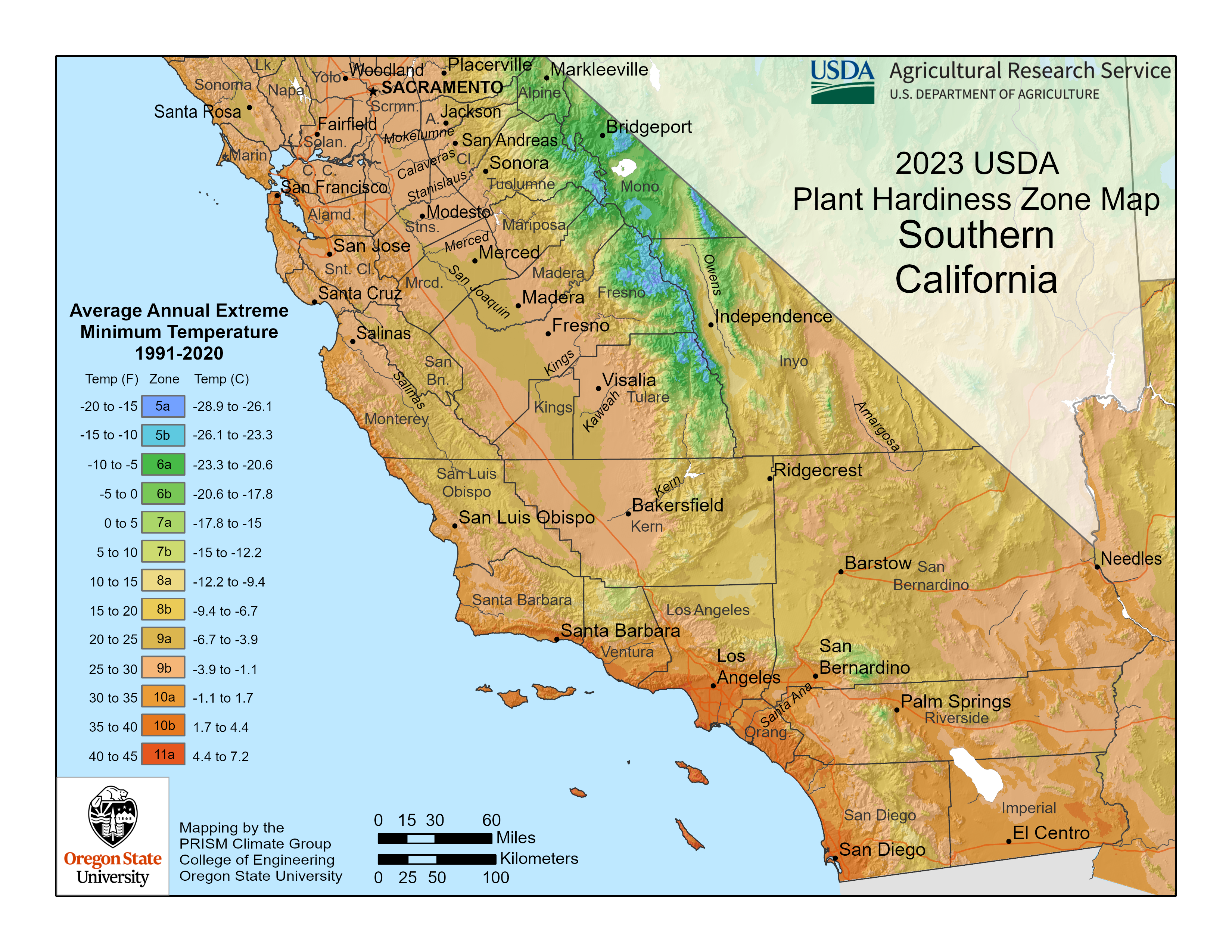
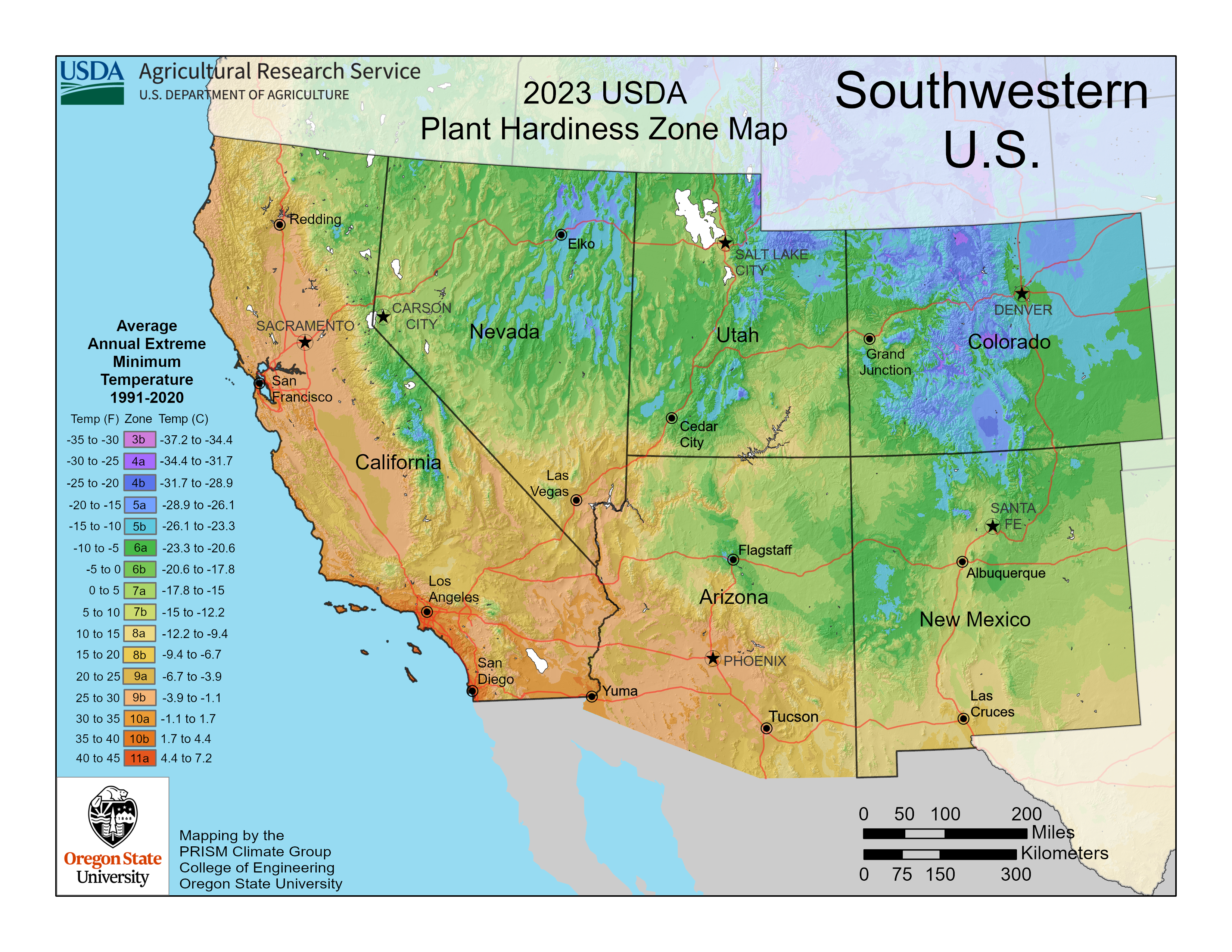
The first step in selecting fruit trees is to determine the climate zone. Fruit trees require climates appropriate to their needs, well-drained soil, correct planting methods, and regular maintenance throughout the growing season. Temperature hardiness climate zones are based on normally expected high and low temperatures and serve as guides to help you know which plants will grow where you live.
The Sunset Zones, created by UC ANR and Sunset Magazine, are considered the standard gardening references in the West. They are more precise than the USDA Zones since they factor in not only winter minimum temperatures, but also summer highs, lengths of growing seasons, humidity, and rainfall patterns. For Orange County, the Sunset Zones are 21-23, and the USDA Zones are 10a-11.
Chill Hours
Chill hours are the number of hours below 45°F required for certain trees to end dormancy. Fruit trees such as apples and cherries need a certain number of chill hours for fruit production. Orange County typically receives approximately 300-1,000 chill hours each winter. Chill-hour accumulation varies across the county; coastal regions typically record fewer chill hours than inland areas. Tracking local weather conditions can assist in estimating chill hour totals. For information on chill hours in your area, visit UC Davis Cumulative Chilling Hours, which monitors chill hours from November 1 through the end of February annually. Visit Proven Selections for the Southwestern Fruit Gardener for recommendations of low-chill fruits to plant in Orange County.
Pollination
Pollination is essential for fruit production, relying on pollinators like bees and insects to transfer pollen and enable fertilization. Fruit trees may be self-fruitful, capable of pollinating themselves, or self-unfruitful, requiring pollen from different varieties planted nearby with overlapping bloom periods. Some species need separate male and female trees for fruit development. Successful pollination depends on factors such as weather, pollinator activity, and synchronized blooming, with careful tree selection and placement maximizing fruit yield. Visit Pollination Requirements for Various Fruits and Nuts for more information.
Read the label. Check if the fruit tree is self-pollinating or needs cross-pollination, and research compatible varieties. If space is limited, self-pollinating trees are practical. Crop varieties differ in fruit color, size, shape, and flavor.
When reading the label:
- The Variety: Shows the specific type, highlighting traits like flavor, ripening time, and chill hour needs. In coastal areas, select types with low chill requirements.
- The Rootstock: Indicates where the tree grows best. Grafted rootstocks can control tree height, boost drought or cold tolerance, and allow growth in more regions. Local nurseries usually choose combinations suited to their area.
Space Availability and Layout
Adequate space and thoughtful layout are essential for safety, efficiency, and long-term success. The following outlines a recommended process:
- Evaluate both the available space and the potential layout to support tasks such as weeding, pruning, harvesting, and general maintenance.
- Consider each tree’s size at maturity, bloom time, and cultivation requirements. Allow enough space for trees to grow, or plan to remove some as space becomes limited. Many fruit trees can reach large sizes without regular pruning.
- Be aware of powerlines: planting too close may result in necessary extensive pruning by utility companies. Powerlines also pose potential hazards, so it is advisable to avoid planting near them.
- Consider neighboring properties and avoid planting close enough to the fence line that tree growth could extend into adjacent yards.
- Ensure proper spacing that allows each tree to receive sufficient sunlight and airflow, reducing disease risk.
- Maximize productivity in limited spaces by selecting dwarf or semi-dwarf rootstocks.
- Be mindful of the climate and microclimate—these will influence the final layout and management practices.
Preparing the Planting Site
Before planting fruit trees, carefully evaluate the soil—particularly its drainage. Most fruit trees struggle in consistently waterlogged conditions, as prolonged moisture after rainfall can damage roots and stunt growth. Follow these steps to assess and prepare your site:
- Test drainage: Dig a hole two to three times wider than the root system and as deep as the longest root (no deeper). A shallower hole helps prevent the tree from settling below ground level. Fill the hole with water and allow it to drain completely. Refill it a second time; if the water takes more than three to four hours to drain, consider relocating the planting site or creating a raised mound to improve drainage.
- Handle compacted soils: In dense or compacted soils, cultivate a wide area deeply before planting, as tight soil limits root expansion. Work decomposed compost into the surrounding soil before digging. In heavy soils, fresh organic matter may break down too slowly or harm new roots.
Planting
Fruit trees are commonly planted during their dormant period, which occurs from late winter to early spring. They may be planted at various times throughout the year, but are often bought in winter as dormant bare-root stock. Planting during this time is economical and helps root establishment in garden soil.
When selecting bare-root trees, choose specimens with healthy, fibrous roots and an undamaged taproot. Keep roots moist during transport using damp compost, shavings, or wet newspaper. Trees with trunks measuring between ½ and ⅝ inch in thickness tend to reestablish more efficiently and experience less damage. Store in a cool, shaded location with the roots covered. If planting is postponed for longer than two days, bare-root trees should be kept moist by "heeling in" with moist compost, sand, or soil to prevent drying out.
Planting Bare Root Fruit Trees
- Remove all packaging and twine from roots. Soak roots in water for 1–24 hours before planting.
- Dig a hole 2–3 times wider than the root spread, but no deeper than the longest root. A shallower hole prevents the tree from sinking after planting.
- In the center of the hole, create a cone-shaped mound from the excavated soil high enough to allow roots to drape over the mound. The cone should rise 2–3 inches above the surrounding ground to allow for settling.
- Leave space around the cone for roots to spread naturally.
- Trim away any broken, diseased, or kinked roots with a clean, sharp tool. Avoid shortening roots – instead, make the hole bigger to accommodate them.
- Set the trunk on top of the soil cone. The graft union should be 2–4 inches above the soil surface and facing north to prevent sunscald. The graft is a small bulge or jog near the base of the trunk.
- Fan the roots evenly over the soil cone. Cover halfway with soil and water gently to settle the soil around the roots.
- Add soil until all roots are covered—but do not bury the stem.
- Lightly tamp the soil and water again to remove air pockets. If the tree settles below grade, gently lift it and add soil underneath.
- Form a shallow ring of soil 8–12 inches from the trunk, or as wide as the root spread. Fill this moat when watering to direct moisture to new fibrous roots.
- Spread 3–4 inches of compost or mulch over the root area. Keep mulch 4–6 inches away from the trunk to prevent crown rot.
- Use a heading cut to shorten the trunk to no more than 24–30 inches from the ground level. Cut at a 45-degree angle about one-quarter of an inch above the bud chosen to be the top bud. Several buds should remain below the cut.
- Shorten the remaining branches to three to four buds.
- Make sure that the bud closest to the cut faces upward (if the branch has a broad angle) or outward (if the branch has a shallow angle).
- Protect the bark from sunburn and infestation by borer insects by painting it. Use white interior latex paint diluted to half strength. Apply paint from 2 inches below the soil surface up the entire trunk.
- Staking is not necessary for bare-root trees.
- Maintain consistent soil moisture—do not let roots dry out.
Planting Container-Grown Trees
- Dig a hole at least 2 –3 times the width of the root ball. The hole should be no deeper than the root ball. If the soil is compacted, break it up. Score the sides of the hole so that roots can penetrate.
- Gently ease the tree from its container. Check for girdling or circling roots and gently pull away from the root ball before planting.
- Place the tree in the hole with the graft union at least 2–4 inches above the soil surface. The graft is usually a small bend or bulge near the base of the trunk, sometimes several inches above where the roots begin. The protruding notch should face north/northeast to reduce the likelihood of sunburn.
- Partially fill the hole with the same soil and tamp gently. Avoid placing fertilizer or organic amendments directly into the planting hole.
- Place a shovel across the hole while planting to ensure the tree is level, then fill the hole with the rest of the excavated soil. Tamp down the soil to remove air pockets.
- Construct a doughnut-shaped basin for watering, as wide as the root spread. Thoroughly water to settle the soil around the root ball.
- Add a 3–6-inch layer of mulch to the basin to control weeds and conserve moisture. Keep mulch several inches away from the trunk of the tree to minimize crown rot and hiding places for pests.
- Protect the bark from sunburn and infestation by borer insects by painting it. Use white interior latex paint diluted to half strength. Apply paint from 2 inches below the soil surface up the entire trunk.
- Staking is not necessary for small container trees, and required for large container-grown trees.
- Keep soil evenly moist; do not allow roots to dry.
Options to in-Ground Planting
- Raised Bed. Bare-root trees will be best for this type of planting. Use a combination of native soil and good-quality topsoil. Visit Raised Beds for more information.
- Container. Planting in a container involves using dwarf rootstock, annual repotting and root pruning, and a specific soil blend. Replanting in the ground may be required after several years. Visit Container Gardening for more information.
Maintenance
Irrigation
Begin irrigation in the spring once temperatures are warmer. Maintaining consistent soil moisture is essential during the establishment period, ensuring that the root zone remains adequately hydrated at all times. Regularly monitor irrigation to avoid overwatering and the risk of waterlogged roots. Visit Irrigating Fruit and Shade Trees and Shrubs and Watering fruit and nut trees for more information.
Training and pruning
In the first summer, prune to develop the desired structure. Regular pruning improves structure, airflow, and fruit production. Visit Training and pruning your home orchard and Pruning Fruit Trees for more information.
Fertilization
Do not apply fertilizer before there is 6–8 inches of new growth. Use compost or organic fertilizers to enrich the soil. Apply a balanced fertilizer in early spring and/or fall, with rates depending on the tree's age. Visit Fruit Tree and Vine Care Calendar for more information.
Pest Management
Integrated Pest Management (IPM) provides techniques to help maintain ecological balance without excessive chemical use. Decide what you can live with, and use accepted control methods. Visit Pest Notes Library and Home, garden, turf, and landscape pests for more information about pests.
Harvesting, Storage, Preserving
Harvest, storage, and preservation are specific to the chosen fruit or nut. Following are a few resources that will provide information in each category.
Harvesting. For information about the maturity, quality, and postharvest handling and storage of vegetables, visit the UC Davis Postharvest Research and Extension Center webpage, Produce Fact Sheets. In addition, the University of Wisconsin Extension has a helpful publication, Storing Fruits and Vegetables from the Home Garden
Storage. To learn about storage – in the refrigerator, ripening on the counter and then storing in the refrigerator, or storing only at room temperature, visit the UC Davis Postharvest Research and Extension Center website at Store Fruits and Vegetables for Better Taste.
Preserving. UC Food Safety has lots of information, including "Safe Handling of Fruits and Vegetables", "Safe Methods of Canning Vegetables", "Chart on Storing Fresh Fruits and Vegetables", and more. Visit their web page UC Home Preservation and Storage Publications for more details.
The best Orange County resource for food storage is the Master Food Preservers of Orange County. They have a Helpline, classes, and information that can help you decide how to preserve your vegetables. For complete information on preserving the harvest, refer to Storing Fresh Fruits & Vegetables for Better Taste or National Center for Home Food Preservation (NCHFP).
A home orchard is not just fruit trees, but a productive ecosystem that supports sustainability. With good planning and care, even small yards can yield abundant fruit. As sustainability and food security become more important, backyard orchards offer a practical model for greener living.
For an overview of all aspects of fruit tree care, visit Fruit trees, nuts, berries, & grapevines