
By Kevin Marini, UC Community Education Specialist: Natural Resources
From The Curious Gardener, Spring 2023
In this day and age, it can be challenging to find common ground on a myriad of social and environmental issues that confront us in our modern societies. It has become a societal norm to hold a position on an issue and stick to it fiercely even when simultaneously recognizing that there is nuance involved with it. If there is one issue that we may all agree on, it is the need for “defensible space” and “home hardening” in and around our homes in California due to the threat of wildfire (and even if you don’t agree, there are laws to follow).
Nevertheless, even within the defensible space concept, nuance exists and, especially when it comes to horticultural and ecological goals, homeowners can get confused with the mixed messages and conflicting actions recommended from different entities. Let me try and “daylight” a few of these nuances so we can get a better idea of the considerations when creating defensible space in and around our homes.
The overall concept of defensible space is creating a landscape that is resilient when fire approaches; that is, giving the yard a chance of passively slowing the fire down and withstanding the onslaught of flames rather than escalating them. The goal is to slow the spread of fire in your landscape and around your house so that firefighters can safely enter the area and defend your home/ property. Without defensible space in place, there is a greater chance of fire running quickly through your yard and into your home with the potential for structure damage or loss, especially if firefighters cannot get in there to do their job.
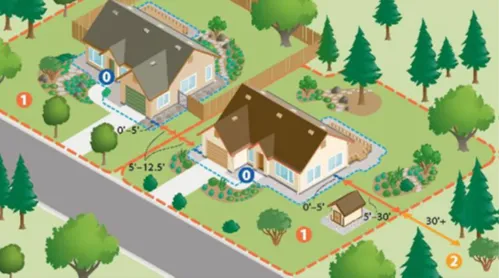
Creating defensible space appears to be a very simple concept with well-researched steps to give homeowners a straightforward “prescription” for implementation (see Resource links below). There are defensible space “zones” that guide homeowner actions regarding the design, organization and maintenance of one’s landscape. I will now explain the zones briefly and offer some nuance in each to illustrate the competing goals that can challenge homeowners.
Ember-resistant zone (Zone 0)
This zone refers to the area from your home to 5' (0-5 ft.) and is the most important area when it comes to fire safety since we know that the majority of fires that burn down homes start from ember cast landing near or on your home. Take a tape measure, lock it at 5 feet, and walk around your home taking note of ANY flammable material in the 0-5 ft. zone and remove. This area needs all your attention NOW. But, let’s say you purchased an older home with fabulous “foundation plantings” of gorgeous shrubs that offer aesthetic appeal and privacy. Or maybe you have some amazing
large oak trees right around your home offering you shade in the hot summer. Or maybe all of the mulch you’re using around your home is keeping the water bill down. One can quickly see that there are competing goals even in this relatively small area of Zone 0. What you choose to prioritize here is CRUCIAL.
Lean, Clean and Green zone (Zone 1)
This zone refers to the area from 5' to 30' out on your property and usually includes landscaped areas. In this area, the most important considerations are plant maintenance and plant spacing. ALL dead vegetation should be removed completely and existing vegetation maintained in a way that eliminates vertical and horizontal “fire ladders”. What is a “fire ladder”? It is a continuous flow of vegetation; that is, a vertical fire ladder would be a small plant under a medium shrub under a medium sized tree. Fire can quickly climb into the canopies of trees through vertical fire ladders. A horizontal continuous flow of plants again allows fire to move quickly and uninterrupted. It is crucial to space plants apart individually or place in clusters that, in turn, have spacing between other islands of plants. Hardscape, like rock retaining walls, flagstone patios, and gravel pathways in this area can help break up the landscape so as to slow the spread of fire. But, what about that wooden play structure right outside the house? You would like to be able to watch the kids when they are out there playing, right? You may have a nice green lawn that you’ve been thinking about tearing out due to the drought but it sure would be nice to keep as a buffer for fire. How about that propane tank – do you really have to relocate it or can you clear around it? Maybe going solar can eliminate the need for it? Again, we see the nuance in Zone 1 and know that choices will have to be made based on where you live, the current state of your landscape and the resources you have.
Reduced Fuel zone (Zone 2)
The final zone reaches from 30' to 100' or to your property line if closer than that. In this area, the focus is still on plant maintenance and spacing but in many “WUI” (Wildland Urban Interface) areas in Placer and Nevada Counties, this is where there is native vegetation to consider. One of the challenges facing rural properties is that fuel reduction is costly and is rarely accomplished by the homeowner alone. In many areas, companies clear entire properties of low growing plants, native shrubs and young trees leaving only mature trees spaced apart. This is marketed as creating a park-like atmosphere but in reality it is a tragedy for our native habitats. It is impossible to remove so much vegetation and not invite invasive plants to colonize the newly opened up spaces. This usually happens quickly without intervention and leads to a worse fire situation in the long run. Therefore, selective fuel reduction is a much better option, especially when coupled with bringing back “good fire” in the form of prescribed burns to help re-balance the ecosystem.
Final Thoughts
This article is meant to bring attention to the nuances of creating defensible space and how some decisions you make in your landscape may not be the ones your neighbor makes. Of course, following the law is essential and sometimes decisions are made for you that you have very little control over. The main thing is to keep thinking about defensible space, talking with others in the community about its importance and taking the appropriate action while considering the nuance involved in the process.
Resources
- Prepare for Wildfire. Cal Fire: Wildfire Is Coming…Are you Ready? 2019 Defensible Space - Ready for Wildfire
- Fire Resources and Information. UCCE: Fire in California 2023. Fire in California (ucanr.edu)