
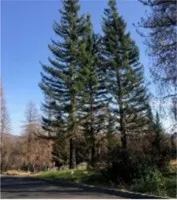
The first and foremost trait required of a tree for resilience is bark. Thick bark results in more resistance to fire. Thicker bark protects the cambium layer of tissues underneath. Did the fire completely surround the tree or did it move from one side to the other preventing an intense burn on the leeward side? Were there grasses, shrubs or a flammable pile of demolished pinecones (squirrels), at the trunk of the tree. How much fuel kept the fire burning at the base of the tree?
Secondly, soil moisture content is a factor. Trees surrounded by lawn and in well irrigated areas generally have foliage with a higher moisture content. This higher moisture content will increase the temperature required to cause the foliage to ignite and protect the buds underneath. Was the tree exposed to high temperature in the canopy and is the canopy still green or resprouting?
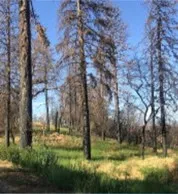
Measuring the live remaining crown can be helpful in determining survival. Many times, the foliage may have been singed and dead, but if the underlying buds are still alive and viable, the tree will likely survive. The twigs can be examined through binoculars to see how much of the tree is still alive.
Cavities in trees from old wounds make a place for fire to get inside the tree. In October, while working in the Caldor fire, I noticed smoke seeping from a cavity in a large ponderosa pine. It was a small opening, such as an old branch failure or woodpecker cavity. The fire passed through the area about August 30th. The tree had been smoldering for more than 2 months slowly burning the structural cells inside the tree. This can happen on the main trunk of the tree or in large branches.
Prepare your landscape and trees before fire season. In natural areas, remove grasses, leaf litter, and debris from the base of trees to keep potential fuels away from the trunk. The thinner the bark of the tree, the further away you should move the fuel. In the landscape, irrigate heavily during fire season. After a fire, you can evaluate which trees are likely to survive based on how the fire acted on the site and the species. Once you have decided which trees are likely to survive, evaluate risk of failure and what the tree might strike if it did fail. When in doubt, call a qualified consulting arborist.
References
Mullen, Luba. How Trees Survive and Thrive After A Fire. National Forest Foundation: Your National Forests Magazine. Summer/Fall 2017. https://www.nationalforests.org/our-forests/your-national-forests-magazine/how-trees-survive-and-thrive-after-a-fire
Lawson, P. and C. Lawson. USDA Plant Guide: Ponderosa Pine. USDA/ Natural Resources Conservation Service. July 29, 2004. https://plants.usda.gov/DocumentLibrary/plantguide/pdf/pg_pipo.pdf
Hood, Sharon and Iral Ragenovich, Bill Schaupp. Post-fire Assessment of Tree Status and Marking Guidelines for Conifers in Oregon and Washington. USDA. n.d. https://digital.osl.state.or.us/islandora/object/osl:957682
Fire Effects Information System (FEIS). USDA. February 3, 2021. https://www.feis-crs.org/feis/