
Author: Chuck Ingels, Farms Advisor, Sacramento County.
Edited by Judy McClure, Master Gardener Program Coordinator.
Illustrated bY Walter Dong.
Publication Number 31-S84 (Published April 2000)
Most trees produce more fruit than they can support or develop adequately. If weather conditions are right, the far majority of flowers on a tree will set fruit, especially if the tree was not adequately pruned. The excessive fruit compete with each other for carbohydrates and so remain small. This carbohydrate drain, or “sink,” can also weaken the tree and make it more susceptible to pests and sunburn damage. Excessive fruit can also lead to alternate bearing, a cycle in which the tree bears excessively in one year and little the next year.
Benefits
Fruit thinning has several benefits. The main benefit is to increase fruit size and quality. Thinning allows each fruit to develop to its maximum size and little reduction of tree vigor. Thinning also allows each fruit to receive more light, so fruit color and flavor may be improved. Fruit thinning also reduces alternate bearing.
Reducing the fruit load through proper pruning and fruit thinning, especially near the ends of branches, reduces the chances of limb breakage. Keeping trees small, as discussed in Training and Pruning Fruit Trees (EH Notes #82), makes thinning much more feasible for most people. Fruit thinning is also required on fruit bushes.
Another benefit of fruit thinning is that spread of some diseases can be reduced. For example, brown rot can quickly move from fruit to fruit just before harvest when the fruit are touching. Air movement around tightly clustered fruit is minimal, so unthinned fruit that is rained on just before harvest cannot adequately dry, allowing disease organisms to multiply rapidly.
Natural Fruit Drop
Flowers and fruit naturally thin themselves, often at distinct time periods. Flowers not pollinated turn yellow and drop off just after flowering. If there were many flowers but little set, the flowers were probably not pollinated because cold or wet weather prevented bees or other insects from visiting flowers. Also, it may be necessary to plant a pollinizer variety nearby or graft one onto the tree. Another period of natural drop is known as “June drop,” which usually occurs in May in California. Fruit that is diseased or infested with insects also often drop prematurely. For example, codling moth-infested apples or pears will usually drop early, but often not before the larvae have already emerged and pupated in bark crevices.
Species That Require Thinning
Not all species require fruit thinning. Cherry fruit are small enough that they are usually not a significant carbohydrate sink. All other stone fruits do require thinning. All apples and Asian pears require thinning, as do most European pears. ‘Bartlett’ pears will often naturally thin themselves, and harvesting larger fruit early (early to mid July) will allow the smaller fruit to increase in size for a second pick one to two weeks later. Figs, persimmons, pomegranate, and nut trees do not require thinning, although branches of persimmon trees may break with the weight of excessive fruit and may benefit from some fruit thinning or propping. Grapes that have more fruit than the vine can support, especially young vines, also benefit from thinning. Citrus do not require thinning.
Timing of Thinning
Fruit should be thinned when they are fairly small — typically from early April (for early ripening fruit) to mid-May (for late ripening fruit). Thinning too late reduces the chances that fruit size will increase, and thinning too early can result in split pits in stone fruits, especially peaches. Stone fruits are thinned when they are about ¾ to 1 inch in diameter and pome fruits are thinned at ½ to 1 inch, or within about 30 to 45 days after full bloom.
Amount of Fruit to Thin
The amount of fruit to thin depends on the species and the overall fruit load on the tree. For example, apricots and plums are fairly small, so they should be thinned to 2 to 4 inches, whereas peaches and nectarines should be thinned to about 3 to 5 inches. If spring conditions for pollination were ideal, excessive fruit may have set, requiring more thinning. If fruit load is light, but one or two branches have a large amount of fruit, less thinning is required because the total carbohydrate sink is light. However, consider factors such as disease spread and limb breakage if excessive fruit is allowed to remain on a branch.
Methods of Thinning Stone Fruits
There are two main ways to thin fruit: by hand or by a pole. Thinning by hand is more thorough and accurate than the pole method but is much slower.
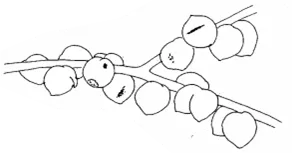
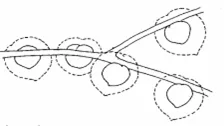
Hand thinning mainly involves removing enough fruit to allow the remaining fruit to have sufficient space so they do not touch at maturity (Fig. 1). On short spurs, this may mean leaving only two or three fruit. If a long fruiting branch produces fruit on the entire length of the branch (which should have been headed at pruning), thin more heavily, especially near the terminal end. Remove small, disfigured, or damaged fruit when you have the option (Fig. 1). Remove “doubles” (two fruits fused together) unless they are well spaced. Many times, it is possible to leave somewhat more fruit by selecting those on alternating sides of the branch.
Pole thinning is used mainly on large trees where hand thinning would be cumbersome. Pole thinning is much faster, and although it is less accurate, the results are often adequate. With this method, a short rubber hose, cloth, or thick tape is fastened on the end of the pole to reduce scarring or bruising. Strike individual fruit or clusters to remove a portion of the fruit. With experience, you will be able to strike a cluster once or twice with just enough force to adequately break up the cluster.
Apples and Pears
Unlike stone fruits, which produce one fruit per bud, pome fruits produce a cluster of flowers and fruit from each bud. Thin to no more than one to two fruit per cluster, depending on the total fruit set and growing conditions. Ideally, fruit on a heavily cropped tree should be spaced no less than 6 to 8 inches apart. Thinning in this manner can reduce codling moth damage because larvae often move between fruits that are touching. Remove small fruit where possible, because fruit that is smaller when young will be smaller at harvest.
Reference
Adapted from Environmental Horticulture Notes #84, University of California Cooperative Extension, Sacramento County