


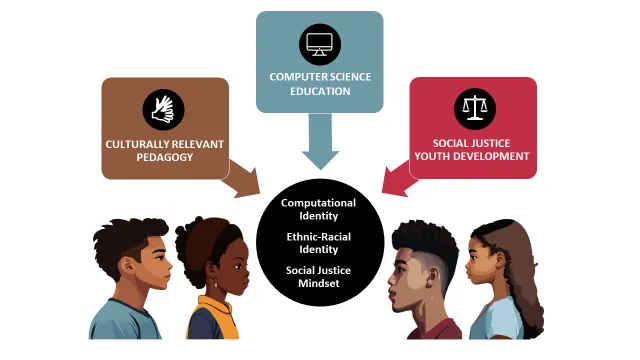
iCode develops computational thinking, computer science skills, and career motivations by focusing on identity and cultural heritage. The activities encourage exploration, discourse, and reflection to foster positive ethnic-racial identity. The curriculum integrates culturally relevant and experiential learning experiences in ways that improve motivation and aspirations for ongoing computer science education for all youth. iCode uses unplugged activities, block-based coding (Scratch), and BBC micro:bit microcontroller design to develop computer science and computational thinking skills.
Educator Checklist -- What is needed to facilitate iCode?
- Create identity-affirming “brave spaces”
- Co-build and revisit group agreements; model empathy, paraphrasing, and cultural humility; prompt validating responses; actively listen.
- Anticipate emotions in discussions of bias and identity; plan prompts and strategies that keep the space kind and inclusive.
- Use youth development practices that grow belonging and mindset
- Apply the 4-H Thriving Model: belonging, developmental relationships, and a growth mindset through safe, engaging, reflective activities.
- Partner with families and communities
- Invite and inform families, address language access, host orientation and celebration events; bring in relatable CS role models.
- Use family knowledge in activities like “What’s in a Name?” and culminate with public showcasing.
- Teach core CS and computational thinking clearly
- Explain and coach the CT pillars: decomposition, abstraction, algorithms, and pattern recognition, connecting them to youth projects.
- Normalize iteration and debugging; help youth manage frustration during design and coding.
- Run Scratch and micro:bit smoothly (technical facilitation)
- Set up CS First classes and student logins; know offline options for limited internet.
- Prepare micro:bit gear, shields, and sensors; be comfortable in MakeCode and basic hardware connections.
- Before build sessions, review tutorials and example projects so you can coach efficiently.
- Facilitate critical conversations about equity and technology
- Guide inquiry on stereotypes, bias, AI fairness, algorithms, and social justice links to computing.
- Support projects that connect historical and contemporary marginalization to youth’s cultural stories.
Background Reading Materials
- Preparing educators to integrate computer science education and ethnic-racial identity exploration using social justice youth development
- To strengthen 4-H professionals’ leadership to coordinate a sustained learning and support group of educators to teach the iCode curriculum.
Image by Janet Kratfel
Video Learning Modules
#1 Addressing inequity in Computer Science
Explore how social justice youth development can be an effective approach to engage young people in learning and doing computer science.
Learn how starting by building relationships and a sense of belonging helps young people develop their computational thinking and computer science skills.
Learn how to use block-based coding to help young people develop their computational thinking and computer science skills.
Explore how the iCode helps integrate learning about computer science with developing ethnic-racial identity. See how this empowers young people.
Learning with micro:bit helps youth understand the power of technology.
Explore how educators and youth can create Brave Spaces where they feel safe, respected and empowered to talk about challenging topics.