Agriculture

Primary Image
The queen bee (the largest bee, center) is surrounded by her court, the worker bees, who take care of her every need. They feed her, groom her and protect her "and then they have the additional tasks of rearing and feeding her young," said bee breeder-geneticist Susan Cobey of the UC Davis Department of Entomology. (Photo courtesy of Susan Cobey, UC Davis Department of Entomology)

The Queen Bee

September 11, 2008
By Kathy Keatley Garvey
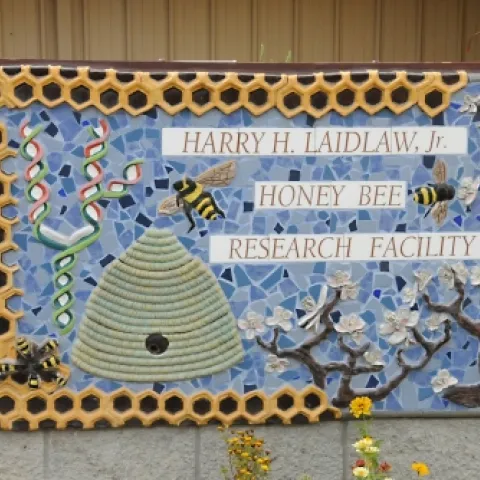
If you were a queen bee, you'd be laying about 1500 to 2000 eggs today. It's your busy season. "She's an egg-laying machine," said bee breeder-geneticist Susan Cobey of the Harry H. Laidlaw Jr. Honey Bee Research Facility at UC Davis. "And she's the mother of all the bees in the hive.
View Article
Primary Image
This is a bee nesting block built to attract native pollinators. (Photo by Kathy Keatley Garvey)

Build It And They Will Come

September 9, 2008
By Kathy Keatley Garvey
Build it and they will come. Baseball's Field of Dreams? No, a bee nesting block. Think "bee condo." It's an artificial nesting site made of wood and drilled with different-sized holes and depths to accommodate the diversity of native pollinators. Often the bee block is nailed to a fence post.
View Article
Primary Image
A female carpenter bee (Xylocopa tabaniformis orpifex) pierces the corolla of salvia to rob the nectar. (Identified by Robbin Thorp, UC Davis emeritus professor of entomology.) (Photo by Kathy Keatley Garvey)

I've Been Robbed!

September 5, 2008
By Kathy Keatley Garvey
Robber at work. No, this isn't a bank heist or a gas station hold-up or a home invasion. A carpenter bee is slitting the sides of salvia (sage) to steal the nectar. Floral larceny! Book 'em, Danno! Carpenter bees are nectar robbers.
View Article
Primary Image
A female varroa mite on a drone (male bee). The mite is the reddish-brown parasite on the bee's thorax. (Photo by Kathy Keatley Garvey)

Mighty Mite

September 4, 2008
By Kathy Keatley Garvey
It's a mighty mite and it's causing beekeepers fits. The varroa mite (see photo below) is an external parasite that attacks honey bees. It sucks blood from the adults (apparently preferring drones, the male bees) and from the brood (immature bees).
View Article
Primary Image
Light brown apple moth, female. (Photo courtesy of David Williams, principal scientist, Perennial Horticulture, Department of Primary Industries, Victoria, Australia.)

Ain't No Moths on Me

September 1, 2008
By Kathy Keatley Garvey
Bam! LBAM is back in the news. The California Department of Food and Agriculture announced Aug. 29 that it has established a 19-square-mile quarantine straddling portions of two counties after the light brown apple moth (LBAM) was found July 23 in Napa County and Aug. 10 in Sonoma County.
View Article
Primary Image
Karen Flores and Dennis Price: The bees have their attention and their respect. (Photo by Kathy Keatley Garvey)

Honey, Meet Me at the Fair

August 25, 2008
By Kathy Keatley Garvey
As a child, Dennis Price loved to watch the honey bees. I could sit and watch them all day, he said. He still does. Love the honey bees, that is. And he never tires of watching them. If you attended the California State Fair on Sunday, Aug. 17 or Saturday, Aug.
View Article
Primary Image
Hillary Thomas is studying the saltcedar beetle (Diorhabda elongata): a good bug on a bad weed. (Photo by Kathy Keatley Garvey)

Good Bug, Bad Weed

August 20, 2008
By Kathy Keatley Garvey
Hillary Thomas' biological control research on a leaf-eating beetle that targets saltcedar has scored a bullseye. Thomas, a doctoral candidate in entomology at UC Davis, has received a $15,000 Robert and Peggy van den Bosch Memorial Scholarship to support her research.
View Article
Primary Image
Svastra obliqua expurgata (Cockerell) leaves the flower. (Photo by Kathy Keatley Garvey)

Carrying a Lot of 'Baggage'

August 19, 2008
By Kathy Keatley Garvey
If she were boarding an airline, she'd be charged double for baggage. But she didn't and she wasn't. She's a pollen-packed sunflower bee enjoying our sunflower. Not a honey bee but a sunflower bee. A native bee.
View Article
Primary Image
Mediterranean fruit fly (Photo by Jack Kelly Clark)

Medfly Wars

August 15, 2008
By Kathy Keatley Garvey
The war is overagain, wrote reporter Pat Brennan of the Orange County Register in a news article published Aug. 14. Brennan was referring to the war against the Mediterranean fruit fly, a tiny pest that targets some 260 crops.
View Article
Primary Image
This male carpenter bee (Xylocopa tabaniformis orpifex Smith NB) visits salvia (sage). (Photo by Kathy Keatley Garvey)

If I Were a Carpenter...Bee

August 14, 2008
By Kathy Keatley Garvey
I've got black bumblebees buzzing around our backyard like crazy, the caller said. They're loud. Very loud. They're dive-bombing and scaring the cat and dog. I've never seen anything like this before. The unwelcome visitors were not bumblebees. They were carpenter bees.
View Article